

Key Takeaways
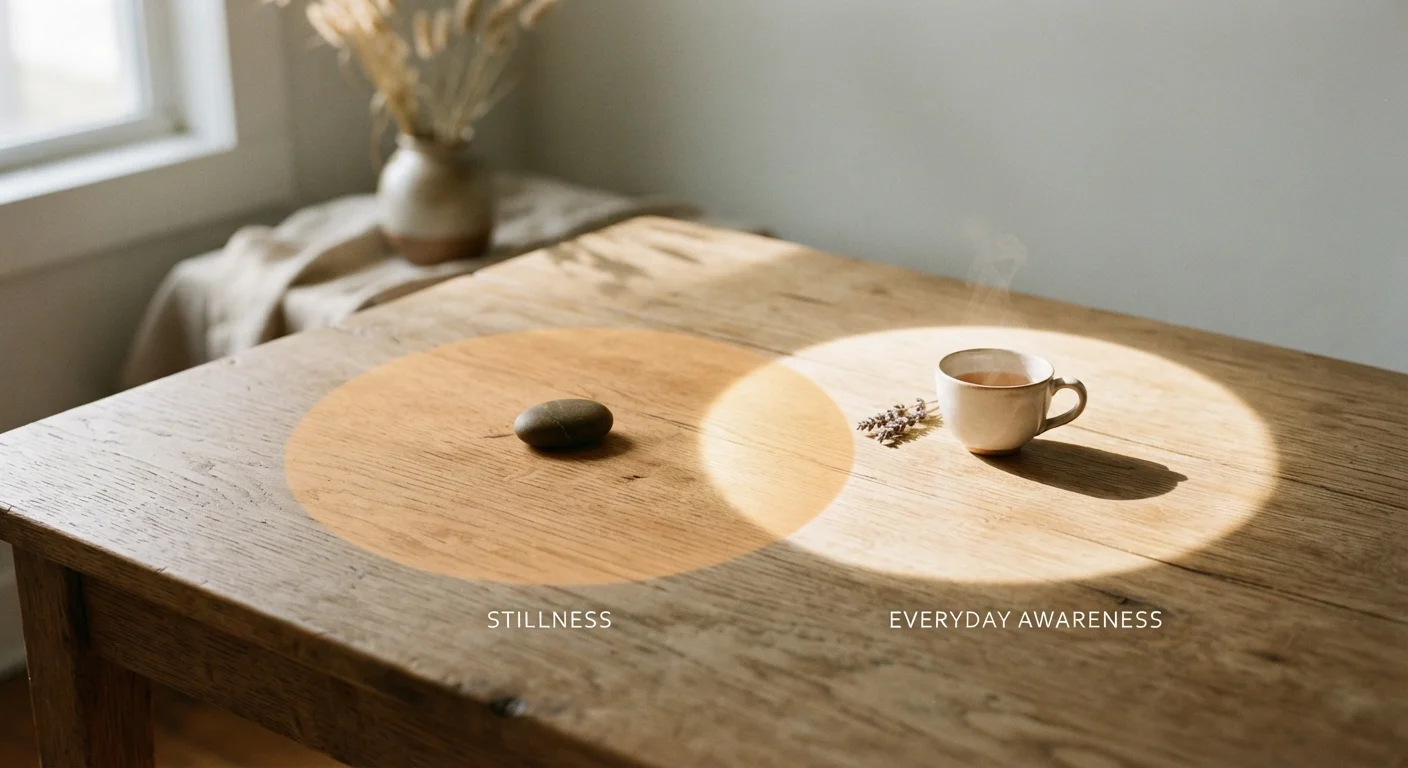
- Meditation is a formal practice; mindfulness is a quality of awareness that can be applied anytime.
- All meditation can cultivate mindfulness, but mindfulness doesn't require sitting down to meditate.
- Both practices are supported by research showing benefits for stress, focus, and emotional regulation.
- Neither requires special equipment, training, or large time commitments to start.
- For many people, combining both approaches produces the most durable results.
Option A
Meditation
The dedicated, structured practice.
Best for: People who benefit from setting aside intentional, scheduled time to train their attention and build mental stillness.
Option B
Mindfulness
The continuous, woven-in awareness.
Best for: People who want to bring present-moment attention into everyday activities without requiring a separate practice session.
If you want a structured, time-set routine to build mental focus
Meditation
Meditation's defined session format helps you train attention deliberately, making it easier to track consistency and build a habit.
If your schedule rarely allows for dedicated quiet time
Mindfulness
Mindfulness can be practiced during commutes, meals, or conversations - no extra time block required.
If you're managing ongoing stress or anxiety and want deeper relief
Meditation
Longer, consistent meditation sessions are among the most studied approaches for stress reduction; consult a healthcare professional about what fits your situation.
If you want to feel more present and engaged throughout the day
Mindfulness
Mindfulness applied to ordinary moments - eating, walking, listening - gradually shifts how you experience daily life without requiring extra sessions.
If you're completely new to mental wellness practices
Mindfulness
Starting with simple mindful awareness in everyday moments has a lower barrier to entry and can naturally lead you toward a meditation practice over time.
What Each Practice Actually Is
The words meditation and mindfulness are often used as if they mean the same thing. They don't - though they are closely related, and understanding the distinction makes both more useful.
Meditation is a formal practice: a deliberate activity you sit down and do for a defined period of time. It typically involves focusing your attention - on your breath, a phrase, a sound, or a sensation - and gently returning to that focus when your mind wanders. Common forms include breath-focused meditation, body scan meditation, loving-kindness meditation, and transcendental meditation.
Mindfulness is better understood as a quality of attention - the ability to be fully present to whatever is happening right now, without judgment. You can bring mindfulness to washing dishes, having a conversation, or sitting in traffic. It doesn't require a timer or a quiet room.
Think of it this way: meditation is one of the most reliable ways to train mindfulness, but mindfulness itself is something you can carry into every part of your day. This distinction matters because it changes how you integrate these practices into a real, busy life. For a broader look at how mental wellness fits into everyday life, it helps to understand what these terms mean on their own terms.
| Criterion | Meditation | Mindfulness |
|---|---|---|
| Format | Formal, scheduled practice session | Informal, woven into daily activities |
| Time required | Dedicated block (5-45 min typical) | No extra time needed |
| Setting | Quiet, distraction-reduced space | Anywhere, any situation |
| Primary focus | Training attention through repetition | Present-moment awareness without judgment |
| Barrier to entry | Moderate (requires habit formation) | Low (starts with intention alone) |
| Research base | Moderate; study quality varies | Moderate; often studied alongside meditation |
| Best combined with | Daily mindfulness application | Periodic meditation for deeper training |
What the Research Suggests
Both practices have been studied in clinical and behavioral research, though the evidence base and study designs vary widely. It's worth being clear about what the research does and doesn't show.
Mindfulness-based programs - most notably Mindfulness-Based Stress Reduction (MBSR), developed by Jon Kabat-Zinn at the University of Massachusetts in the 1970s - have been studied across a range of populations. Findings have generally associated these programs with reductions in self-reported stress, improvements in attention, and better emotional regulation. These programs typically combine formal meditation sessions and mindfulness practices applied to daily life, which makes it difficult to separate the effects of one from the other.
Meditation on its own has been associated in research with changes in how the brain processes attention and emotional response, though experts caution that study quality varies and that effects are generally modest for the general population rather than dramatic. Neither practice is a substitute for professional mental health treatment.
38%
U.S. adults who have tried meditation
According to a National Health Interview Survey, roughly 38% of American adults reported using some form of meditation, up significantly from prior decades.
8 weeks
Typical MBSR program duration
Mindfulness-Based Stress Reduction, one of the most studied mindfulness programs, runs over eight weeks and combines formal meditation with everyday mindfulness practices.
10 min
Minimum daily practice shown to show early effects
Several studies have found that even brief daily meditation sessions of around ten minutes can begin to show measurable effects on attention and self-reported stress.
The practical takeaway: both practices have enough support to be worth trying as part of a broader approach to mental well-being. If you're dealing with a specific mental health concern, understanding when to see a professional is an important step alongside any self-guided practice.
How to Fit Either Practice Into a Real Schedule
One of the biggest barriers people report is time. The good news is that neither practice requires a significant time commitment to start producing some benefit.
For meditation, even five to ten minutes of focused, consistent practice is a reasonable starting point. The emphasis on consistency over intensity applies here directly - a short session done regularly tends to be more effective than an occasional long one. Morning sessions before the day gets busy work well for many people, though the best time is simply the one you'll actually keep.
For mindfulness, the entry point is even simpler: pick one routine activity each day - your morning coffee, your commute, or a short walk - and commit to doing it with full attention. Notice what you see, hear, and feel, without reaching for your phone or mentally running through your to-do list. Over time, that quality of attention tends to extend naturally into other parts of your day.
Many people find that starting with mindfulness builds enough familiarity with present-moment awareness that sitting down to meditate eventually feels less foreign. Neither has to come first - follow what feels accessible.
A Note on Mental Health and These Practices
Meditation and mindfulness are general wellness tools, not treatments for clinical conditions. If you're experiencing significant anxiety, depression, or other mental health concerns, these practices may complement - but should not replace - professional care. Speak with a qualified healthcare provider about what's appropriate for your situation. Some people, particularly those with trauma histories, may find certain meditation formats uncomfortable; a trained instructor or therapist can help you adapt.