

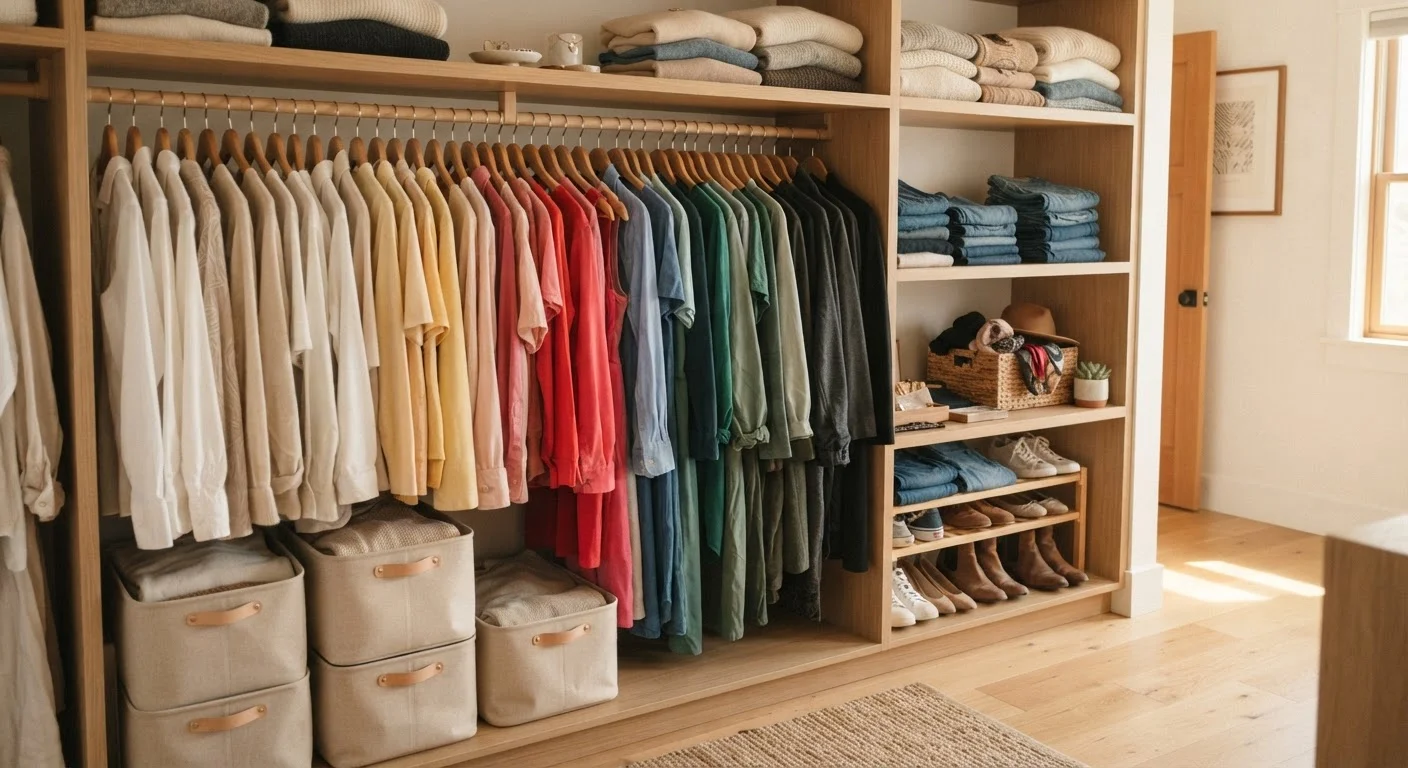
Key Takeaways
- Matching hangers improve visual calm but won't fix overcrowding - decluttering comes first.
- Viral organizing products often solve aesthetic problems rather than real storage problems.
- Sustainable closet organization depends on systems you'll actually maintain daily.
- Categorizing by how you get dressed beats alphabetical or color-only arrangements for most people.
- More containers rarely solve the problem - editing what you own almost always does.
Why Pinterest Closets Don't Translate to Real Life
Scroll through any home organization feed and you'll find closets that look immaculate - identical linen bins, color-coded rails, matching velvet hangers lined up like soldiers. They're genuinely beautiful. They're also often staged, maintained by professional stylists, or photographed before a single real morning routine disrupts them.
The gap between what looks good online and what actually functions for a household is where most people lose money and motivation. You buy the bins, the dividers, the label maker - and six weeks later the closet looks exactly as it did before. That's not a personal failure. It's a system design problem.
This article separates the closet strategies that deliver lasting results from the ones that mostly deliver good photos. For a broader look at organizing every room in your home, see our complete room-by-room organization walkthrough.
Myth
Buying matching hangers and bins is the first step to an organized closet.
Fact
Editing what you own is always the first step. Uniform containers applied to too much stuff just create neatly packaged clutter.
Matching hangers do reduce visual noise, and that's genuinely useful once your closet holds only what you intend to keep. But purchasing organizing products before decluttering is one of the most common - and expensive - closet mistakes. The containers fill right back up with items that didn't deserve storage in the first place. Start with a thorough edit: remove anything you haven't worn in over a year, anything that doesn't fit, and anything kept out of guilt. Only then assess what storage tools you actually need.
Myth
A color-coded wardrobe is the most functional way to organize clothes.
Fact
Color coding looks striking online but often conflicts with how people actually search for clothes - by type or occasion, not by hue.
Color organization works well as a secondary layer within categories. Organizing all your tops together by color makes finding a specific item easier. But color as the primary system scatters category-related items - your workwear might span three color sections, making it harder to pull together an outfit quickly. Category-first, color-second tends to serve real morning routines better than pure rainbow arrangements. Consider how you actually think when you open your closet, and build the system around that behavior.
Myth
Open shelving in a closet keeps things accessible and tidy.
Fact
Open shelves require consistent maintenance - without it, they become the most visible source of disorder in the space.
Open shelving is appealing because it makes items easy to see and grab. But folded items shift, stacks topple, and dust accumulates faster on open surfaces. For households that fold and replace items precisely every time, open shelving works well. For most people, a combination of closed bins on open shelves - or doors on lower sections - provides the accessibility benefit while containing the visual mess. Our article on open shelving vs. closed cabinets explores the real trade-offs in depth.
Myth
If you just had more storage space, your closet would stay organized.
Fact
More space without fewer items typically results in the same disorganization spread across a larger area.
Research on household clutter consistently points to volume of possessions - not lack of storage - as the core problem in most home organization challenges. Adding shelving, a dresser, or an over-door organizer can help, but if the root issue is owning more than the space is designed to hold, expansion just delays the reckoning. The most durable closet systems are built around a realistic, edited wardrobe. Once volume is under control, even modest closets can function smoothly. This is particularly true in smaller homes - a point explored further in our guide to vertical and horizontal storage.
Myth
A perfectly organized closet, once set up, stays organized on its own.
Fact
Any closet system requires regular, brief resets - usually seasonal - to stay functional as habits and wardrobes change.
Closets drift. Clothes come in, seasons change, and items migrate from where they belong. The most effective approach is a short seasonal reset - typically 20 to 30 minutes - where items are returned to their designated spots, anything no longer needed is removed, and the system is adjusted if behavior has shifted. Building this into a routine (many people tie it to seasonal clothing swaps) prevents the slow accumulation that leads to a full reorganization project every year or two. A well-designed system makes resets fast; a poorly designed one makes them feel pointless.
The Strategies That Actually Stick
Once you've cleared the noise of trending products, a handful of straightforward principles make a real difference in closet function.
Organize by how you actually get dressed
Most people don't think "I need a blue shirt" - they think "I need something casual for today" or "I need workwear." Grouping clothes by category first (tops, bottoms, outerwear, occasion) and then by color within those groups mirrors the way most people make clothing decisions. Color-only organization looks cohesive but can scatter functionally related pieces across the closet.
Accessible placement beats aesthetic placement
Items you reach for daily should be at eye level and within arm's reach. Seasonal or rarely worn pieces can go high, low, or in deep storage. When frequently used items require effort to reach, the system breaks down quickly. This principle applies whether your closet is a walk-in or a single rod behind a door - it's especially worth considering if you're working with limited space. Our guide on organizing small apartments covers placement strategies in tight spaces specifically.
Vertical space is almost always underused
Most closets have dead space above the top shelf and below hanging short items. Simple shelf risers or a second hanging rod for folded or shorter garments can meaningfully increase usable capacity without a renovation. For a full comparison of approaches, see vertical vs. horizontal storage strategies.
80%
Of closet items rarely or never worn
Professional organizers commonly report that most households regularly use only about 20% of what's stored in their closets, with the remainder worn rarely or not at all.
~$300
Average spent on organizing products per home
Consumer surveys suggest American households spend hundreds of dollars on storage and organization products annually, much of it on items that don't address the underlying volume problem.
Labels help - but only if the system underneath is sound
Labeling bins and shelves reduces decision fatigue and keeps shared closets functional across multiple household members. However, labels on a poorly designed system just make the disorder easier to name. If you're weighing digital tracking tools against physical labels, this comparison of digital and physical labeling approaches offers practical guidance.
Don't Let Organizing Products Become Clutter
It's easy to accumulate bins, dividers, and shelf inserts that seemed like solutions but didn't fit your actual closet or habits. Before purchasing any organizing product, measure your space carefully and identify the specific problem it needs to solve. Unused organizers take up the very space they were meant to free.