

Key Takeaways
- A savings account is a tool; an emergency fund is a strategy — they're not the same thing.
- Emergency funds cover unplanned, urgent expenses; savings accounts are typically used for planned goals.
- You can keep an emergency fund inside a savings account, but the purpose must stay separate.
- Most financial guidance suggests three to six months of essential expenses as an emergency fund target.
- Mixing emergency and goal-based savings in the same account can make both less effective.
Emergency Fund vs. Savings Account
A savings account is a bank account where you set aside money for future goals — a vacation, a down payment, or anything planned. An emergency fund is money reserved specifically for unexpected financial shocks, like a sudden job loss or a major car repair. The key difference isn't where the money is stored — it's the purpose and the rules you set around when you're allowed to use it.
An emergency fund is often held inside a savings account, but the account type alone doesn't define it — the designated purpose and access discipline do.
Why People Confuse the Two
It's an easy mix-up. Both an emergency fund and a savings account involve putting money aside. Both might sit in the same type of bank account. And both feel like responsible financial behavior. But treating them as interchangeable can quietly undermine your financial stability.
The confusion usually starts because the term "savings account" describes an account type, while "emergency fund" describes a purpose. You can absolutely hold your emergency fund in a savings account — most people do — but that doesn't mean every savings account is an emergency fund, or that your emergency fund can safely share space with your vacation savings.
Same Account, Different Purpose
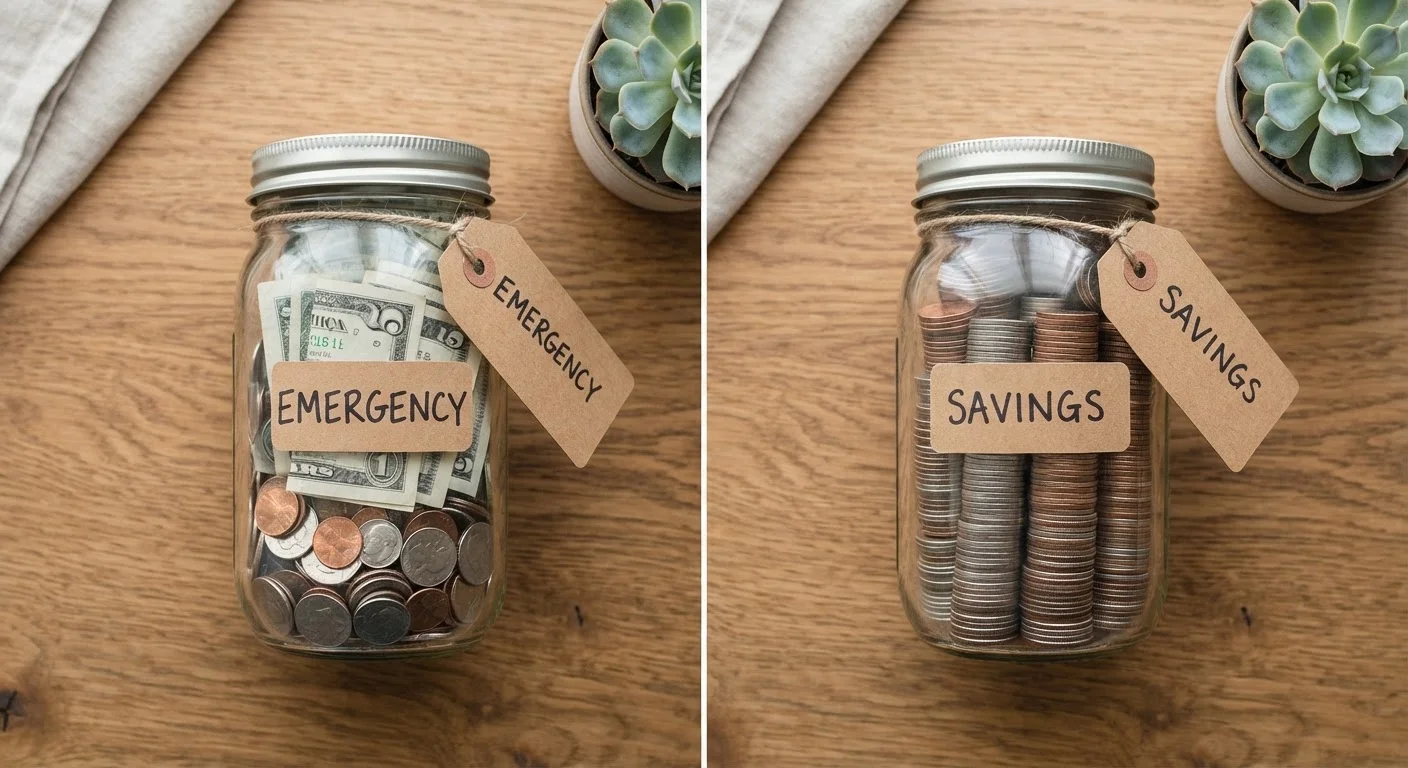
Holding your emergency fund in a savings account is completely normal — it doesn't make the fund any less effective. What matters is that the money is mentally and, ideally, physically separated from savings earmarked for other goals. The account type is just a container; the purpose is what counts.
What Each One Actually Does
A savings account is a deposit account offered by banks and credit unions that holds money separate from your checking account and typically earns some interest. People use savings accounts for all kinds of goals: a home down payment, a new car, a wedding, or just building up a general cushion. The goal is flexible — the account is just the container.
An emergency fund is money set aside for one specific purpose: unplanned financial emergencies. Job loss. An ER visit. A furnace that quits in January. The fund exists so that when life throws a financial curveball, you can absorb it without going into debt or derailing your other financial goals.
Think of it this way: a savings account is a tool. An emergency fund is a decision about how that tool gets used.
~57%
Americans who can't cover a $1,000 emergency from savings
According to Bankrate's annual emergency savings survey, a majority of U.S. adults would need to borrow or use credit to cover an unexpected $1,000 expense.
3–6 months
Recommended emergency fund coverage of essential expenses
This range is widely cited by financial educators as a reasonable target for most working households, though the right amount varies by individual circumstances.
The Problem With Mixing Them
When your emergency fund and your other savings goals live in the same account, boundaries blur fast. You tell yourself you'll only tap the emergency money if things get really bad — but "really bad" is surprisingly easy to redefine when you're staring at a flight deal or an unexpected bill that feels urgent but isn't truly an emergency.
The practical fix is simple: use separate accounts with separate labels. Many banks allow you to open multiple savings accounts and name each one. One account for emergencies, one for your vacation fund, one for a future car purchase. The separation itself creates a psychological guardrail that helps you stick to the rules you've set for yourself.
If you're ready to take the first step toward building that cushion, our guide to building your first emergency fund walks through the process from zero. And once your emergency fund is established, you might explore how sinking funds can handle irregular planned expenses without touching your safety net.
Name Your Accounts to Reinforce Boundaries
Most online banks and credit unions let you assign a nickname to each savings account. Labeling one 'Emergency Only' and another 'Vacation 2025' takes about 30 seconds and makes a real difference in how you treat each balance. When you can see the label, you're less likely to rationalize a withdrawal that doesn't fit the account's purpose.
Choosing the Right Home for Your Emergency Fund
Because emergencies don't announce themselves, your emergency fund needs to be liquid — meaning you can access the money quickly without penalties or delays. That rules out CDs with lock-up periods or investment accounts where values fluctuate.
A high-yield savings account is a popular choice. It keeps your money accessible while earning a better interest rate than a standard savings account. If you want to understand the real trade-offs between account types, see our comparison of high-yield savings versus traditional savings accounts.
Whatever account you choose, the goal is the same: your emergency fund should be easy to reach in a genuine crisis, clearly separated from money earmarked for other purposes, and stable enough that a market dip doesn't shrink it right before you need it.
This article is for general informational purposes only and does not constitute personalized financial advice. Consider speaking with a licensed financial professional about decisions specific to your situation.