

Key Takeaways
- Minimum payments protect your credit standing but barely reduce your principal balance.
- High APRs mean most of each minimum payment is consumed by interest charges.
- Compounding interest causes a manageable balance to grow surprisingly slowly toward payoff.
- Paying even a modest amount above the minimum can cut years off your repayment timeline.
- Understanding how interest is calculated helps you make smarter payment decisions.
Minimum Payment
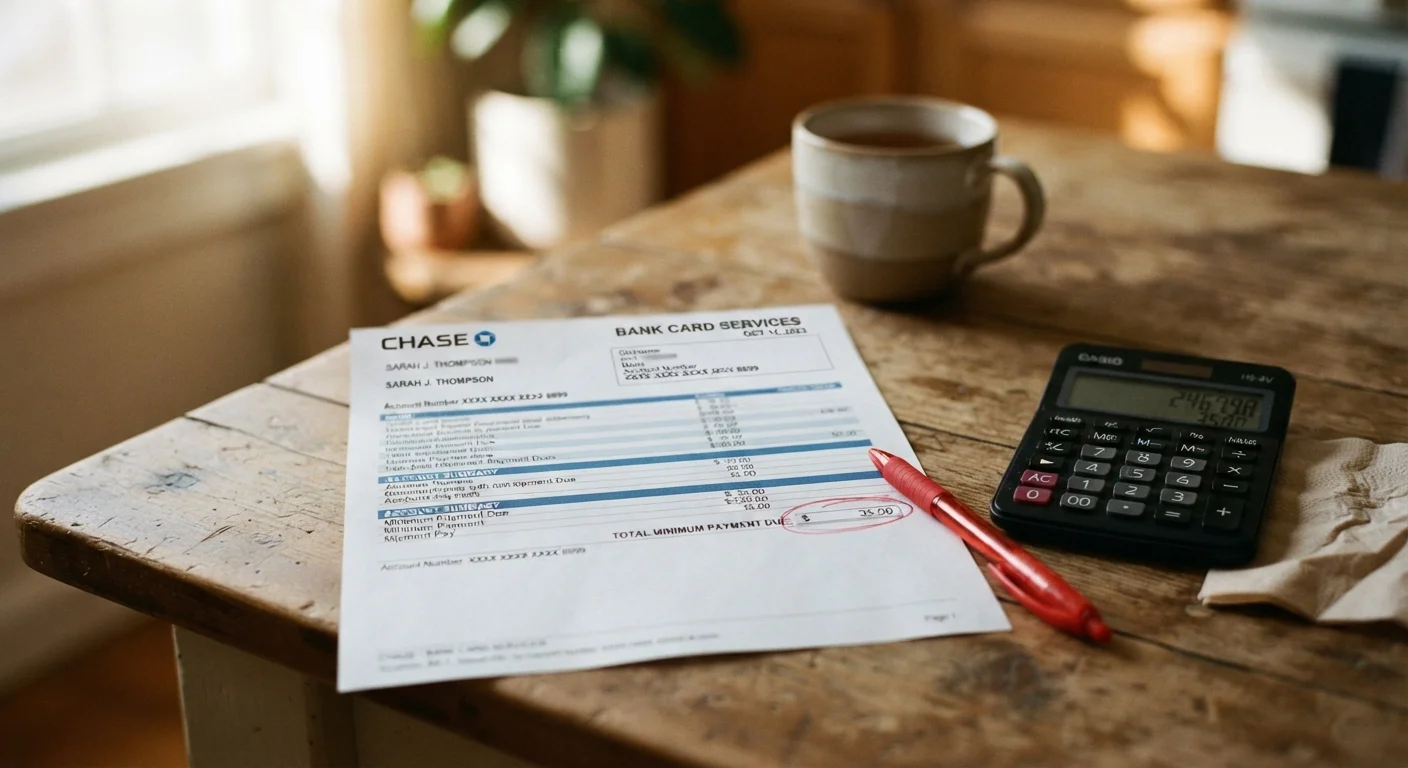
A minimum payment is the smallest amount your credit card issuer requires you to pay each billing cycle to keep your account in good standing. Paying it on time avoids late fees and protects your credit score, but it does not meaningfully reduce what you owe. Because interest continues to accrue on the remaining balance, most of a minimum payment goes toward interest charges rather than your actual debt.
Most issuers calculate the minimum as either a flat dollar amount (often $25–$35) or a small percentage of the outstanding balance (typically 1–3%), whichever is greater. The exact formula varies by issuer and is disclosed in your cardmember agreement.
What the Minimum Payment Is Actually Covering
When you carry a balance on a credit card, interest accrues daily based on your annual percentage rate (APR). By the time your statement closes, that accumulated interest is added to what you owe. When you make a minimum payment, the issuer applies it to interest and fees first, and whatever is left reduces your principal — the actual debt you borrowed.
On a typical balance with a high APR, that leftover amount can be just a few dollars. So even though you made a payment, your balance barely moves. If you continue spending on the card, it may not move at all.
For a deeper look at how APR and daily interest work, see our plain-language guide to credit card interest and APR.
1–3%
Typical minimum payment as a share of balance
Most major credit card issuers set the minimum at roughly 1–3% of the outstanding balance or a flat floor amount, whichever is higher, as disclosed in their cardmember agreements.
20%+
Average credit card APR in recent years
According to Federal Reserve data, average credit card interest rates have risen substantially over recent years, making the cost of carrying a balance higher than in previous decades.
10+ years
Potential payoff timeline on minimum payments
Consumer Financial Protection Bureau (CFPB) guidance illustrates that a balance of several thousand dollars paid with only minimum amounts can take a decade or more to eliminate.
How Compounding Turns a Small Balance Into a Long-Term Problem
Credit card interest compounds monthly. That means interest is charged on your balance, and if you do not pay it off, next month's interest is calculated on the new, higher balance — including last month's interest charges. This cycle is called compounding, and it works powerfully against you when you carry a balance.
Consider a $3,000 balance at 22% APR. If the minimum payment starts at $75 and decreases as the balance drops (as many issuers calculate it), it could take over a decade to pay off and cost well over $3,000 in interest alone — more than the original balance. This is not a scare tactic; it is a straightforward result of the math involved.
This dynamic is one of several traps that quietly slow down debt repayment that are easy to overlook when a monthly bill seems manageable.
“The minimum payment is designed to keep you as a customer for as long as possible — not to help you get out of debt as fast as possible. Understanding that distinction changes how you look at every statement.”
— Generalized industry observation, Widely cited perspective in consumer finance education
The Real Cost of Paying the Minimum — and What Changes When You Pay More
The difference between the minimum payment and a fixed, higher payment can be dramatic over time. The reason is simple: a larger payment reduces principal faster, which means less balance for interest to compound on each month.
Paying a fixed amount — say, $150 per month — rather than a shrinking minimum keeps your paydown pace consistent. As the balance drops, a greater share of each fixed payment goes toward principal rather than interest, accelerating progress.
Try a Fixed Payment Instead of the Minimum
Rather than paying whatever the minimum shows each month, pick a fixed dollar amount you can sustain and stick with it. As your balance falls, the minimum will shrink too — but a fixed payment keeps your paydown pace steady and gets you to zero much faster. Even a modest increase above the minimum, applied consistently, compounds in your favor over time.
Your credit card statement may already show you this comparison. Federal rules require many issuers to include a minimum-payment warning disclosing how long payoff will take and the estimated total cost — alongside a comparison showing the monthly payment needed to pay off the balance in three years. That box is worth reading carefully.
It is also worth revisiting assumptions about debt. Some widely held beliefs — like the idea that minimum payments are an acceptable long-term strategy — are addressed in our piece on debt myths that keep people stuck longer than necessary.
Steps Toward Paying More Than the Minimum
You do not need a dramatic overhaul to start making faster progress. A few practical shifts can help:
- Set a fixed payment amount rather than paying whatever the minimum shows. Even $20–$50 above the minimum makes a compounding difference over time.
- Avoid adding new charges to a card you are actively paying down, if possible. New spending resets your progress.
- Review your statement's payoff disclosure each month. Seeing the numbers in writing can motivate consistency.
- Consider your full financial picture. Paying down debt and building savings at the same time is possible — our guide on balancing saving and debt repayment walks through how to approach both goals.
If you are navigating unfamiliar debt terminology on your statements, our glossary of key borrower terms can help you decode them.
If your debt feels unmanageable, a nonprofit credit counseling agency can provide personalized guidance without a sales agenda. The National Foundation for Credit Counseling (NFCC) is one established resource for finding accredited counselors.
This article is for general informational purposes only and does not constitute personalized financial or legal advice. Consult a qualified financial professional for guidance specific to your situation.