

Key Takeaways
- Dogs pull on the leash because of instinct and learned reinforcement, not defiance or stubbornness.
- A dog's natural walking pace is significantly faster than a human's, creating a built-in mismatch.
- Every step forward while pulling inadvertently teaches the dog that pulling works.
- Loose-leash walking is a learned skill that requires deliberate, consistent practice.
- Understanding the 'why' behind pulling makes training approaches far more effective.
Leash Pulling
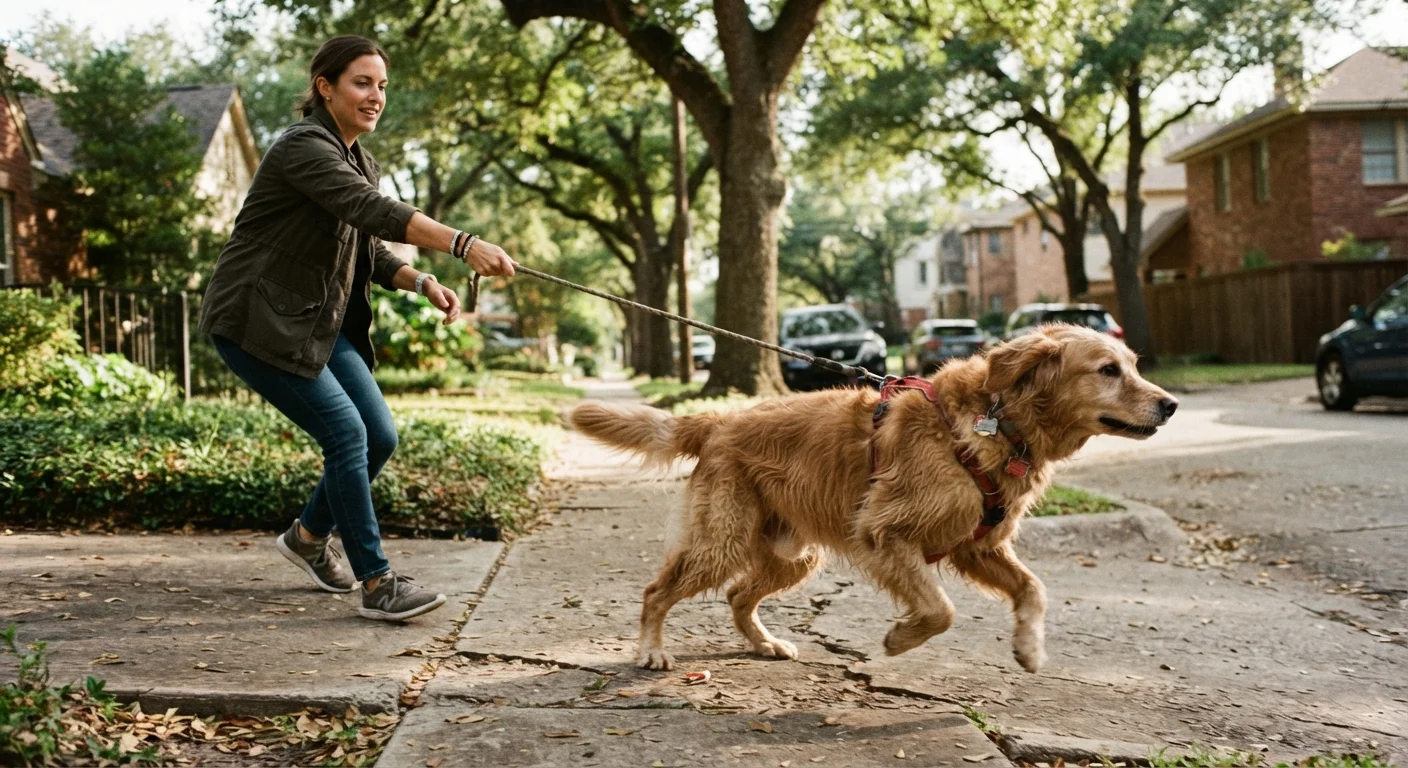
Leash pulling is when a dog moves forward on a walk faster than its owner, creating tension on the leash. It's not a sign of a badly behaved or dominant dog — it's a natural result of how dogs are wired to move and explore. Dogs walk much faster than humans, are driven by scent, and have never been taught that tension on the leash is a signal to slow down.
From a behavioral science standpoint, leash pulling is often maintained by negative reinforcement — the dog pulls, moves closer to the interesting smell or object, and the behavior is reinforced by reaching the goal.
Your Dog Isn't Trying to Be Difficult
Leash pulling frustrates nearly every dog owner at some point — and the instinct is to label the dog as stubborn, untrained, or out of control. But that framing misses what's actually going on. Dogs don't pull to challenge you. They pull because walking on a leash is a completely unnatural situation that no dog was born understanding.
In the wild, dogs and their ancestors cover ground at a trot — roughly two to three times the pace of a casual human walk. They navigate by scent, stopping frequently to gather information from the environment. When you clip on a leash and head outside, you're asking your dog to suppress nearly every natural movement instinct it has. That's a significant ask, and without training, most dogs simply won't do it.
Understanding this reframes the whole problem. Pulling isn't a character flaw. It's the predictable result of a dog following its instincts in an environment where no one has yet taught it a different way to behave.
The Reinforcement Loop You Didn't Know You Were Creating
Here's the part most owners don't realize: every walk where the dog pulls and keeps moving forward is a lesson in pulling. Behaviorally, this is called reinforcement — the dog does something, gets what it wants, and is therefore more likely to do it again.
When your dog strains toward a fire hydrant and you eventually get there, the pulling worked. When your dog surges toward another dog on the sidewalk and closes the distance, the pulling worked. Leash tension becomes a deeply ingrained strategy because, from the dog's perspective, it consistently produces results.
Stop Moving When Pulling Starts
One of the most consistent strategies trainers recommend is simple: when the leash goes tight, stop walking entirely. Don't pull back, don't scold — just stand still. When your dog returns to your side and the leash loosens, the walk resumes. Repeated consistently, this teaches the dog that tension ends the walk and a loose leash keeps it going.
This isn't about blame — it's about mechanics. Recognizing the reinforcement loop is the first step toward interrupting it. Training methods that work focus on making loose-leash walking the behavior that gets rewarded, rather than simply correcting the pulling after it happens.
For a broader look at how habitual behavior patterns develop in dogs, see why pets develop behavioral problems — understanding the roots matters before reaching for a quick fix.
What Good Leash Walking Actually Requires
Loose-leash walking isn't a dog's default setting. It's a trained skill — one that asks your dog to pay attention to you, regulate its pace, and ignore a constant stream of environmental distractions. That's genuinely hard for most dogs, especially young ones or those with high energy.
Effective training approaches generally share a few common principles: reward the dog the moment the leash goes slack, stop moving when pulling begins so the pulling stops working, and keep early sessions short and in low-distraction environments before gradually increasing difficulty.
It also helps to give dogs some structured sniff time during walks. Sniffing is mentally tiring and genuinely satisfying for dogs — building in a few designated moments to investigate the environment can reduce the frantic urgency that fuels pulling. A dog that's had its sensory needs met is easier to walk.
If your dog's behavior on the leash has you questioning other aspects of its training, common training myths are worth reviewing — some popular approaches are based on outdated ideas that can make pulling worse, not better.
When to Seek Extra Help
Most leash pulling responds well to consistent positive reinforcement training over time. But some dogs pull with intensity that makes walks unsafe or distressing — lunging at cars, reacting aggressively to other dogs, or pulling so hard they risk injury. In those cases, working with a certified professional dog trainer or applied animal behaviorist is a practical step, not a last resort.
~80%
Dog owners reporting leash pulling as a challenge
Leash pulling consistently ranks among the top behavior complaints cited by dog owners in veterinary and trainer surveys.
2–3×
Faster: a dog's natural trot vs. human walking pace
The pace mismatch between dogs and humans is a primary mechanical reason pulling develops so readily on walks.
It's also worth noting that extreme reactivity on leash can sometimes be linked to anxiety. If your dog seems panicked, not just excited, understanding anxiety in dogs may offer useful context for what you're seeing.
The goal isn't a perfectly robotic walking companion. It's a dog that can move through the world with you — curious, engaged, and connected — without your shoulder paying the price.
This article is for general informational purposes only and does not constitute professional veterinary or behavioral advice. If your dog displays severe or dangerous behavior, consult a qualified veterinary or certified animal behavior professional.