
Key Takeaways
- Product type, urgency, and fit requirements are the three most reliable factors for choosing a channel.
- In-store shopping wins when you need to touch, try, or take something home immediately.
- Online shopping tends to offer wider selection and easier price comparison for standardized goods.
- Your return tolerance and proximity to stores should factor into every channel decision.
- A consistent personal framework eliminates second-guessing and reduces post-purchase regret.
What you will need
Why Channel Choice Matters More Than Most People Realize
Most shoppers default to a channel out of habit — either they always buy online, or they always head to a store. But the channel you choose affects more than convenience. It shapes your selection, your return options, your total cost, and how confident you feel about what arrives or goes home with you.
The friction of a bad purchase — returning a piece of clothing that didn't fit the way the photos suggested, or waiting a week for a hardware item you needed today — is avoidable when you match the channel to the purchase deliberately. This isn't about loyalty to one method. It's about using each channel where it actually performs better for your specific situation.
For a broader look at how the two channels compare across multiple factors, see our complete consumer's guide to online vs. in-store shopping.
What you will need
What You'll Need Before You Start
This framework works best when you have a specific purchase in mind, not a vague browsing impulse. The steps below apply to any product category — from a $15 kitchen item to a $1,500 appliance. The inputs change; the logic stays the same.
Product category reference
Helps you quickly determine which channel historically suits your product type.
Retailer return policy information
Knowing return windows and processes for both channels reduces risk if the purchase doesn't work out.
Shipping time estimator
Used to confirm whether an online order can arrive within your required timeframe.
Before walking through the steps, it's also worth asking yourself the foundational questions covered in our pre-purchase checklist — they complement the channel decision process directly.
The Decision Framework: Step by Step
Work through each step in order. Most purchases will resolve clearly by step three or four — you rarely need to run all six filters to reach a confident answer.
Define what you actually need from this purchase
Before choosing a channel, clarify your real requirements. Ask: Does the item need to fit my body or space precisely? Do I need to assess texture, weight, or build quality in person? Will I require same-day availability? The more your purchase depends on sensory evaluation or immediate access, the more in-store leans ahead. Standardized items — things with fixed specs like a USB cable, a water filter, or a known brand of laundry detergent — rarely require hands-on assessment.
Assess your urgency honestly
Urgency is one of the cleanest decision filters available. If you need the item within hours, a nearby physical store is almost always the only viable option. If your timeline is flexible — a week or more — online typically opens up a wider selection at potentially lower total cost. Where urgency is moderate (two to four days), check shipping estimates before defaulting to a store trip. Many online retailers now offer expedited delivery that competes with a short drive.
Match your product category to its stronger channel
Some product categories have clear channel advantages based on how purchasing decisions are made. Clothing, shoes, furniture, and mattresses carry high fit and feel risk — in-store tends to reduce costly returns. Electronics with precise specs (a specific laptop model, a router) often suit online purchasing once you know the exact model. Groceries, prescriptions, and perishables typically have strong local options and no meaningful online advantage for most people. See our product category channel guide for a deeper look at how to match item type to channel.
Factor in your return tolerance
Returns are not equal across channels. In-store purchases are generally simpler to return — you hand it back and walk out. Online returns require repackaging, shipping labels, drop-off trips, and waiting for refund processing. If you're purchasing something with a meaningful chance of being wrong (the wrong size, color, or fit), weigh the return friction of each channel before deciding. Some retailers offer in-store returns for online purchases, which reduces this gap significantly — confirm this before buying.
Check your personal context: proximity and time cost
The true cost of in-store shopping includes travel time, fuel, and the risk of the item being out of stock when you arrive. If the nearest relevant store is 30 minutes away and stock isn't guaranteed, that trip carries real cost. For urban shoppers with stores nearby, this calculus favors in-store more readily. For suburban or rural shoppers, online often wins on pure convenience for most product categories. Be precise: a 10-minute errand is not the same as a 45-minute round trip.
Make your decision and commit to it
Once you've run through the filters above — need, urgency, product type, return tolerance, and personal context — a clear channel should emerge for most purchases. If the decision is still close, default to whichever channel gives you the easier return path; that minimizes downside. Document your reasoning briefly if this is a recurring purchase type. Over time, you'll build a consistent personal framework that makes future decisions faster. For a structured approach to building those personal rules, see our guide on building a personal buying framework.
The Hybrid Approach Often Wins
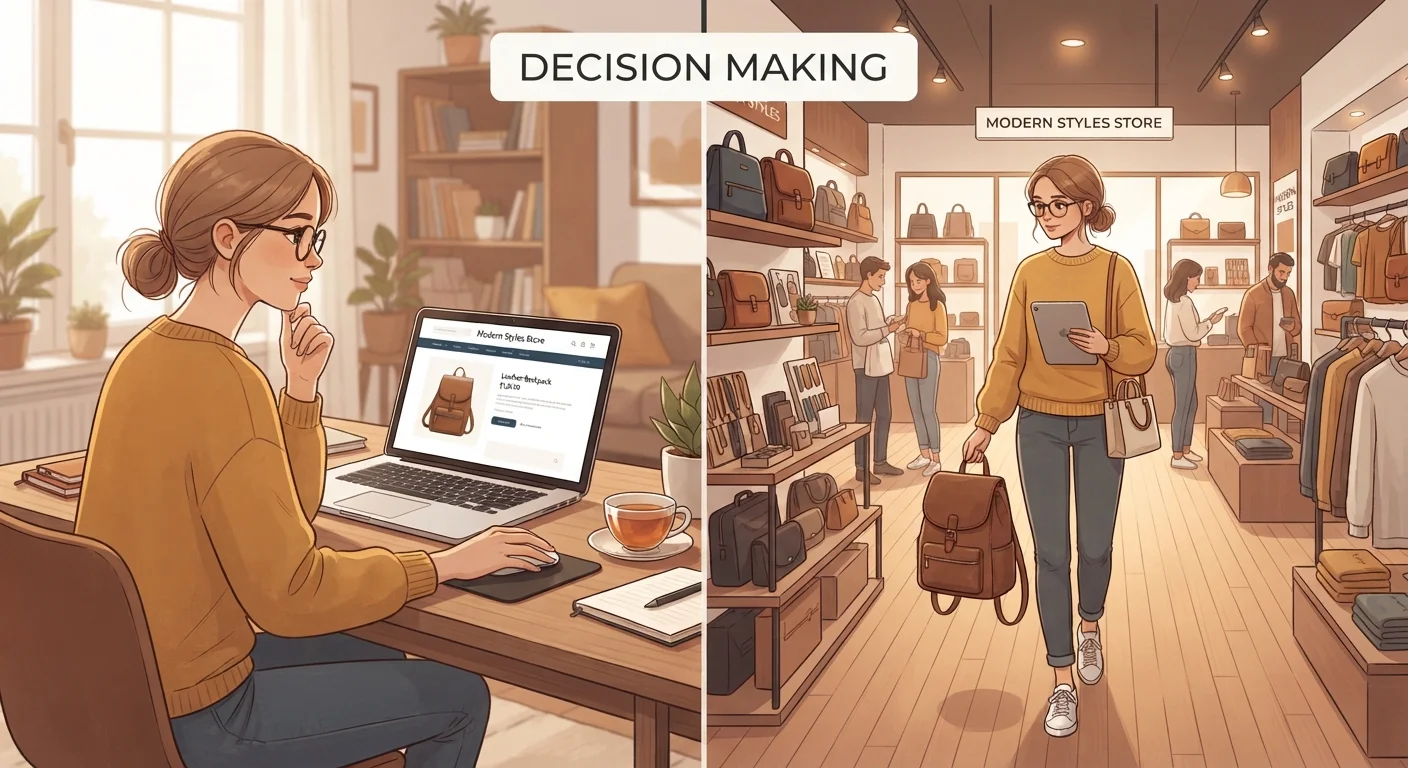
For big-ticket or high-uncertainty purchases, research online and buy in person — or handle in store and purchase online. You get the information depth of one channel and the confidence of the other. This approach is especially effective for furniture, footwear, and large appliances.
If cost is a major factor in your channel decision, it helps to understand where each channel actually wins financially. Our article on which channel actually saves you more breaks down shipping costs, convenience fees, and impulse buying patterns in both environments.
When the Decision Is Still Unclear
Some purchases genuinely sit in the middle — moderate urgency, moderate fit risk, stores that are somewhat nearby. For these, a hybrid approach often works best: use online tools to research specifications, read verified reviews, and compare options, then visit a physical location to confirm fit or quality before purchasing. You can also reverse this: handle the item in store to confirm it's right, then make the final purchase online if the return policy and price work in your favor.
What matters most is that the decision is intentional, not accidental. Habit-driven shopping — always clicking "add to cart" or always driving to the mall — leaves money and satisfaction on the table regularly. Building a consistent personal framework is the longer-term solution. If you want to go deeper on that, our guide to building a personal buying framework walks through how to set your own rules across categories.
Don't Let Habit Override Good Judgment
Defaulting to the same channel for every purchase is one of the most common causes of buyer's remorse. A shirt bought online without checking sizing charts, or an appliance bought in-store without comparing specs, can both lead to regret. Run the framework at least briefly, even for purchases that feel routine.