

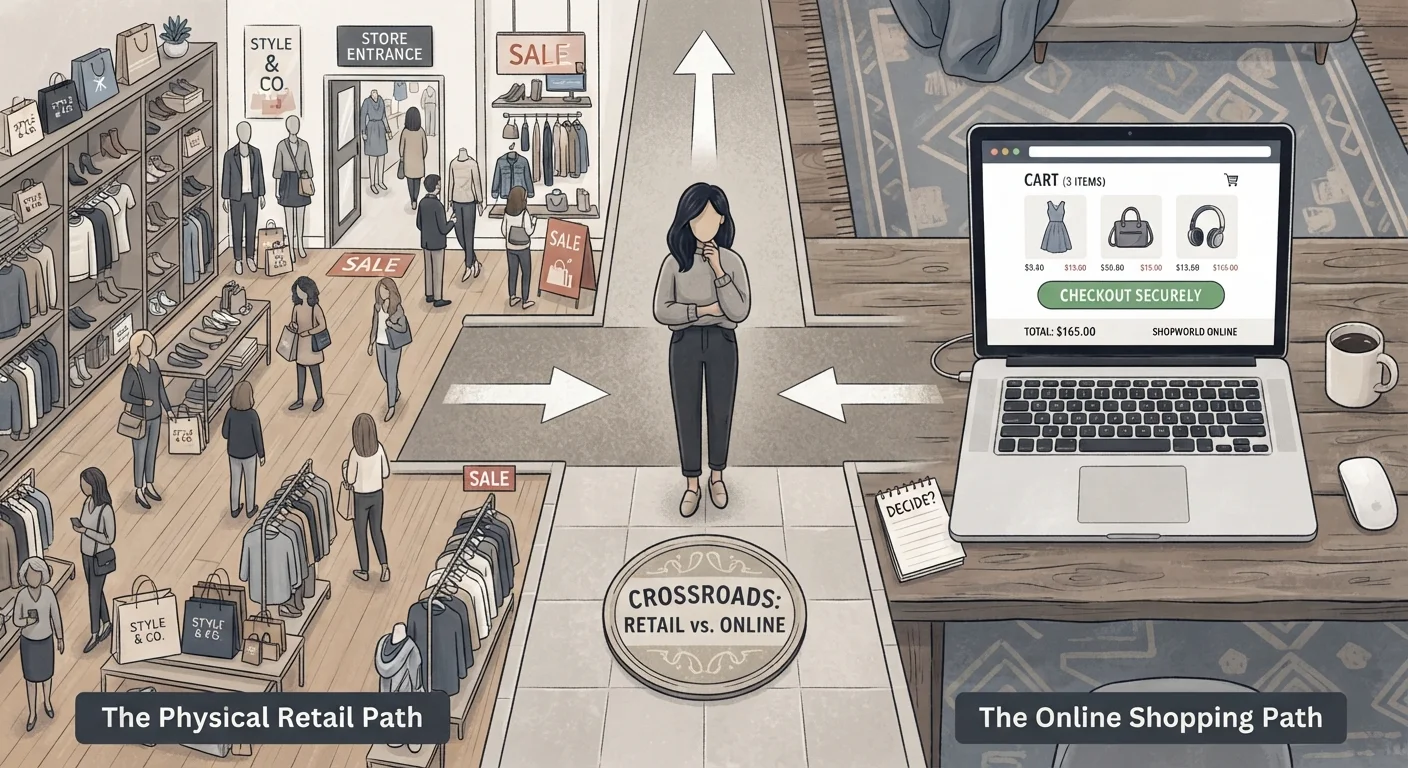
Key Takeaways
- The true cost of any shopping trip includes time, travel, decision fatigue, and emotional energy — not just dollars spent.
- In-store shopping offers immediacy and tactile confidence but costs more in time and physical effort.
- Online shopping saves travel time but introduces waiting, return friction, and browsing overload.
- Matching your shopping method to the purchase type — not habit — produces the most consistent satisfaction.
- A quick pre-purchase audit can prevent regret regardless of where you shop.
Our Verdict
Neither in-store nor online shopping is universally superior. The channel that delivers the most satisfaction depends on what you're buying, how much time you have, and how much uncertainty you can tolerate. Treating each shopping trip as a deliberate choice — rather than a default habit — consistently produces better outcomes and fewer regrets.
| Best for | Recommended |
|---|---|
| Shoppers who need certainty before committing to a purchase | In-store shopping |
| Routine or repeat purchases where the product is already known | Online shopping |
| Complex or high-stakes purchases requiring research and comparison | Hybrid approach (research online, buy in-store or vice versa) |
| Time-constrained shoppers with predictable needs | Online shopping with scheduled delivery |
The Hidden Costs That Don't Show Up at Checkout
Most shoppers mentally subtract the sticker price from their wallet and call it done. But a shopping trip carries a fuller ledger. Drive time, parking, waiting in line, browsing fatigue, and the mental overhead of making decisions all consume real resources — even when no dollar is attached to them.
Behavioral economists sometimes describe this as the total cost of acquisition: everything it takes to get a product from shelf (or warehouse) to your hands. When that fuller picture is considered, the "cheaper" option isn't always obvious, and the "convenient" channel isn't always faster.
Understanding these layers doesn't mean overanalyzing every grocery run. It means recognizing patterns — the kinds of purchases where your default habit consistently leaves you drained, rushed, or disappointed — and making deliberate adjustments. For a deeper look at trade-offs between channels, see what you actually give up or gain depending on where you shop.
In-Store vs. Online: A Full Cost Comparison
Comparing shopping channels fairly means looking beyond price. The table below maps both methods across the dimensions that actually shape your experience and satisfaction.
| In-Store Shopping | Online Shopping | |
|---|---|---|
| Time cost | High — travel, parking, checkout lines | Low — browsing from home, but delivery wait |
| Physical effort | Moderate to high — walking, carrying, driving | Minimal — click and wait |
| Sensory confidence | High — see, touch, try before buying | Low — photos and descriptions only |
| Selection breadth | Limited to local inventory | Vast — near-unlimited SKUs and variants |
| Impulse purchase risk | Moderate — end caps and displays | High — algorithms and one-click checkout |
| Return friction | Low — immediate exchange or refund at counter | Moderate — repackaging, drop-off, wait for refund |
| Satisfaction for first-time buys | Higher — uncertainty resolved in person | Lower — product may differ from expectations |
| Satisfaction for repeat purchases | Overkill — effort exceeds benefit | High — known product, zero travel |
The key insight from this comparison: neither channel dominates on every dimension. In-store shopping tends to win on sensory confidence and immediacy; online tends to win on time efficiency and selection breadth. The purchase category — not personal loyalty to a channel — should drive the choice.
When In-Store Shopping Is Worth the Effort
Physical retail earns its place for purchases where uncertainty is high. Clothing fit, furniture scale, paint color accuracy, and fresh food quality are all categories where touching, trying, or seeing the item in person substantially reduces the risk of a wrong call. The effort invested in the trip is effectively insurance against a costly return or a disappointing product.
In-store shopping also has a pacing advantage for certain buyers. When decision fatigue is already a factor — say, after a long workweek — a constrained physical selection can paradoxically make choosing easier than scrolling through hundreds of online options. Decision fatigue quietly undermines your judgment in ways that aren't always visible in the moment.
Match the Channel to the Category
A useful rule of thumb: if you wouldn't be able to describe exactly what you want before walking into the store, in-person browsing will likely serve you better. If you can write out the product specs or model number from memory, online ordering removes unnecessary effort. Applying this filter consistently saves both time and return-trip hassle.
The effort equation flips, however, when the product is standardized and you've bought it before. Driving twenty minutes for a brand of coffee you've purchased a dozen times adds cost without adding value.
When Online Shopping Delivers More for Less
Online channels shine for repeat purchases, commodity items, and products where specs — not tactile experience — drive the decision. Electronics with published benchmark scores, household consumables, and items you've already vetted in person all fit this profile. The time savings are real: no commute, no parking, no checkout line.
The friction point is the return process. Online returns, while often free at the label level, require repackaging, drop-off trips, and waiting for refunds — costs that erode the convenience advantage when a wrong purchase is likely. This is especially relevant for categories like apparel, where fit uncertainty is high.
Impulse risk also rises online. One-click purchasing and algorithmically curated recommendations are engineered to reduce the pause between desire and purchase. Frictionless checkout is designed for speed, not satisfaction — a distinction worth keeping in mind before you add to cart.
Watch for Hidden Return Costs Online
"Free returns" rarely accounts for your time. Repackaging an item, printing a label, driving to a drop-off location, and waiting up to two weeks for a refund can add meaningful hidden cost — especially for categories like apparel or home goods with high return rates. Factor likely return probability into your channel choice before you buy, not after.
Building a Shopping Method That Matches the Purchase
The most satisfied shoppers tend to treat channel selection as a deliberate decision, not a default. A simple framework: before any purchase, ask two questions. First, how confident are you in what you're buying? Second, how much does getting it wrong cost you — financially or in hassle?
High confidence, low consequence: order online and move on. Low confidence, high consequence: the trip to the store is worth it. Mixed situations often benefit from a hybrid approach — researching and comparing online, then verifying in person (or vice versa).
Running a quick audit before checkout — whether at a register or on a product page — catches impulse additions and confirms the purchase still makes sense. A pre-checkout checklist can be completed in under two minutes and consistently reduces buyer's remorse. For the broader trade-off framework behind these decisions, understanding the price-quality-convenience triangle helps you prioritize without second-guessing yourself.
This article is for general informational and educational purposes only. It does not constitute financial or purchasing advice tailored to your individual circumstances.