

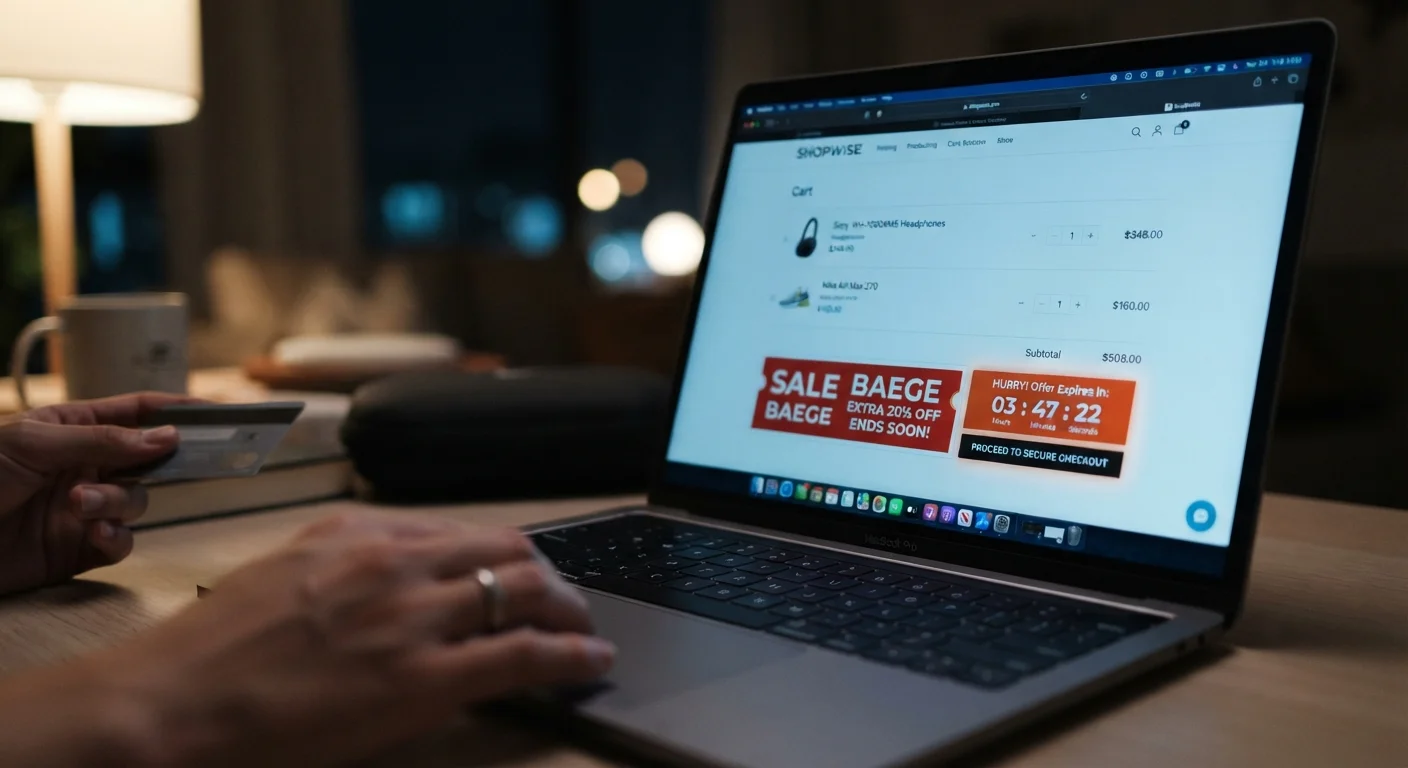
Key Takeaways
- Countdown timers and stock warnings often create artificial urgency that doesn't reflect real inventory.
- Anchor pricing makes a marked-down item feel like a deal even when the original price was inflated.
- Pre-checked subscription boxes and default add-ons quietly raise your total without your active consent.
- Free shipping thresholds are engineered to push cart totals higher than you planned to spend.
- Pausing before checkout — even briefly — disrupts the momentum these tactics rely on.
Why Retail Websites Feel Different From Physical Stores
Walk into a physical store and the persuasion is mostly spatial — product placement, lighting, end-cap displays. Online retail adds a new layer: the interface itself is the sales floor, and every element on the page can be tested, optimized, and retargeted to reduce the gap between browsing and buying.
This isn't speculative. Conversion rate optimization is a well-documented discipline, and many of its techniques are explicitly designed to reduce deliberation time. That's not inherently sinister — but it does mean that the path of least resistance on most retail sites leads toward spending more, faster, than you might otherwise choose. Understanding how retailers use anchoring, scarcity, and social proof is a practical first step toward shopping on your own schedule.
The Mistakes That Cost You Most at Checkout
Most overspending online doesn't happen in a single dramatic moment. It accumulates through small capitulations to well-designed pressure — a timer here, a pre-checked box there, a 'you're almost there' nudge on the shipping page. The mistakes below are among the most common, and none of them require sophisticated manipulation to work. They just need you to be moving quickly.
Treating countdown timers as genuine deadlines and rushing to checkout.
Why it happens: Urgency triggers a fear-of-missing-out response that short-circuits rational evaluation. Timers look official and feel authoritative.
Accepting anchor prices at face value without verifying the original price's legitimacy.
Why it happens: A crossed-out 'original' price makes any sale figure look rational by comparison, even when the original was briefly set high just to create that contrast.
Missing pre-checked subscription boxes and auto-enrolled add-ons during checkout.
Why it happens: Checkout flows are designed with visual hierarchy that draws attention toward the 'Place Order' button, not toward the fine print surrounding it.
Spending more to reach a free shipping threshold when the extra items aren't needed.
Why it happens: The framing 'You're only $12 away from free shipping' presents extra spending as saving — which it isn't. The math only works if you genuinely need what you add.
Relying on 'only 3 left in stock' warnings as accurate inventory signals.
Why it happens: Scarcity language triggers the same loss-aversion instinct as countdown timers. Many retailers display low-stock warnings algorithmically regardless of actual warehouse levels.
Buying a bundle because it appears cheaper without checking individual item value.
Why it happens: Bundle pricing creates the illusion of comprehensive value. Shoppers assume the retailer has done the math in their favor when that's rarely the motivation.
Before you finalize any order, a structured pause pays off. The pre-checkout spending audit is a practical tool for catching exactly these moments before they become charges on your statement.
Building Habits That Neutralize These Tactics
These Tactics Are Legal — But Costly
None of the design patterns described here are necessarily illegal, but they are deliberately engineered to reduce your deliberation time and increase your spend. Awareness is your primary defense. If a page element is making you feel rushed or guilty for not acting, treat that feeling as a signal to pause, not proceed.
The most durable defense against retail design pressure is a consistent decision-making routine that you apply regardless of what the page is telling you to feel. A few practical anchors:
- Add to wish list first. Defer the purchase by 24 hours. Most urgency tactics lose their power when time passes.
- Check your running total against a pre-set limit before adding anything to your cart — not after. Budgeting basics can help you establish those limits in the first place.
- Treat subscriptions as opt-in, not opt-out. If a recurring charge appears at checkout that you didn't actively choose, remove it before proceeding. For a broader view of how recurring costs accumulate, thinking in systems about recurring purchases is worth reading.
The goal isn't to make online shopping adversarial — it's to make it deliberate. Deliberate shopping and one-click convenience represent genuinely different habits with genuinely different financial outcomes over time.