

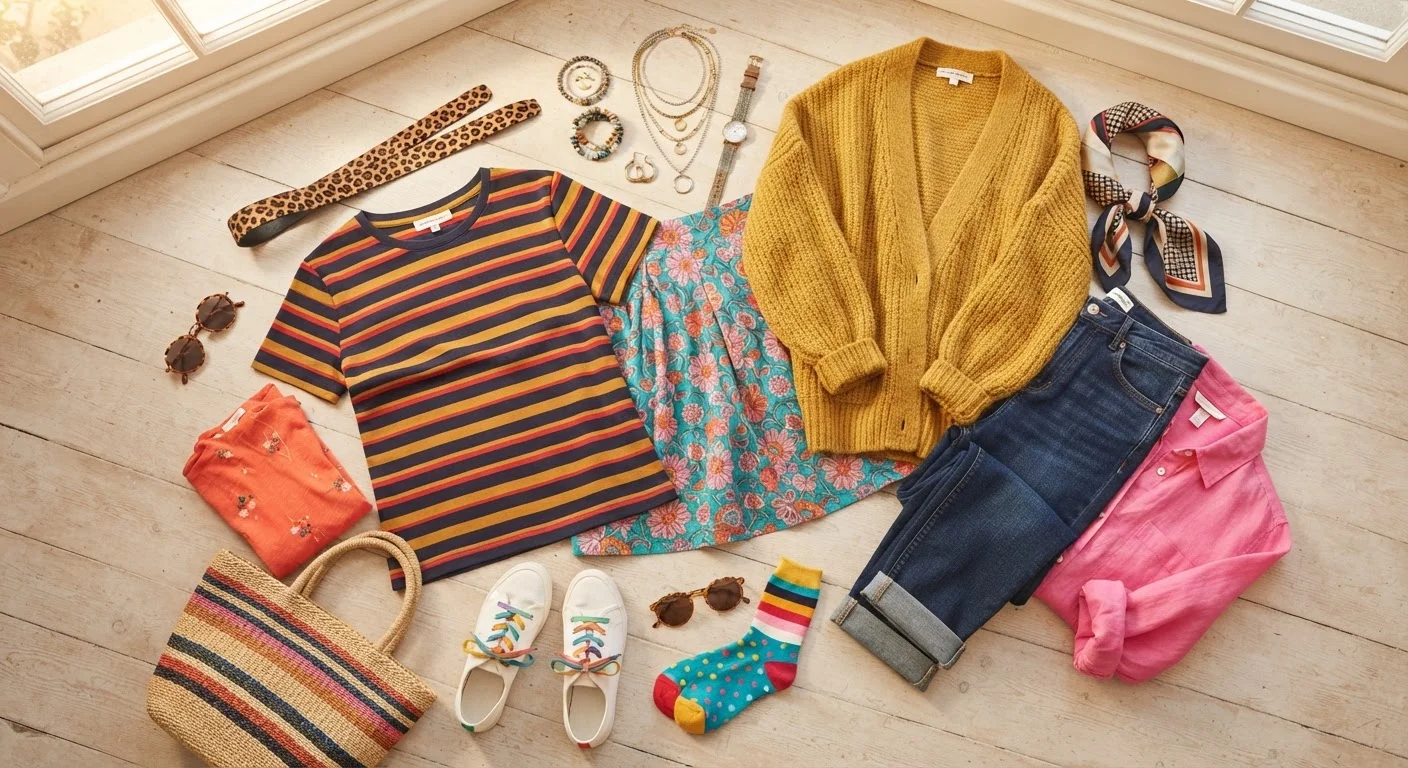
Key Takeaways
- Horizontal stripes do not automatically make you look wider — fit and scale matter far more.
- Mixing metals in jewelry and accessories is widely accepted in contemporary styling.
- Black and navy worn together can read as intentional and sophisticated, not accidental.
- Wearing all-one-color head to toe is a legitimate, polished technique, not a mistake.
- Expensive clothes don't automatically look good — proportion, fit, and confidence do the heavy lifting.
Why Style Myths Stick Around
Fashion rules have a peculiar staying power. They get passed down through generations, reinforced by magazine spreads from decades past, and repeated so often they start to feel like facts. The trouble is, most of them were never universal truths to begin with — they were context-specific guidelines that hardened into commandments.
Understanding where a rule came from is often enough to dissolve its hold. Many originated in early 20th-century etiquette culture, others in the practical limitations of older fabric and dye technology, and still others in commercial fashion messaging that benefited from consumers feeling like they were constantly doing something wrong.
Rules Were Made to Be Reconsidered
Most classic style rules originated in highly specific cultural and commercial contexts — not universal truths about what looks good. Fashion is subjective, and what reads as polished is far more about fit, intention, and confidence than rigid adherence to dos and don'ts. Give yourself permission to experiment.
Letting go of rules that don't serve you isn't about abandoning all structure — it's about swapping rigid dos and don'ts for a sharper eye and more genuine confidence. Just as money myths can quietly steer financial decisions in the wrong direction, style myths can quietly drain the joy from getting dressed.
The Myths, Debunked
The following misconceptions are among the most commonly repeated — and most consistently contradicted by how clothes actually behave on real people in real light. Work through them and notice how many are quietly shaping your daily choices.
Myth
Horizontal stripes make you look wider, so curvier or taller people should avoid them.
Fact
Stripe scale, garment fit, and overall silhouette have far more visual impact than stripe direction alone.
The idea that horizontal stripes universally widen the figure has been around for decades, but it oversimplifies how the eye actually reads clothing. Research in visual perception — including a frequently cited study by psychologist Peter Thompson — has suggested that under certain conditions, horizontal stripes can actually make a figure appear narrower. What matters more: how well the garment fits, how wide the stripes are, and the contrast level between them. A well-fitted striped top reads very differently than an oversized one.
Myth
You should never mix gold and silver metals — pick one and stick to it.
Fact
Mixed metals are a widely used and intentional styling technique in contemporary fashion and jewelry.
The single-metal rule dates back to an era when matching everything — shoes, bag, belt, jewelry — was the dominant etiquette. That aesthetic has largely given way to more layered, eclectic approaches. Mixed metals work well when the combination is deliberate: layering rings in varied tones, or pairing a silver watch with gold earrings. The key is intentionality — it should look like a choice, not an oversight. When in doubt, keeping the metals balanced (rather than one stray piece) helps the look feel cohesive.
Myth
Black and navy should never be worn together — they clash badly.
Fact
Black and navy is a classic, widely worn combination in both casual and professional dressing.
This myth likely came from an era of limited artificial lighting, when the two dark tones could genuinely be difficult to distinguish — and accidentally wearing near-identical shades looked like a mismatch. In daylight, and styled with intention, black and navy create a rich, understated contrast. Many style professionals actively recommend the pairing for its versatility. If you're concerned about the look reading as accidental, making the contrast more obvious — say, a deep black jacket over lighter navy trousers — removes any ambiguity.
Myth
Wearing one color head to toe is boring or visually flat.
Fact
Monochromatic dressing is one of the most consistently cited techniques for creating an elongated, put-together silhouette.
All-one-color outfits — or tonal dressing, where you layer shades within the same color family — are a go-to approach in editorial styling for good reason. When the eye isn't interrupted by contrasting blocks of color, the body reads as a single continuous line. This is especially effective for creating a streamlined look without requiring any specific body shape. Texture variation (matte vs. sheen, knit vs. woven) keeps monochromatic outfits from feeling flat. For more on building outfits with intention, see our guide on dressing for your body shape without the outdated rules.
Myth
More expensive clothes always look more expensive.
Fact
Fit, condition, and proportion consistently outperform price point as visual quality signals.
A beautifully tailored mid-price piece will almost always read as more polished than an expensive item that fits poorly or is visibly worn. The factors that actually communicate quality to an observer's eye include: clean lines, appropriate length and proportion for the wearer's body, and fabric that holds its shape. This means alterations — even minor ones like hemming trousers or taking in a waist — can dramatically improve how any garment reads, regardless of what it cost.
Myth
You can't mix patterns — it always looks chaotic.
Fact
Pattern mixing follows learnable principles around scale and color that make it very achievable.
The most reliable approach to mixing patterns is varying the scale: pair a large-scale print with a smaller, more restrained one. Keeping both patterns within a shared color palette helps them feel cohesive rather than competing. A bold floral with a fine stripe, or a large plaid with a subtle polka dot, can hold together well when the colors overlap. For a deeper dive into what actually makes the technique click, our piece on pattern mixing covers the logic in detail.
Don't Let Rules Replace Your Own Eye
Following style rules too literally can lead to outfits that feel safe but joyless. If a combination makes you feel great and fits your life, that's the most reliable signal you have. No checklist can replicate your own judgment about what works for your body and context.
Style myths share something with myths in other areas of everyday life: they tend to collapse once you look at them directly. If you've been curious about similar patterns in grooming and fragrance, our piece on fragrance myths worth unlearning applies the same myth-busting lens to scent.
What Actually Makes an Outfit Work
Strip away the rules and a clearer picture emerges: outfits land well when they fit properly, when there's some internal logic to how the pieces relate (whether through color, texture, or proportion), and when the wearer feels comfortable in them.
62%
Women who say fit matters more than brand
A survey by fashion research platform Edited found that fit consistently ranks as the top purchase driver for women's clothing, above brand recognition or price.
3x
More outfit use from well-fitted basics
Style coaches frequently note that well-fitted wardrobe staples get worn significantly more often than statement pieces that don't fit comfortably.
Fit is the single highest-leverage factor most people can act on immediately. Even modest alterations — shortening a hem, adjusting a shoulder seam — shift how a garment reads entirely. Proportion matters too: mixing volumes (a relaxed top with a more fitted bottom, or vice versa) tends to create visual interest without requiring any complicated pattern or color work.
None of this requires a large wardrobe or a significant budget. It requires attention to what's actually on your body rather than adherence to a checklist someone else wrote.