

Key Takeaways
- Liability coverage is required in almost every state and protects others - not you - when you're at fault.
- Collision and comprehensive are separate coverages that protect your own vehicle in different scenarios.
- Uninsured/underinsured motorist coverage fills a real gap - roughly 1 in 7 U.S. drivers carries no insurance.
- Medical payments (MedPay) and personal injury protection (PIP) cover occupant injuries regardless of fault.
- Most drivers benefit from reviewing their coverage mix, especially as their vehicle ages or their financial situation changes.
Auto Insurance Coverage Types
Auto insurance is made up of several distinct coverage types, each protecting against a different category of loss or liability. Rather than one blanket policy, your auto insurance is typically a package of coverages - some required by law, others optional. Knowing what each one actually does helps you avoid paying for things you don't need and avoid gaps you didn't know existed.
Coverage limits (the maximum an insurer pays per incident) and deductibles (what you pay out-of-pocket before coverage kicks in) vary by coverage type and are set individually within a single policy.
Liability Coverage: Protection for Everyone Else
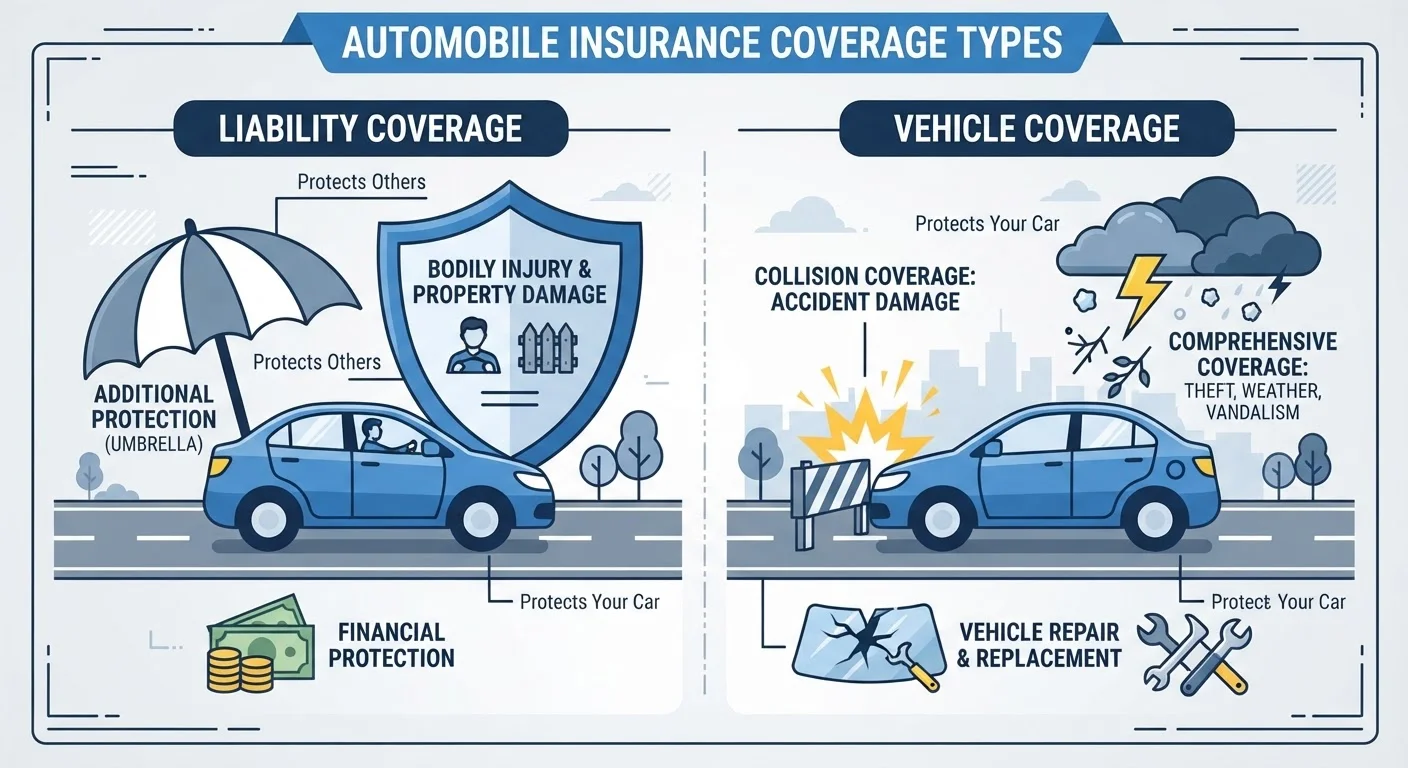
Liability insurance is the foundation of any auto policy and is legally required in nearly every U.S. state. It covers two things: bodily injury liability (medical costs, lost wages, and legal fees for people you injure) and property damage liability (repair or replacement costs for property you damage). What it does not cover is anything that happens to you or your car.
Limits are typically written as three numbers - for example, 100/300/100 - meaning $100,000 per injured person, $300,000 per accident, and $100,000 in property damage. State minimums are often much lower than these figures, and a serious accident can exceed minimums quickly. Carrying only the state-mandated minimum leaves your personal assets exposed if a claim exceeds your coverage.
Coverage Requirements Vary by State
What's legally required in your state depends on local law. Some states mandate PIP; others require UM/UIM; a few only require basic liability. Always verify current requirements with your state's department of motor vehicles or a licensed insurance professional - don't rely solely on what you carried in a previous state.
For a broader look at how auto insurance fits into your overall financial protection, see the six types of insurance most Americans actually need.
Collision and Comprehensive: Protecting Your Own Vehicle
These two coverages are commonly sold together but cover entirely different situations.
Collision pays for damage to your vehicle when it makes contact with another object - another car, a guardrail, a curb. It applies regardless of fault, though your insurer may seek reimbursement from the at-fault party afterward.
Comprehensive covers damage from events that aren't collisions: theft, vandalism, fire, flooding, hail, or animal strikes. If a tree falls on your parked car or someone steals your catalytic converter, that's a comprehensive claim.
Both come with a deductible you choose when you set up the policy. If you're financing or leasing your vehicle, your lender will almost certainly require both. For older vehicles with low market value, it's worth evaluating whether the annual cost of these coverages is proportionate to what you'd actually receive in a claim. How your insurer calculates that payout - actual cash value vs. replacement cost - is a separate but related consideration.
~1 in 7
U.S. drivers estimated to be uninsured
According to the Insurance Research Council, an estimated 14% of U.S. motorists were uninsured in a recent study period.
49 of 50
States requiring some form of auto liability coverage
New Hampshire is the only state that does not mandate auto liability insurance, though drivers must still demonstrate financial responsibility.
~$1,700
Average annual full-coverage auto premium in the U.S.
Average premium figures vary significantly by state, driving record, vehicle type, and coverage limits selected.
Uninsured and Underinsured Motorist Coverage
Not every driver on the road carries insurance - or carries enough. Uninsured motorist (UM) coverage steps in when you're hit by a driver who has no insurance at all. Underinsured motorist (UIM) coverage applies when the at-fault driver's liability limits aren't sufficient to cover your damages.
UM/UIM typically covers bodily injury. In some states, it also covers property damage (UMPD). If you rely on the at-fault driver's insurance to cover your bills after an accident, and they have none or not enough, you could be left with significant out-of-pocket costs for medical care and vehicle repairs.
Some states require UM/UIM coverage; others make it optional. Given how common underinsurance is on U.S. roads, most drivers have a genuine reason to consider it regardless of whether it's mandated. This ties directly into the broader problem of coverage gaps - an issue explored further in why people are underinsured and don't know it.
Check Your UM/UIM Limits Annually
Your uninsured motorist coverage limit is often tied to your liability limit by default, but you can usually adjust them independently. If your liability limits are low because you're trying to keep premiums down, make sure your UM/UIM limits still reflect the actual cost of medical care and lost income in your area.
Medical Coverages: MedPay and PIP
Two coverage types address medical costs for you and your passengers - regardless of who caused the accident.
Medical payments coverage (MedPay) pays for medical and funeral expenses up to the policy limit. It's relatively simple and available in most states as an optional add-on.
Personal injury protection (PIP) is broader. It covers medical expenses, but in most states it can also cover lost wages, child care costs resulting from an injury, and rehabilitation. PIP is required in no-fault states - states where each driver's own insurer covers their injuries, regardless of fault.
If you have solid health insurance, you may have less need for MedPay or high PIP limits. But health insurance won't cover lost wages or certain out-of-pocket costs the way PIP can, so the two aren't always redundant. If you work with a licensed agent or broker when building your policy, they can help you assess where overlaps exist. Understanding the difference between agents and brokers can help you know whose interests they're representing.
This article is for general informational purposes only and does not constitute personalized insurance, financial, or legal advice. Coverage types, requirements, and terms vary by state and insurer. Consult a licensed insurance professional to evaluate your specific situation.