

Key Takeaways
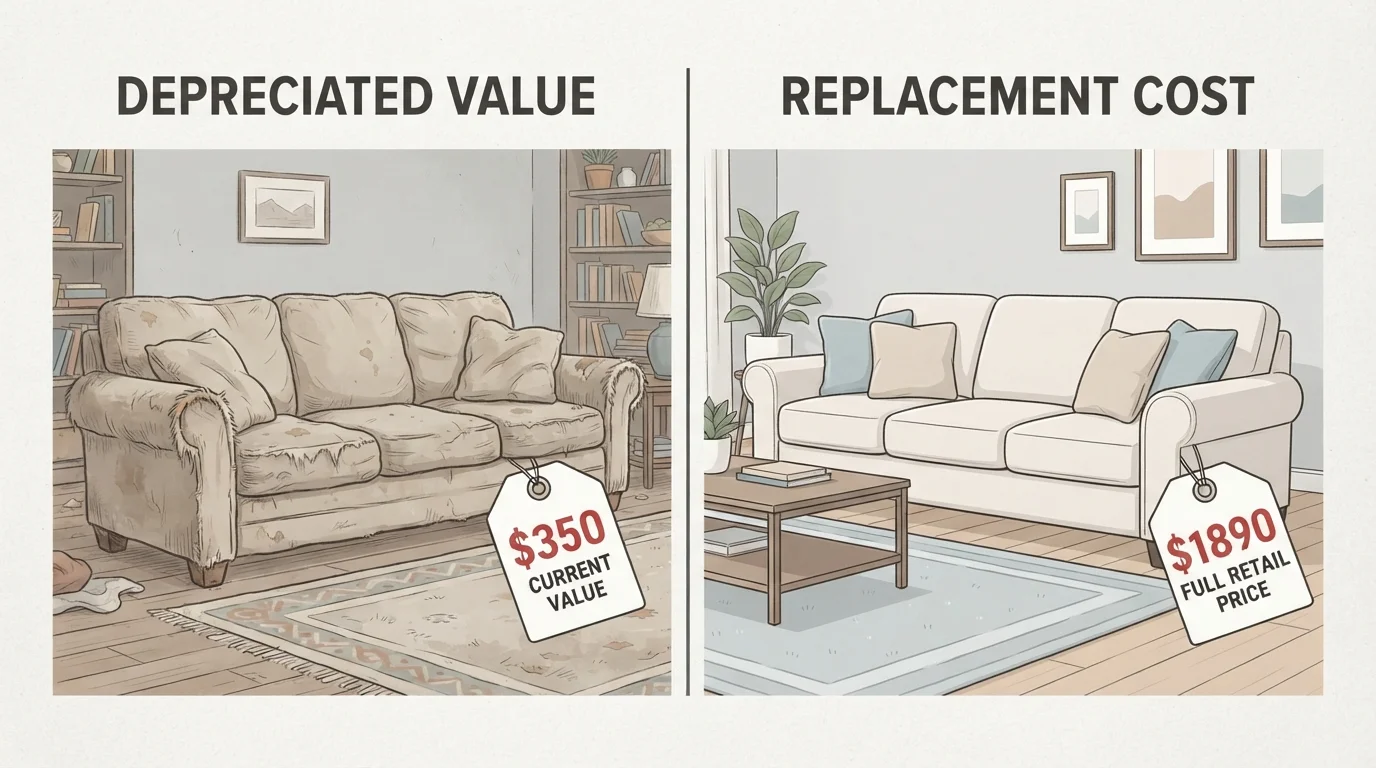
- ACV pays what your property is worth now, factoring in depreciation - often far less than what you paid.
- Replacement cost pays what it costs to buy a comparable new item today, closing the gap depreciation creates.
- RCV policies typically carry higher premiums than ACV policies for the same coverage.
- The difference between the two can easily reach thousands of dollars after a major loss.
- Check your policy's declarations page to confirm which valuation method applies to your coverage.
- Consulting a licensed insurance agent helps you weigh the premium difference against your financial risk tolerance.
Option A
Actual Cash Value (ACV)
What your belongings are worth today - after depreciation.
Best for: Policyholders seeking lower premiums who are comfortable absorbing some out-of-pocket cost after a claim.
Option B
Replacement Cost Value (RCV)
What it costs to replace your belongings with new equivalents.
Best for: Homeowners and renters who want claims to fully restore what was lost without a significant financial gap.
If you want to keep premium costs as low as possible
Actual Cash Value (ACV)
ACV policies generally cost less per year, making them appealing when budget is the primary concern - though you accept a larger out-of-pocket gap at claim time.
If you own relatively new appliances, electronics, or furniture
Replacement Cost Value (RCV)
Newer items depreciate quickly. RCV coverage ensures a claim payout keeps pace with what you'd actually spend to replace them.
If a major loss would strain your finances to recover from
Replacement Cost Value (RCV)
When you cannot easily absorb the gap between depreciated value and current store prices, RCV reduces that financial exposure significantly.
If you own older property with heavy depreciation already factored in
Actual Cash Value (ACV)
Items that have already lost most of their value leave a smaller depreciation gap, making the premium savings of ACV more attractive.
What Separates These Two Coverage Types
When you buy a homeowners or renters policy, one of the most consequential decisions buried in the fine print is how your insurer will value your property after a loss. Two policies may look nearly identical on the surface - same deductible, same coverage limits - yet pay out very differently when you actually file a claim.
Actual Cash Value (ACV) is calculated by taking the replacement cost of an item and subtracting depreciation. Depreciation accounts for age, wear, and obsolescence. A five-year-old laptop that originally cost $1,200 might be valued at $400 under ACV - because that reflects its market value at the time of the loss, not what you'd pay to walk into a store today.
Replacement Cost Value (RCV) skips the depreciation calculation. If that same laptop was destroyed in a covered event, an RCV policy would pay what it costs to purchase a comparable new laptop today - potentially the full $1,200 or close to it, minus your deductible.
That gap isn't trivial. Across an entire household of appliances, furniture, and electronics, the difference between ACV and RCV payouts can run into tens of thousands of dollars. Many policyholders only discover this when a claim is already filed - a painful moment to learn the lesson. For a closer look at how this plays out at claim time, see how ACV vs. replacement cost affects your actual claim.
| Criterion | Actual Cash Value (ACV) | Replacement Cost Value (RCV) |
|---|---|---|
| Payout basis | Current market value after depreciation | Cost to buy a comparable new item today |
| Depreciation deducted | Yes - always subtracted from payout | No - depreciation not deducted |
| Typical premium cost | Generally lower | Generally higher |
| Out-of-pocket gap at claim time | Potentially large, especially on older items | Smaller - payout closer to actual replacement cost |
| Best scenario for policyholder | Older items with limited remaining value | Newer or high-value belongings |
| Common in | Standard auto and some home policies | Upgraded home, renters, and contents policies |
How Depreciation Is Calculated - and Why It Matters
Insurers use depreciation schedules that vary by item category. Electronics, appliances, and flooring tend to depreciate faster than structural elements. A refrigerator might depreciate at 10% per year; carpeting could depreciate even faster. These schedules are set by the insurer and aren't always disclosed upfront, which is why it pays to ask.
10-20%
Typical annual depreciation rate for electronics
Insurance depreciation schedules commonly apply steep annual rates to consumer electronics, reducing ACV payouts significantly within just a few years of purchase.
$1,000s
Potential payout gap between ACV and RCV
For a household with moderate furnishings and appliances, the difference between ACV and RCV claim payouts can routinely reach several thousand dollars on a single loss event.
Under ACV, this math works against you with every passing year. A roof that's 15 years old and gets damaged in a hailstorm may be valued at a fraction of current replacement cost - even if the rest of the roof structure was perfectly functional. Homeowners who don't know their policy type sometimes expect a full roof replacement and receive a check that barely covers materials.
RCV doesn't ignore age entirely in all cases - some policies pay ACV first, then release the remaining "recoverable depreciation" once you provide proof of actual repair or replacement. This two-step process is common and worth understanding before you assume a full check arrives upfront. Review your policy documents carefully, and ask your agent to walk through how a hypothetical claim would be paid.
It's also worth knowing that this same logic applies to auto policies. Understanding how auto coverage types are valued helps you spot the same ACV vs. RCV distinction in your car insurance.
Making the Right Call for Your Situation
Neither coverage type is universally better. The right choice depends on your premium budget, the age and value of what you own, and how much financial risk you can absorb if a major loss occurs.
If your belongings are older and already heavily depreciated, the premium savings from an ACV policy may outweigh the reduced payout. If you've recently furnished a home or own high-value electronics, the gap between ACV and RCV could be significant enough that the higher RCV premium is worth it.
A few practical steps before you decide:
- Pull your current policy's declarations page and look for the valuation method - it's usually spelled out explicitly.
- Create a basic home inventory listing major items, their purchase dates, and approximate current replacement costs. This makes the depreciation math concrete rather than abstract.
- Ask your agent to quote both options side by side so you can see the exact premium difference for your specific coverage level.
Misunderstanding what your policy actually covers is one of the most common - and costly - insurance mistakes. Common insurance myths that leave people worse off covers several related misconceptions worth reviewing. And since coverage needs shift over time, a yearly policy checkup is a smart habit regardless of which valuation type you choose.
This article is for general informational purposes only and does not constitute insurance, financial, or legal advice. Coverage terms, calculations, and availability vary by insurer and state. Consult a licensed insurance agent or adviser for guidance specific to your situation.