

Key Takeaways
- Most EV owners charge at home overnight, making daily range anxiety far less common than headlines suggest.
- Long road trips require more planning around charging stops compared to gas vehicles.
- Lower fuel and routine maintenance costs can offset higher upfront purchase prices over time.
- Apartment dwellers and those without off-street parking face genuine charging access challenges.
- Federal and state incentives exist but vary widely - verify current eligibility before budgeting.
Lower per-mile fuel costs than gasoline
Electricity typically costs less per mile than gasoline in most U.S. regions, and charging at home overnight on off-peak rates amplifies those savings further.
Significantly reduced routine maintenance
No oil changes, fewer brake replacements (thanks to regenerative braking), and a simpler drivetrain mean fewer scheduled service visits and lower maintenance bills over time.
Convenient home charging for most owners
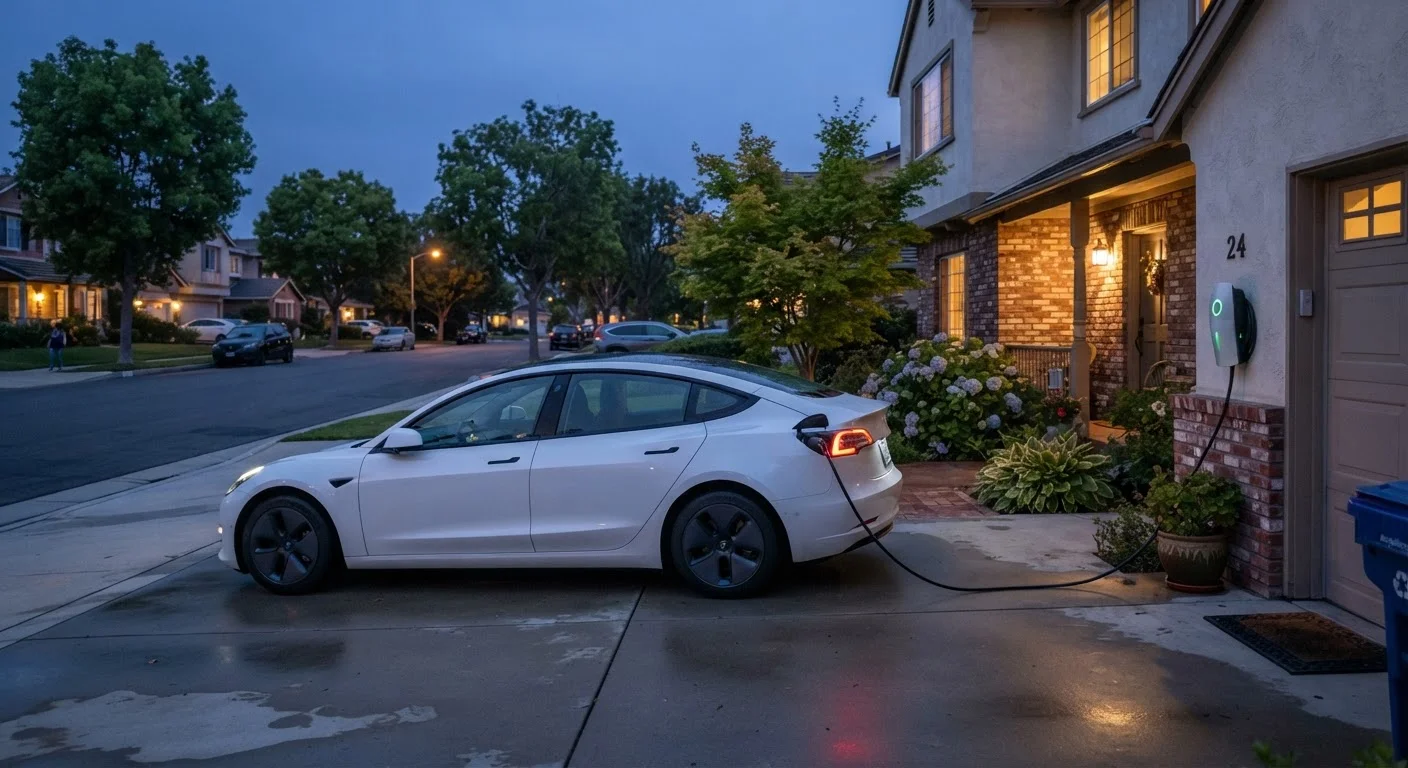
Drivers with off-street parking can install a Level 2 charger and start every day with a full battery, effectively eliminating the need for fuel stops during daily use.
Smooth, quiet daily driving experience
Instant torque delivery and a near-silent cabin make EVs particularly pleasant in stop-and-go urban commuting, a notable quality-of-life difference from combustion vehicles.
Potential tax incentives lower effective purchase price
Federal and state programs can meaningfully reduce upfront costs for eligible buyers, though income limits and vehicle eligibility rules apply - verify current rules before budgeting.
Higher upfront purchase price than comparable gas models
EVs generally command a premium over equivalent gas-powered vehicles at the point of sale, which can make the initial financial outlay a barrier even when long-term savings are favorable.
Long road trips require careful charging planning
Interstate travel often means routing around fast-charging stations and budgeting 20-40 minutes per stop, a meaningful shift in habit compared to a 5-minute gas fill-up.
Home charging not accessible to all drivers
Renters, apartment dwellers, and those without dedicated parking often lack reliable access to home charging, making them dependent on public infrastructure that varies in quality and availability.
Public charging reliability remains inconsistent
Despite network expansion, non-functional or occupied public chargers are a documented frustration among EV drivers, particularly outside major metropolitan areas.
Battery degradation affects range over many years
While modern EV batteries hold up well past 100,000 miles in most cases, gradual capacity loss is real and eventual battery replacement represents a potentially significant long-term cost.
Our Verdict
Electric vehicles are a genuinely practical daily driver for most suburban and urban households with access to home charging. The trade-offs - higher sticker prices, longer road-trip planning, and charging infrastructure gaps - are real but manageable for the right driver. Those without reliable home charging or who regularly make long interstate trips face a steeper adjustment.
Best suited to drivers with off-street parking, a predictable daily commute under 150 miles, and occasional rather than frequent long-distance travel.
What Everyday EV Ownership Actually Looks Like
The gap between the EV ownership experience portrayed in ads and the one lived by actual drivers is worth examining honestly. For the majority of American commuters - whose average one-way commute is well under 30 miles - a fully charged EV in the morning means driving all day without thinking about energy once. That convenience is real.
The picture changes depending on where you live and how your home is set up. Drivers with a garage or dedicated parking spot can install a Level 2 home charger (240-volt, similar to a dryer outlet) and wake up to a full battery every day. Renters, condo owners, or anyone relying on street parking face a fundamentally different situation - one that requires leaning on public charging infrastructure, which remains uneven across regions.
For a fuller picture of how EVs stack up against gas vehicles across fuel costs, maintenance, and range, see our practical guide to gas vs. electric vehicles.
Lower per-mile fuel costs than gasoline
Electricity typically costs less per mile than gasoline in most U.S. regions, and charging at home overnight on off-peak rates amplifies those savings further.
Significantly reduced routine maintenance
No oil changes, fewer brake replacements (thanks to regenerative braking), and a simpler drivetrain mean fewer scheduled service visits and lower maintenance bills over time.
Convenient home charging for most owners
Drivers with off-street parking can install a Level 2 charger and start every day with a full battery, effectively eliminating the need for fuel stops during daily use.
Smooth, quiet daily driving experience
Instant torque delivery and a near-silent cabin make EVs particularly pleasant in stop-and-go urban commuting, a notable quality-of-life difference from combustion vehicles.
Potential tax incentives lower effective purchase price
Federal and state programs can meaningfully reduce upfront costs for eligible buyers, though income limits and vehicle eligibility rules apply - verify current rules before budgeting.
Where EVs Create Real Friction
The honest cons of EV ownership tend to cluster around three areas: charging logistics, upfront cost, and range limitations on long trips.
Public fast-charging networks have expanded considerably, but reliability and availability are still inconsistent outside major metro corridors. A road trip that would take five hours in a gas car may require one or two planned 20-30 minute charging stops in an EV. That's manageable for many people - but it's a real change in habit.
Purchase prices for EVs generally run higher than comparable gas models, though operating costs tend to be lower over time. Understanding the full picture - depreciation, insurance, and maintenance - matters before committing. Our article on hidden costs of car ownership covers the expenses many buyers overlook regardless of powertrain.
Battery degradation over many years is also a legitimate concern, though most modern EVs retain substantial range capacity well beyond 100,000 miles based on real-world fleet data.
Higher upfront purchase price than comparable gas models
EVs generally command a premium over equivalent gas-powered vehicles at the point of sale, which can make the initial financial outlay a barrier even when long-term savings are favorable.
Long road trips require careful charging planning
Interstate travel often means routing around fast-charging stations and budgeting 20-40 minutes per stop, a meaningful shift in habit compared to a 5-minute gas fill-up.
Home charging not accessible to all drivers
Renters, apartment dwellers, and those without dedicated parking often lack reliable access to home charging, making them dependent on public infrastructure that varies in quality and availability.
Public charging reliability remains inconsistent
Despite network expansion, non-functional or occupied public chargers are a documented frustration among EV drivers, particularly outside major metropolitan areas.
Battery degradation affects range over many years
While modern EV batteries hold up well past 100,000 miles in most cases, gradual capacity loss is real and eventual battery replacement represents a potentially significant long-term cost.
Costs Over Time: The Honest Accounting
Electricity is generally cheaper per mile than gasoline, and EVs have significantly fewer moving parts - no oil changes, no transmission service, less brake wear due to regenerative braking. These savings accumulate meaningfully over years of ownership.
~3-4¢
Average cost per mile on electricity
U.S. Department of Energy estimates put average EV fuel costs at roughly 3-4 cents per mile, compared to around 10-12 cents per mile for a typical gas vehicle at national average prices.
~40%
Reduction in scheduled maintenance costs
Studies from the U.S. Department of Energy's Argonne National Laboratory have found EV maintenance costs run meaningfully lower than those for comparable internal combustion vehicles over time.
Federal tax credits and state-level incentives can reduce effective purchase prices, but eligibility rules are income-based and tied to vehicle price caps and assembly location. These rules have changed frequently - always verify current program details with the IRS or your state's DMV before factoring incentives into your budget.
If you're deciding between purchasing and leasing an EV, the calculus has some unique wrinkles. See what the numbers actually tell you about leasing vs. buying for a grounded breakdown.
Incentive Rules Change - Always Verify
Federal EV tax credit eligibility has shifted several times in recent years, with rules around income caps, vehicle MSRP limits, and battery sourcing requirements affecting who qualifies. State-level incentives vary widely and some are subject to funding limits. Before assuming a credit reduces your effective purchase price, check current IRS guidance and your state's DMV or energy office for the most up-to-date terms.
Who Should - and Shouldn't - Make the Switch
EVs are a strong fit when: you have reliable home charging, your daily driving stays well within the vehicle's stated range, and your road trips are infrequent or you're willing to plan charging stops. The daily driving experience - smooth, quiet, low-maintenance - is genuinely excellent once charging is solved.
EVs are a harder fit when: you live in an apartment without charging access, you regularly drive long distances on routes with sparse charging infrastructure, or your budget is tight and the higher purchase price creates financial strain that fuel savings won't recover quickly enough.
Neither situation is permanent. Charging infrastructure is expanding, vehicle prices are gradually coming down, and apartment complexes are increasingly adding EV charging. The math and logistics that don't work today may well work in a few years - which means it's worth revisiting the decision periodically rather than treating it as a one-time calculation.