
Smoke Detectors, CO Alarms, and Fire Extinguishers: What Every Home Actually Needs

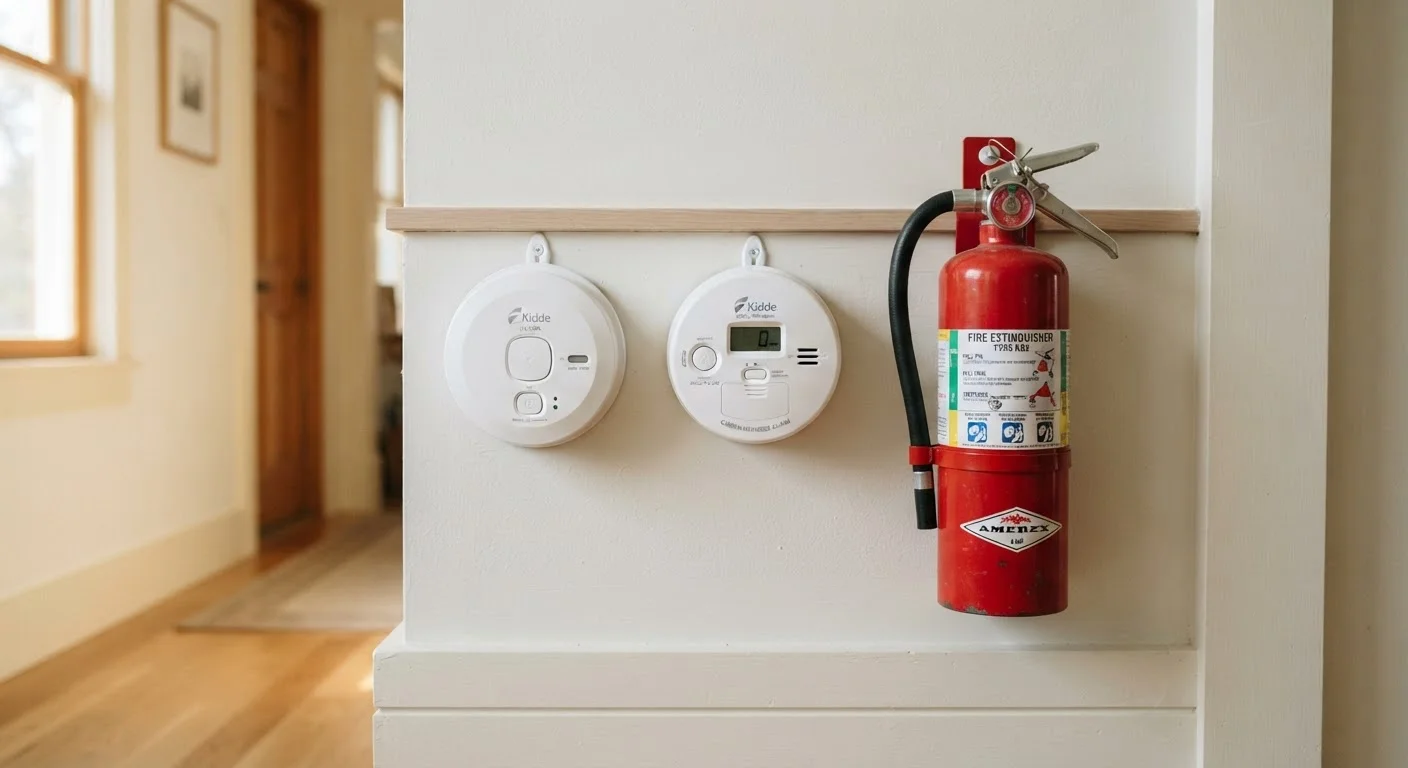
The Three Devices Every Home Should Have
Smoke detectors, carbon monoxide (CO) alarms, and fire extinguishers are not optional extras - they are the baseline safety layer for any occupied home. Yet many households either lack one of the three entirely or rely on devices that are past their useful life. This reference guide cuts through the confusion with clear, lookup-ready answers on placement, testing, and replacement.
Keep in mind that local building and fire codes vary by state and municipality. Always verify requirements with your local fire marshal or building department - what's covered here reflects widely accepted general guidance, not a legal standard for your specific address.
Smoke Detectors: Placement, Testing, and Replacement
Where to Place Them
- Every bedroom and directly outside each sleeping area
- Every level of the home, including the basement
- At least 10 feet from cooking appliances to reduce nuisance alarms
- On the ceiling or high on a wall (within 12 inches of the ceiling), since smoke rises
- Away from windows, doors, and vents where drafts could interfere
Testing Schedule
- Press the test button once a month
- Replace batteries at least once a year - or choose a 10-year sealed-battery model
- Vacuum dust from the unit twice a year using a soft brush attachment
Replacement Timeline
Smoke detectors should be replaced every 10 years from the manufacture date printed inside the unit. Sensors degrade over time regardless of how the device looks or sounds on the test button.
Ionization smoke detector
A type of smoke alarm that uses a small amount of radioactive material to detect fast-flaming fires. It responds quickly to open flames but may be slower on slow, smoldering fires.
Photoelectric smoke detector
A smoke alarm that uses a light beam and sensor to detect smoke particles, making it more responsive to slow, smoldering fires. Many fire safety organizations recommend having both types or a dual-sensor unit.
Carbon monoxide (CO)
A colorless, odorless gas produced by the incomplete combustion of fuels like gas, oil, wood, and charcoal. Exposure can be dangerous and is not detectable by human senses alone, making a CO alarm essential.
ABC extinguisher rating
A classification indicating an extinguisher can handle Class A (ordinary combustibles like wood and paper), Class B (flammable liquids), and Class C (energized electrical equipment) fires.
PASS technique
A four-step method for operating a fire extinguisher: Pull the pin, Aim at the base of the fire, Squeeze the handle, and Sweep side to side. Intended for small, contained fires only.
Carbon Monoxide Alarms: Placement, Testing, and Replacement
Where to Place Them
- On every level of the home, including the basement
- Outside each sleeping area so the alarm is audible at night
- Near (but not directly on top of) fuel-burning appliances - furnaces, water heaters, gas stoves
- At roughly breathing height (roughly knee-to-eye level on a wall) rather than ceiling height, since CO disperses more evenly in air than smoke
- Not in attached garages - vehicle exhaust will trigger constant nuisance alerts
Combination Alarms: Convenient but Not Always Sufficient
Devices that combine smoke detection and CO sensing in one unit are widely available and can simplify installation. However, placement rules for the two functions sometimes conflict - smoke detectors perform best near the ceiling, while CO sensors work well at a lower height. If you use a combination unit, follow the manufacturer's specific placement guidance. In larger or multi-story homes, dedicated separate devices may provide better coverage.
Testing Schedule
- Test monthly using the built-in test button
- Replace batteries annually unless the unit uses a sealed long-life battery
Replacement Timeline
Most CO alarms have a sensor lifespan of 5 to 7 years. Check the manufacture date on the label and follow the manufacturer's stated end-of-life date, which is typically printed on the back of the unit or in the manual.
Fire Extinguishers: Type, Placement, and Inspection
What Type to Keep at Home
For general household use, a multi-purpose dry chemical extinguisher rated ABC is the standard recommendation. This rating means it can handle ordinary combustibles (Class A), flammable liquids (Class B), and electrical fires (Class C).
3 of 5
Home fire deaths occur in homes with no working smoke alarms
According to the National Fire Protection Association's analysis of home fire fatalities.
~430
Estimated annual U.S. CO poisoning deaths from non-fire sources
Based on Centers for Disease Control and Prevention estimates for unintentional, non-fire CO exposure.
10 years
Maximum recommended lifespan for a smoke detector
Sensors degrade over time; the manufacture date on the unit determines the replacement schedule.
Where to Place Them
- The kitchen is the highest-priority location - mount it near an exit, not directly next to the stove, so you can grab it without reaching through flames
- The garage, particularly if fuel or power tools are stored there
- Each additional floor or workshop area in larger homes
Inspection and Replacement
- Check the pressure gauge monthly - the needle should be in the green zone
- Have a professional inspect it annually
- Recharge or replace immediately after any use, even partial discharge
- Most household extinguishers have a service life of 5 to 12 years depending on the model; check the label
Knowing how to use an extinguisher matters as much as having one. The widely used memory aid is PASS: Pull the pin, Aim at the base of the fire, Squeeze the handle, Sweep side to side. Only attempt to fight a small, contained fire - if a fire grows or blocks your exit, leave immediately and call 911.
For more on maintaining the everyday devices in your home, see our guide to keeping home devices running smoothly. And if you're thinking about adding connected smoke or CO detectors, learn what smart home technology actually means before you shop.
This article provides general home safety information for educational purposes only. Requirements for smoke detectors, CO alarms, and fire extinguishers vary by location. Always consult your local fire department, building code authority, or a licensed professional to confirm what your home specifically requires.