

Key Takeaways
- Tankless water heaters cost significantly more upfront but can lower energy bills over time.
- Traditional tank heaters are cheaper to install and easier to replace but store limited hot water.
- Tankless units typically last 20 years; tank models average 8-12 years.
- Your household's peak hot water demand is the single most important factor in choosing a type.
- Both types require professional installation; gas models may need venting or gas line upgrades.
Option A
Tankless Water Heater
The on-demand, space-saving modern option.
Best for: Households with moderate, predictable hot water usage looking to reduce long-term energy costs.
Option B
Traditional Tank Water Heater
The reliable, widely understood workhorse.
Best for: Homeowners seeking lower upfront costs and straightforward installation with minimal maintenance complexity.
If you want to minimize upfront installation costs
Traditional Tank Water Heater
Tank heaters are widely available and less expensive to purchase and install, making them a practical choice when budget is the primary concern.
If you want lower long-term energy costs and have a smaller footprint
Tankless Water Heater
Tankless units only heat water when needed, which can reduce standby energy loss significantly over years of use.
If your household uses hot water heavily and simultaneously
Traditional Tank Water Heater
A large-capacity tank can meet simultaneous demand from multiple fixtures without the flow-rate limitations of a single tankless unit.
If you're planning to stay in your home long term
Tankless Water Heater
The longer lifespan and ongoing energy savings tend to offset the higher initial investment over a decade or more.
If you need a quick, like-for-like replacement in an emergency
Traditional Tank Water Heater
Tank units are stocked at most supply stores and can usually be installed without major infrastructure changes, reducing downtime.
How Each System Works
Understanding the basic mechanics helps set realistic expectations for either system.
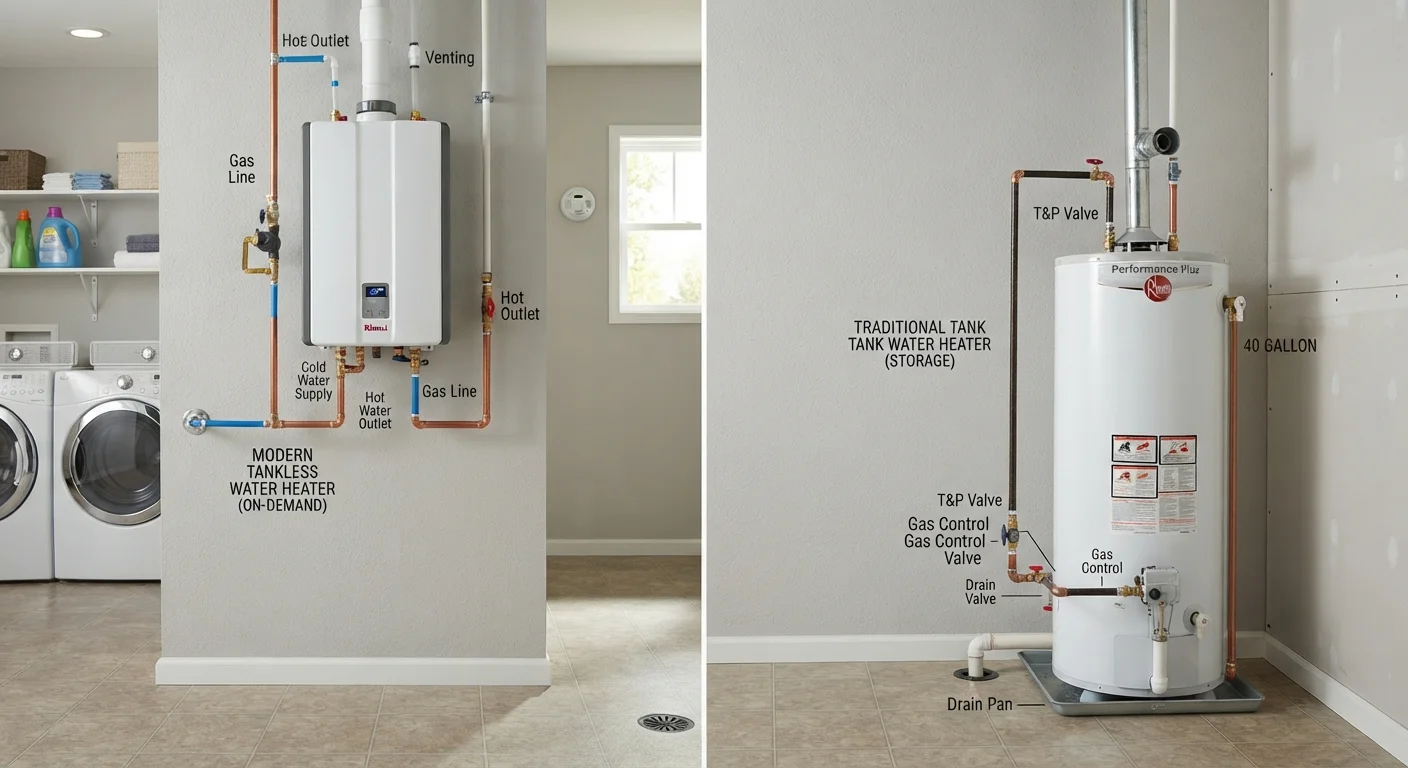
A traditional tank water heater stores a set volume of water - commonly 40 to 80 gallons - and keeps it heated continuously, ready to use whenever a tap opens. Once that stored supply is depleted, you wait for the tank to reheat. This constant heating, even when no hot water is being used, is called standby heat loss, and it represents ongoing energy consumption.
A tankless water heater (sometimes called an on-demand or instantaneous heater) has no storage tank. Instead, it heats water directly as it flows through the unit using powerful electric elements or a gas burner. Hot water is available almost immediately, but the unit can only heat water at a fixed rate - measured in gallons per minute (GPM). Running multiple high-demand fixtures at once can strain a single unit.
| Criterion | Tankless Water Heater | Traditional Tank Water Heater |
|---|---|---|
| Upfront Cost | Higher ($500-$2,000+ unit cost) | Lower ($300-$900 unit cost) |
| Installation Cost | Often higher; may need upgrades | Generally lower; simpler swap |
| Energy Efficiency | Higher; no standby heat loss | Lower; continuous standby use |
| Hot Water Supply | Unlimited, rate-limited by GPM | Limited to tank capacity |
| Typical Lifespan | ~20 years | 8-12 years |
| Space Required | Wall-mounted; compact | Large footprint; floor standing |
| Maintenance Complexity | Moderate; descaling required | Low; periodic flushing |
Cost: Upfront, Installation, and Long-Term
Cost is usually where the comparison gets complicated - because the two types behave very differently across time.
Upfront and installation: Traditional tank heaters are substantially less expensive to purchase. Installation is often straightforward if you're replacing a like-for-like unit. Tankless systems carry a higher purchase price, and installation costs can increase further if your home needs new gas lines, upgraded electrical panels, or revised venting - which is common in older homes.
Operating costs: Because tankless heaters eliminate standby heat loss, they can use less energy per unit of hot water produced. The actual savings depend on your local energy rates, fuel type (gas tends to cost less than electricity in most U.S. regions), and how much hot water your household uses. Homes with very high usage sometimes see smaller per-unit savings because the unit runs nearly continuously anyway.
24-34%
Potential energy savings for average households
The U.S. Department of Energy estimates tankless water heaters can be 24-34% more energy efficient than tank models for homes using 41 gallons or less of hot water daily.
8-12 years
Average lifespan of a traditional tank water heater
Most manufacturers and plumbing industry sources cite this range under typical residential conditions with standard maintenance.
~$1,000+
Typical additional installation cost for tankless
Conversion from a tank to a tankless system often involves gas line, venting, or electrical upgrades that add to the base installation fee.
Maintenance: Both types benefit from periodic flushing to remove mineral buildup, particularly in areas with hard water. Tankless units may require descaling more frequently and can have more complex components to service.
Lifespan, Space, and Practical Fit
A tankless unit typically lasts around 20 years with proper maintenance - roughly twice the 8-12 year average lifespan of a conventional tank heater. Over a 20-year period, you may replace a tank unit at least once, which affects the true cost comparison.
Space is another meaningful difference. Tank heaters require a dedicated footprint - often in a utility closet, garage, or basement - and clearance on all sides. Tankless units mount on the wall and take up a fraction of that space, which can matter in smaller homes or when reclaiming storage space.
If you're also considering energy-saving upgrades elsewhere in your home, pairing a more efficient water heater with a programmable thermostat strategy can compound savings. Our look at what smart thermostats actually do covers how those devices interact with broader home energy use - a useful read when planning multiple upgrades at once.
Hard Water Can Affect Both Types
Homes in regions with hard water - water that contains high levels of dissolved minerals - face faster mineral buildup in both tank and tankless heaters. Tankless units are particularly sensitive because scale can accumulate on the heat exchanger, reducing efficiency and potentially shortening lifespan. A water softener or periodic descaling service can help. Ask a plumber about your local water quality before choosing a system.
Making the Right Call for Your Home
No single type is universally better. The right choice depends on your household's specific situation.
Consider these practical questions before deciding:
- How many people live in your home? Larger households with overlapping hot water use (showers, laundry, dishwashers running simultaneously) may find a high-capacity tank more reliable than a single tankless unit.
- How long do you plan to stay? The higher upfront cost of a tankless system tends to make more financial sense if you have a long horizon in the home.
- What fuel source do you have? Gas tankless heaters typically deliver higher flow rates than electric models and often cost less to operate. If your home only has electric service, your options and payback period shift accordingly.
- What does your local infrastructure require? Always consult a licensed plumber before committing. In many jurisdictions, water heater installation or replacement requires a permit and inspection - verify requirements with your local building department.
This article provides general home information for educational purposes and is not a substitute for advice from a licensed plumbing professional. Always consult a qualified contractor and check local permit requirements before replacing or installing a water heater.