

Key Takeaways
- Smart thermostats let you control home temperature remotely and on a schedule, but they don't automatically optimize energy use.
- The advertised energy savings are real for some households but depend heavily on how inconsistent your current heating and cooling habits are.
- Most smart thermostats require a compatible HVAC system and a Wi-Fi connection to function fully.
- The learning features work best when your schedule is consistent — irregular routines can confuse the algorithm.
- Setup is straightforward for many homes, but older systems or rentals may need professional help.
Remote access prevents wasted heating and cooling
Adjusting the temperature from your phone when plans change — leaving work early or arriving home late — means the system runs only when needed, without relying on memory.
App-based scheduling is genuinely easier to use
Compared to the cryptic button sequences on traditional programmable thermostats, smartphone apps make it straightforward to set and revise weekly schedules in minutes.
Energy usage reports add visibility
Many models show daily and monthly energy use in plain charts, which helps identify unexpected patterns — like the system running overnight when it shouldn't.
Occupancy detection reduces waste automatically
Motion-sensing models can detect an empty house and shift to an energy-saving mode without requiring you to remember to activate it manually.
Integrates with voice assistants and home systems
Most smart thermostats work with common voice platforms, allowing quick temperature adjustments as part of a broader connected home setup.
Learning algorithms struggle with irregular schedules
The auto-learning feature builds expectations based on past behavior. If your routine varies significantly, the thermostat may heat or cool the home at the wrong times, requiring frequent manual overrides.
Compatibility with older HVAC systems isn't guaranteed
Homes with two-wire or high-voltage heating systems, certain heat pumps, or multi-zone setups may be incompatible with standard smart thermostat models without additional hardware or professional help.
Energy savings depend heavily on prior habits
Households that already use programmable schedules see minimal additional savings. The biggest gains go to those who previously made no schedule adjustments at all.
Relies on continuous Wi-Fi to function fully
Remote access, app controls, and cloud-based features stop working during internet outages. Manual on-device control still works, but the smart features are unavailable.
Setup can require professional installation
Missing C-wire connections or complex multi-zone HVAC systems may make DIY installation impractical, adding cost that narrows the financial case for upgrading.
Our Verdict
Smart thermostats deliver genuine value for homeowners with compatible HVAC systems and reasonably consistent daily schedules. The remote access and scheduling features alone justify the upgrade for many households. However, the marketing around automatic savings and effortless learning overstates how hands-off the experience actually is — most people need to invest some time in setup and fine-tuning to see real benefits.
Best for homeowners who frequently forget to adjust the thermostat, travel regularly, or want more granular control over their home's heating and cooling without a major system overhaul.
What a Smart Thermostat Actually Does
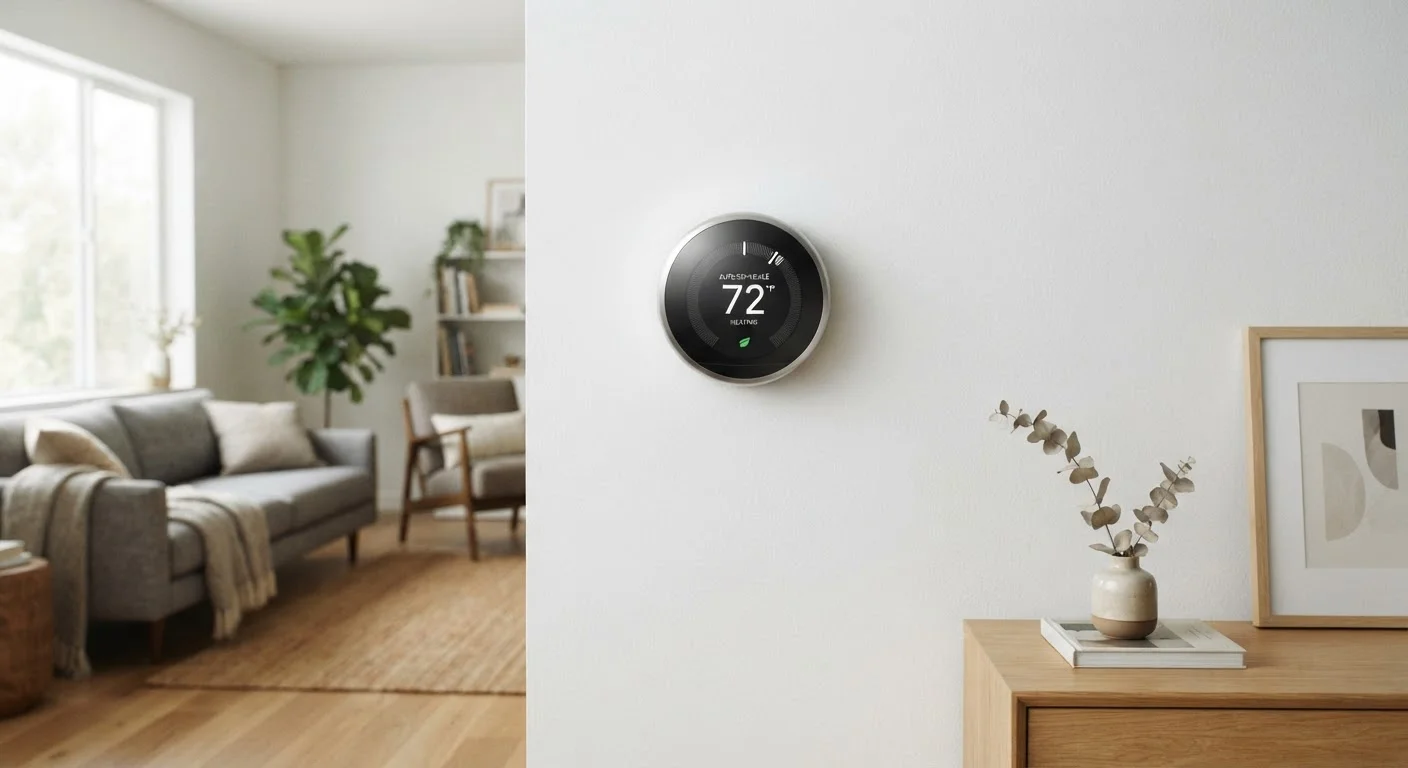
At its core, a smart thermostat is a programmable thermostat with a Wi-Fi connection. It lets you set heating and cooling schedules, adjust settings remotely via a smartphone app, and — in many models — track your energy usage over time. Some models include motion sensors and can detect when no one is home, automatically dialing back the temperature to save energy.
That's genuinely useful. The remote access feature alone solves a real problem: forgetting to turn down the heat before a long trip. And scheduling, while not new, is far easier to set up through a modern app than the confusing button sequences on older programmable models.
For more context on how these devices fit into a broader connected home, see what a smart home actually is.
What the Marketing Oversells
Ads often imply that a smart thermostat will learn your preferences and quietly slash your energy bill without any effort on your part. The reality is more conditional.
The learning feature — where the thermostat observes your manual adjustments and builds a schedule around them — works well if your household follows a consistent routine. If your schedule changes week to week, the algorithm can produce erratic results, overcooling on a day you're home or failing to warm the house before an early morning when you've varied your wake time.
~10–12%
Estimated heating savings for eligible households
Independent analyses of smart thermostat programs suggest heating cost reductions in this range for homes that previously used no scheduling.
~15%
Estimated cooling savings for eligible households
Cooling savings tend to be slightly higher than heating savings, largely because air conditioning is more responsive to shorter on/off cycles.
Energy savings are real but variable. Studies suggest savings of around 10–12% on heating and 15% on cooling for households that previously had no schedule at all — but homes that already used a programmable thermostat see much smaller gains. The baseline matters enormously.
If you're also evaluating other areas of home efficiency, it's worth understanding what HVAC filters actually do, since a poorly maintained system limits any thermostat's impact.
The Pros and Cons, Plainly Stated
Here's an honest breakdown of where smart thermostats earn their keep — and where they fall short of the pitch.
Remote access prevents wasted heating and cooling
Adjusting the temperature from your phone when plans change — leaving work early or arriving home late — means the system runs only when needed, without relying on memory.
App-based scheduling is genuinely easier to use
Compared to the cryptic button sequences on traditional programmable thermostats, smartphone apps make it straightforward to set and revise weekly schedules in minutes.
Energy usage reports add visibility
Many models show daily and monthly energy use in plain charts, which helps identify unexpected patterns — like the system running overnight when it shouldn't.
Occupancy detection reduces waste automatically
Motion-sensing models can detect an empty house and shift to an energy-saving mode without requiring you to remember to activate it manually.
Integrates with voice assistants and home systems
Most smart thermostats work with common voice platforms, allowing quick temperature adjustments as part of a broader connected home setup.
Learning algorithms struggle with irregular schedules
The auto-learning feature builds expectations based on past behavior. If your routine varies significantly, the thermostat may heat or cool the home at the wrong times, requiring frequent manual overrides.
Compatibility with older HVAC systems isn't guaranteed
Homes with two-wire or high-voltage heating systems, certain heat pumps, or multi-zone setups may be incompatible with standard smart thermostat models without additional hardware or professional help.
Energy savings depend heavily on prior habits
Households that already use programmable schedules see minimal additional savings. The biggest gains go to those who previously made no schedule adjustments at all.
Relies on continuous Wi-Fi to function fully
Remote access, app controls, and cloud-based features stop working during internet outages. Manual on-device control still works, but the smart features are unavailable.
Setup can require professional installation
Missing C-wire connections or complex multi-zone HVAC systems may make DIY installation impractical, adding cost that narrows the financial case for upgrading.
Compatibility is a key practical hurdle. Most smart thermostats require a C-wire (common wire) — a continuous power line that older HVAC systems may not have. Some manufacturers include adapter kits, but if your system lacks one, installation may require an electrician. Renters should also verify that their lease allows thermostat replacement.
Setting Realistic Expectations Before You Buy
The honest question to ask isn't "will this save me money?" — it's "do my current habits waste energy that a schedule would recover?" If you already manually adjust your thermostat every morning and evening, a smart thermostat's automation value shrinks considerably. If you routinely leave the heat running at full blast while you're at work, the math is much more favorable.
Renters: Check Before You Install
Many leases require landlord approval before replacing thermostats, and some prohibit it entirely. Even where installation is allowed, you may be required to reinstall the original unit when you move out. Check your lease and get written permission if needed before purchasing a smart thermostat for a rental property.
Privacy is another consideration that doesn't appear in product brochures. Smart thermostats collect occupancy data and usage patterns. This data is generally used to improve scheduling algorithms, but it's worth reading your device's privacy policy. For a deeper look at how connected devices handle data, see common smart home privacy misconceptions.
If you're still deciding where to start with connected home devices, smart thermostats, plugs, and lighting compared walks through the entry points side by side.