

Key Takeaways
- HVAC filters serve two purposes: protecting equipment and improving indoor air quality.
- MERV ratings indicate filtration efficiency - higher isn't always better for every system.
- A filter that's too restrictive can reduce airflow and strain your HVAC unit.
- Replacing filters on schedule is one of the simplest ways to extend system lifespan.
- Filter choice should match both your household needs and your system's design specifications.
HVAC Filter
An HVAC filter is a replaceable barrier placed inside your heating, ventilation, and air conditioning system to trap airborne particles before they pass through the equipment. It protects both the mechanical components of your HVAC unit and the air circulating through your home. Filters are rated by how effectively they capture particles of different sizes.
Filter efficiency is measured by the Minimum Efficiency Reporting Value (MERV) scale, which ranges from 1 to 16 for residential use; higher numbers capture smaller particles but also restrict airflow more significantly.
What an HVAC Filter Actually Does
Your HVAC system pulls air from your home through return vents, conditions it, and pushes it back out through supply vents. Every time that air moves through the system, it carries whatever is floating in it - dust, pet dander, pollen, mold spores, and more. The filter sits at the intake point and acts as a physical barrier, catching those particles before they reach the blower, evaporator coil, and other internal components.
This serves two distinct functions. First, it keeps your equipment clean. Dust that builds up on the evaporator coil acts as insulation, making it harder to transfer heat and forcing the system to run longer cycles. Second, it improves the air quality in your home by removing contaminants from the airstream before they're redistributed through your vents.
These two goals sometimes pull in opposite directions - which is why filter selection matters more than most homeowners realize.
Understanding MERV Ratings
The MERV scale (Minimum Efficiency Reporting Value) gives filters a number from 1 to 16 in residential applications. A higher number means the filter captures smaller particles more effectively.
MERV 8
Minimum recommended rating for most households
The U.S. Department of Energy notes that pleated filters rated MERV 7-13 offer a reasonable balance of filtration efficiency and airflow for typical residential systems.
1-3 months
Typical replacement interval for standard filters
HVAC industry guidance generally recommends replacing standard 1-inch filters every one to three months, with shorter intervals for homes with pets or high dust levels.
Up to 15%
Potential efficiency loss from dirty coils
According to the U.S. Department of Energy, dust and debris buildup on evaporator coils can reduce HVAC efficiency, contributing to higher energy use over time.
- MERV 1-4: Basic fiberglass filters. Catch large debris and protect equipment minimally. Low cost, low performance.
- MERV 5-8: Pleated filters that capture dust, pollen, mold spores, and pet dander. A practical choice for most households.
- MERV 9-12: Higher-efficiency pleated filters that also trap finer dust and some smoke particles. Often suitable for households with allergy concerns.
- MERV 13-16: Near-hospital-grade filtration capturing very fine particles. Typically used in medical or commercial settings; may require system modifications for residential use.
The most important thing to know: a filter rated higher than your system is designed to accommodate restricts airflow. That forces the blower motor to work harder, raises energy consumption, and shortens component life.
Match Filter Rating to System Specs First
Before purchasing a higher-MERV filter, check your HVAC unit's manual or the existing filter label for the manufacturer's recommended range. Installing a filter outside that range - even a higher-quality one - can restrict airflow and strain the system. When in doubt, a licensed HVAC technician can advise on the best rating for your specific equipment.
How the Wrong Filter Costs You Money
An undersized or low-quality filter lets debris reach your equipment. Over time, a dirty evaporator coil or clogged blower can reduce system efficiency by a measurable margin - and repairs for those components aren't cheap. A filter that's too restrictive creates a different problem: reduced static pressure causes the system to strain, leading to higher electricity bills and premature wear.
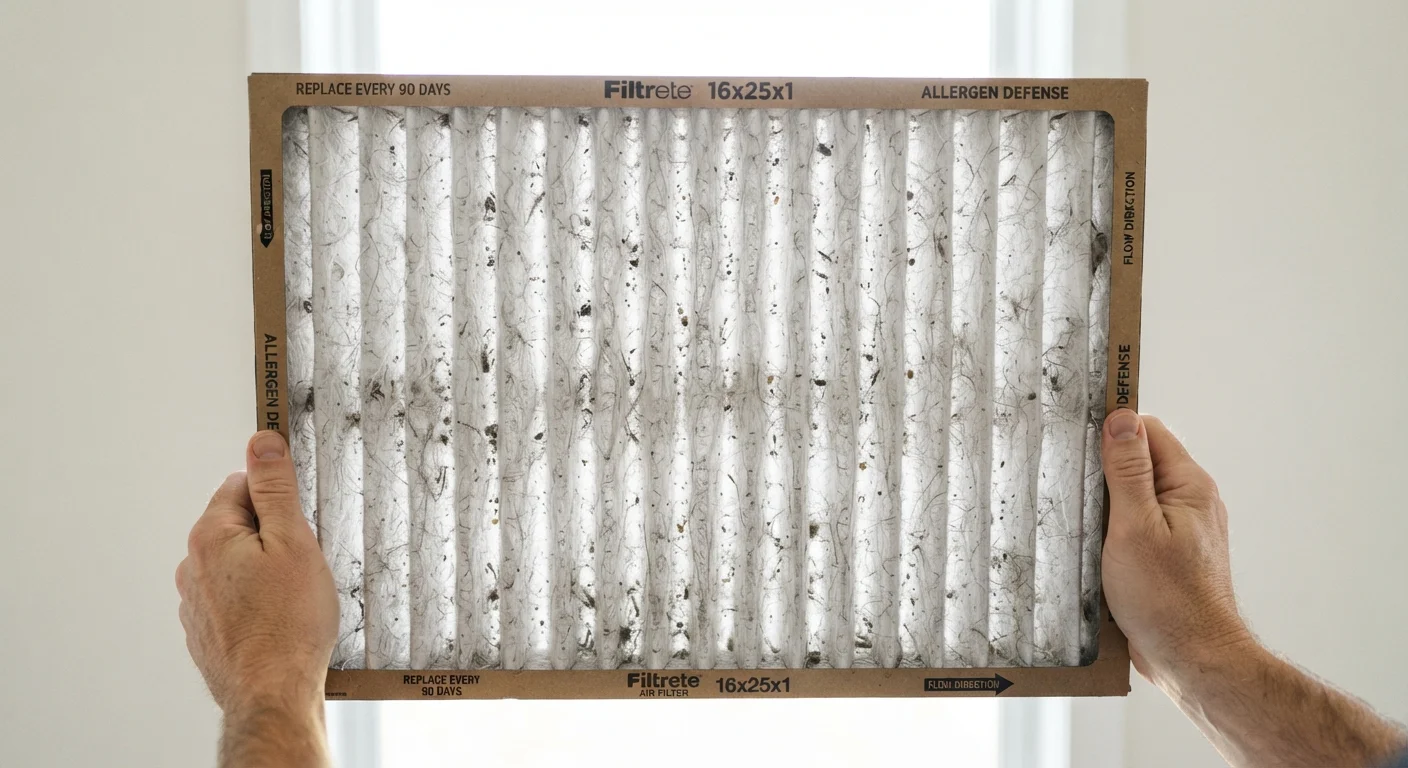
Then there's the clogged-filter scenario. A filter that isn't replaced on schedule becomes a restriction all on its own, regardless of its original rating. At that point, some air bypasses the filter entirely through gaps around the frame, defeating the purpose of having one.
For context on how your thermostat and HVAC system work together as a whole, see our explanation of smart thermostat capabilities.
Choosing the Right Filter for Your Home
The right filter balances air quality needs with your system's airflow requirements. Start by checking your HVAC manual or the label on your existing filter for the recommended MERV range. From there, consider your household:
- If you have pets or live with someone who has allergies, a MERV 8-11 pleated filter is a reasonable upgrade from basic fiberglass.
- If nobody in the household has respiratory sensitivities and your home is low-dust, a MERV 7-8 filter changed on schedule performs reliably.
- If you're considering MERV 13 or above, consult an HVAC technician first to confirm your system can handle the added resistance without modification.
Filter size also matters - an ill-fitting filter allows unfiltered air to bypass it entirely. Measure your existing filter or check the slot dimensions before purchasing a replacement.
Filter Size Must Match Exactly
HVAC filters are labeled with three dimensions: length, width, and thickness. Even a quarter-inch gap between the filter and its housing allows unfiltered air to bypass the media entirely. Always measure your existing filter or the slot dimensions before buying a replacement, and check that the actual filter size matches the labeled size - some products run slightly smaller than their nominal measurement.
This article is for general informational purposes only. For guidance specific to your HVAC system or health needs, consult a qualified HVAC technician or healthcare professional as appropriate.