

Key Takeaways
- Young children need simple, physical systems - not complex rules - to put things away consistently.
- Expecting kids to maintain adult-level organization sets everyone up for frustration and failure.
- Rotation, not accumulation, is the most underused strategy for managing toy and activity clutter.
- Involving children in setting up systems increases the chance they'll actually use them.
- Regular, short tidy sessions work far better than infrequent deep-clean overhauls in family homes.
Why Organizing With Kids Feels Like Starting Over Every Day
Most parents have experienced it: you spend a Saturday getting the playroom under control, and by Monday it looks like it never happened. The instinct is to blame the kids - or yourself. But the real issue is usually that the organizing system was designed for adults, not for the way children actually move through a home.
Children are developmentally wired to explore, scatter, and abandon. That's not defiance - it's how they learn. The goal of family organization isn't to eliminate mess entirely; it's to create systems that make clean-up easier and more intuitive for small hands and short attention spans. If your current setup requires remembering rules, reading labels, or multi-step sorting, it's probably working against you.
This list breaks down the specific things parents most often underestimate - and what to do instead. For a broader room-by-room approach, see our complete home organization walkthrough.
Underestimating how simple 'away' needs to be
Adults can remember that craft supplies go in the second drawer of the blue cabinet. Kids generally cannot - and shouldn't be expected to. For children under eight, "away" needs to be one motion: drop it in the bin, push it on the shelf, hang it on the hook. The moment a system requires two or more steps, it stops being used.
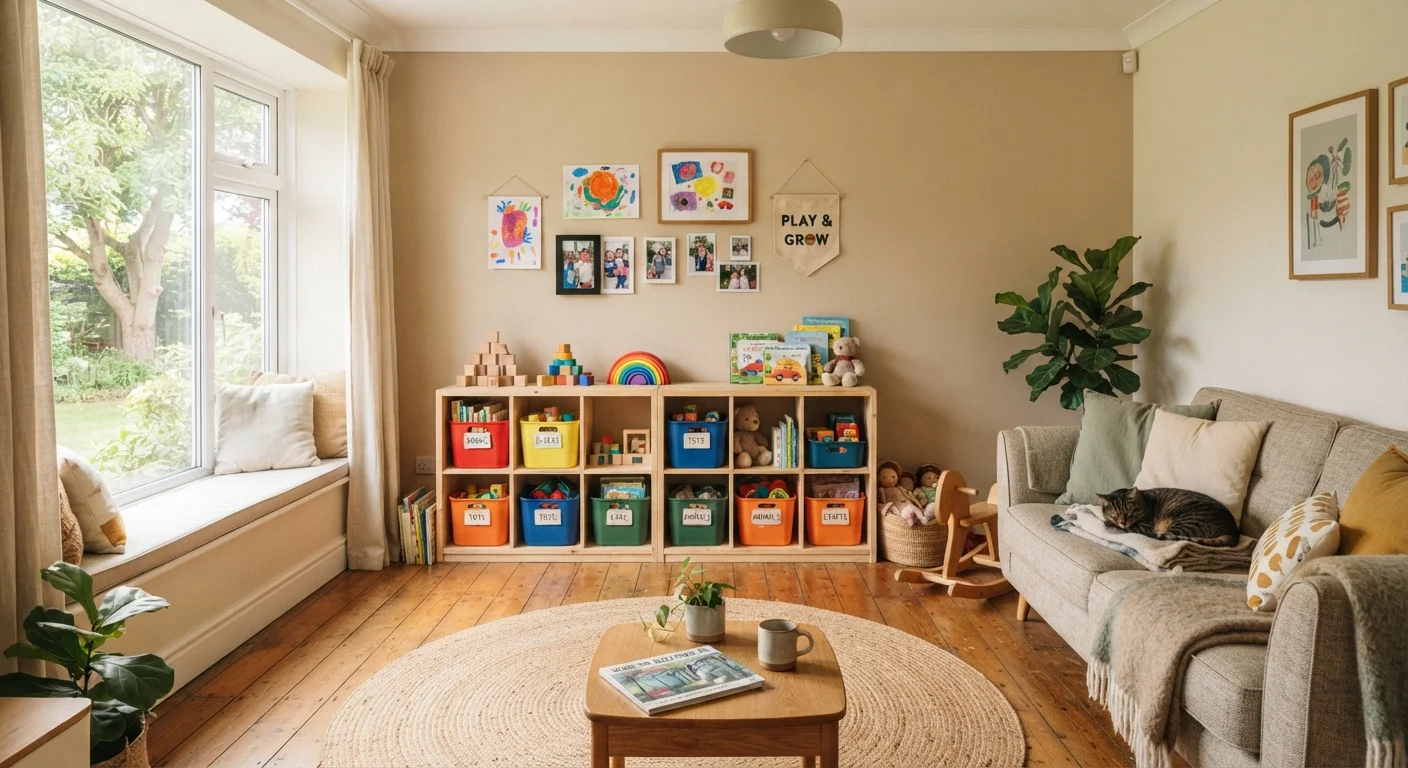
Audit your current setup by asking: can a six-year-old return this item independently without asking for help? If the answer is no, simplify the container, lower the shelf, or reduce the categories. Large, open bins with picture labels (not just text) are often more effective than lidded, sorted storage in children's spaces.
If a six-year-old can't put it away alone, the system is too complicated.
Underestimating how much stuff accumulates
Gifts from grandparents, birthday party favors, school art projects, happy-meal toys - children's possessions multiply at a pace that surprises most parents. Without a regular outflow strategy, even a well-organized space becomes overwhelmed within a few months.
A practical approach is the "one-in, one-out" principle: when a new item enters the home, something comparable leaves - donated, discarded, or passed on. This isn't about deprivation; it's about keeping the volume of things manageable. You can learn more about concepts like this in our plain-English guide to home organization terms.
Without an outflow strategy, even a tidy home becomes overwhelmed within months.
Underestimating the power of toy rotation
Having fewer toys accessible at any given time tends to increase engagement, not decrease it. Toy rotation - storing a portion of toys out of sight and swapping them in every few weeks - reduces clutter on the floor, makes clean-up faster, and often reignites children's interest in toys they'd previously ignored.
Start with two or three boxes. Keep one set out, store the rest in a closet or under a bed. Rotate on a schedule that suits your family, whether that's every two weeks or every month. Children rarely notice what's missing; they notice what's new.
Toy rotation reduces floor clutter and often makes old toys feel exciting again.
Underestimating the value of involving kids in setup
Systems adults design and impose rarely survive contact with the children meant to use them. When kids help decide where things live - even in small ways, like choosing a bin color or picking the hook for their backpack - they develop a sense of ownership that makes them more likely to maintain the system.
This doesn't mean handing over full control. It means offering limited choices: "Should the art supplies go on this shelf or that one?" Children who helped create a system will often remind you when something is out of place, which is a notable change from the typical dynamic.
Children who help design organizing systems are more likely to use them consistently.
Underestimating how often small resets beat big cleanups
Many families save tidying for the weekend, when there's more time. The problem is that five days of accumulation takes far longer to address than a ten-minute daily reset. Short, consistent tidy windows - before dinner, before bed, after school - prevent clutter from compounding into an overwhelming project.
Frame these as a family activity, not a chore imposed on children. Setting a timer for ten minutes and tidying alongside kids normalizes the habit and makes it far less daunting. Over time, short resets become reflexive rather than something anyone needs to be reminded about.
A daily ten-minute reset prevents clutter from becoming a weekend-long undertaking.
Underestimating how paper compounds the chaos
School permission slips, artwork, reading logs, birthday invitations - paper flows into family homes at a remarkable rate. Without a processing system at the door or a designated landing spot, paper spreads across counters, tables, and bags, mixing with junk mail and receipts.
A simple vertical sorter near the entry point - with slots for "action needed," "keep," and "recycle" - can prevent most paper buildup before it starts. For a deeper look at this specific challenge, our article on why paper clutter piles up covers the patterns and fixes in detail.
A simple paper sorter at the door stops school and household paper from spreading everywhere.
Building Systems That Last Beyond the Weekend
The most durable family organization systems share one quality: they require very little willpower to maintain. When clean-up is obvious and effortless, kids participate. When it involves remembering where things go or matching lids to containers, it quietly falls apart - which is often why organizing efforts don't stick long-term in family households.
Make the Reset Visible and Rewarding
Post a simple visual checklist at child height showing the three or four steps of the daily tidy routine - put toys in bins, hang up backpack, shoes on the rack. Younger children respond well to visual cues, and checking off steps gives the task a satisfying endpoint. Keep the list short enough to complete in under ten minutes.
Start small. Choose one zone - a coat closet, a homework corner, or a single toy shelf - and get that working before expanding. A modest system that holds is worth far more than an elaborate one that collapses under daily family life.