

Key Takeaways
- Tackling one room at a time prevents overwhelm and builds lasting habits.
- Every room has a unique function that should drive its organization strategy.
- Regular, small maintenance efforts outperform infrequent deep-decluttering sessions.
- Labeling and zones make systems easier for all household members to follow.
- Shared spaces require agreed-upon systems to stay consistently tidy.
Why a Room-by-Room Approach Works
Whole-home organization projects have a way of stalling before they start. When everything feels like a priority, nothing gets done. A room-by-room framework solves this by breaking the job into completable, visible wins - and each finished room builds momentum for the next.
The key insight is that each room serves a distinct purpose, and its organization should reflect that function. A kitchen demands fast access to frequently used tools; a bedroom prioritizes calm and sleep hygiene; a bathroom rewards vertical space use. One-size-fits-all storage advice rarely lands because it ignores these differences.
If you live in a smaller footprint, many of these principles scale down easily - our guide to organizing small apartments covers space-specific adaptations in detail. For those starting from a bare or newly moved-in home, pairing organization with a thoughtful décor plan can make both feel less daunting - see the complete approach to decorating a home from scratch.
Complete One Room Before Moving On
Resist the urge to work on multiple rooms simultaneously. Finishing one space - even a small bathroom - gives you a tangible reference point for what 'organized' looks and feels like in your home. That clarity makes every subsequent room faster and easier to tackle.
Kitchen: Command Center of the Home
The kitchen generates more daily friction than any other room. Addressing it first delivers the greatest immediate return on your effort.
Start With a Full Drawer Audit
Empty every drawer and cabinet. Sort items into three categories: daily use, occasional use, and rarely or never used. Rarely used items belong in higher cabinets or deep storage; daily-use tools should occupy the most reachable zones near the stove and prep area.
Zone Your Counters
Divide counter space into functional zones - a prep zone, a coffee/beverage station, and an appliance zone. Keeping each zone dedicated prevents the creep of unrelated clutter. Appliances you use fewer than twice a week can live inside a cabinet.
Pantry and Food Storage
Group pantry items by category (grains, canned goods, snacks, baking supplies) and store them at eye level or below. Decanting dry goods into clear containers is optional but helps with quick visual inventory checks before grocery runs.
25%
Homeowners who can't find items in their own home
According to consumer research cited in home organization industry reports, roughly one in four adults regularly struggles to locate household items.
40%
Of household clutter attributed to paper and mail
Industry estimates suggest paper - mail, documents, magazines - accounts for a large share of visible clutter in most American homes.
10 min
Daily reset time to maintain an organized home
Professional organizers commonly recommend a short daily reset as a more effective maintenance strategy than infrequent deep-decluttering sessions.
Bedroom and Closet: Rest Starts With Order
Clutter in a bedroom has been associated with disrupted sleep and elevated stress in several behavioral studies, though individual experiences vary. The goal here is a visual environment that signals rest rather than task completion.
The Closet First Rule
Before organizing any surface in the bedroom, tackle the closet. When storage overflow from the closet lands on chairs, floors, and nightstands, the room never truly looks tidy. Start by removing everything, discarding items that no longer fit or get worn, and grouping what remains by type - tops, bottoms, outerwear, shoes.
Nightstand and Surfaces
Limit nightstand items to what you genuinely use each night: perhaps a lamp, a book, and a glass of water. A small drawer or tray corrals the rest. Under-bed storage is suitable for off-season items in flat, lidded bins - not as a catch-all for things without a permanent home.
Hang a full-length mirror on the inside of your closet door to eliminate the need for a freestanding mirror and immediately open up floor space in the bedroom.
Dual-purpose solutions are the cornerstone of effective small-space organization; a door mirror serves a functional need without consuming any floor real estate.
Store folded clothes vertically (the 'file folding' method) in drawers rather than stacking them. Every item stays visible and accessible without disturbing the rest.
Stacked folding causes a cascade effect - pulling one item disrupts the pile. Vertical storage eliminates that friction and makes it easier to put laundry away quickly.
When organizing the kitchen, store items as close as possible to where they are first used - not where they feel most logical in the abstract.
Proximity to point of use reduces the micro-decisions and extra steps that erode habits over time, making it easier to maintain a system without thinking about it.
Bathroom: Small Space, Big Impact
Bathrooms are high-traffic rooms with limited square footage. Vertical storage - over-the-toilet shelving, cabinet door organizers, and tiered drawer dividers - makes the biggest difference here.
Expire and Edit Ruthlessly
Check expiration dates on medications, sunscreens, and skin care products before organizing. The bathroom often becomes a graveyard for half-used products. Keeping only what you actively use prevents overcrowding immediately.
Under-Sink Organization
Use stackable bins or a two-tier shelf riser under the sink to reclaim vertical depth. Group items by person or by use - cleaning supplies separate from personal care. A small lazy Susan works well for product bottles that get pushed to the back.
For a room where décor and function intersect closely, see our guide to arranging furniture in tight spaces - many of the spatial logic principles apply directly.
Don't Buy Storage Before Decluttering
A common and costly mistake is purchasing bins, baskets, and organizers before sorting out what you actually need to store. Buying containers first typically results in organizing clutter rather than eliminating it. Always declutter a space fully before measuring and shopping for storage solutions.
Living and Common Areas: Taming Shared Spaces
Living rooms, hallways, and dining areas are where household members converge - and where clutter tends to accumulate fastest. Unlike private rooms, these spaces require systems that work for everyone who uses them.
Anchor Points and Drop Zones
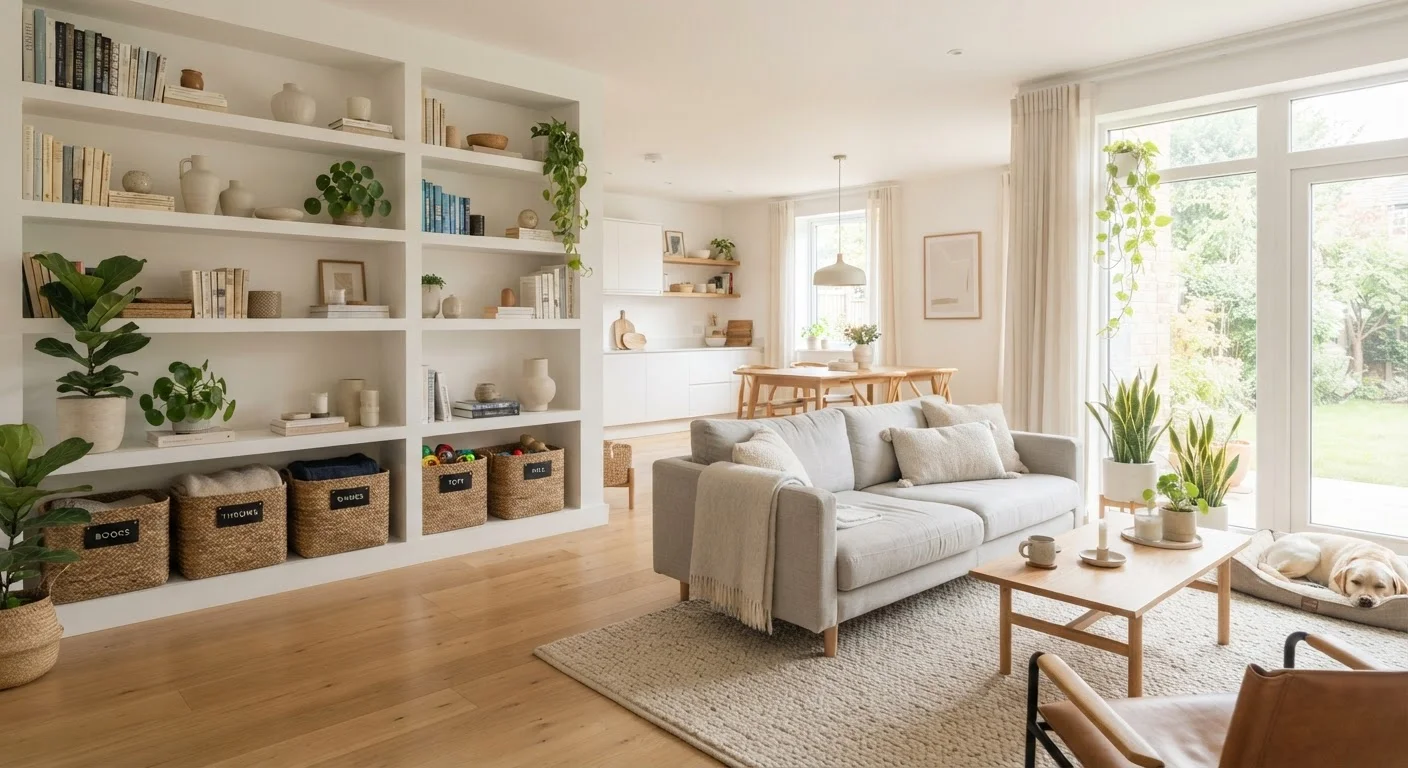
Create intentional drop zones near entryways: a hook for bags and coats, a tray for keys and mail, a small basket for shoes. When people have a designated spot for incoming items, things stop migrating to sofas and counters.
The One-In, One-Out Rule for Décor
Surfaces like coffee tables and bookshelves are prone to accumulation. A simple principle: when something new arrives, something existing leaves. This keeps decorative displays intentional rather than accidental. For guidance on keeping soft furnishings stylish without adding visual noise, our textile layering guide explains how to balance comfort and clarity.
If your household includes a partner or roommate with a different organizing style, shared spaces organization strategies offers practical compromise approaches that prevent recurring friction.
“Clutter is not just physical stuff. It's old ideas, toxic relationships, and bad habits. Clutter is anything that does not support your better self.”
— Eleanor Brown, Author and speaker on simplicity and intentional living
Maintaining Order Over Time
The hardest part of home organization isn't the initial sort - it's preventing the slow drift back to clutter over the following months. Sustainable maintenance relies on two things: simple enough systems and short, regular resets.
The 10-Minute Reset
A nightly or weekly 10-minute reset - where every item is returned to its designated home - does more for long-term order than an annual deep clean. This works only if every item has a designated home; if it doesn't, finding that home is the real task.
Seasonal Reviews
Schedule a light review each season to catch categories that have drifted: paperwork stacks, garage overflow, bathroom product buildup. These reviews take 20-30 minutes per room when done regularly.
Tracking and Labels
Labels help all household members maintain systems without guesswork. Whether you prefer a physical label maker or a digital tracking method depends on your household style - digital tools vs. physical labels walks through both approaches so you can choose what fits. For broader home upkeep that pairs well with an organized space, the complete homeowner's maintenance overview is a useful companion resource.
Systems Should Fit Your Life, Not the Reverse
No single organizational method works for every household. If a system requires significant effort to maintain daily, it probably isn't the right fit for your routine. Good organization is barely noticeable - items go back where they belong without much thought because the system makes it easy.