
Key Takeaways
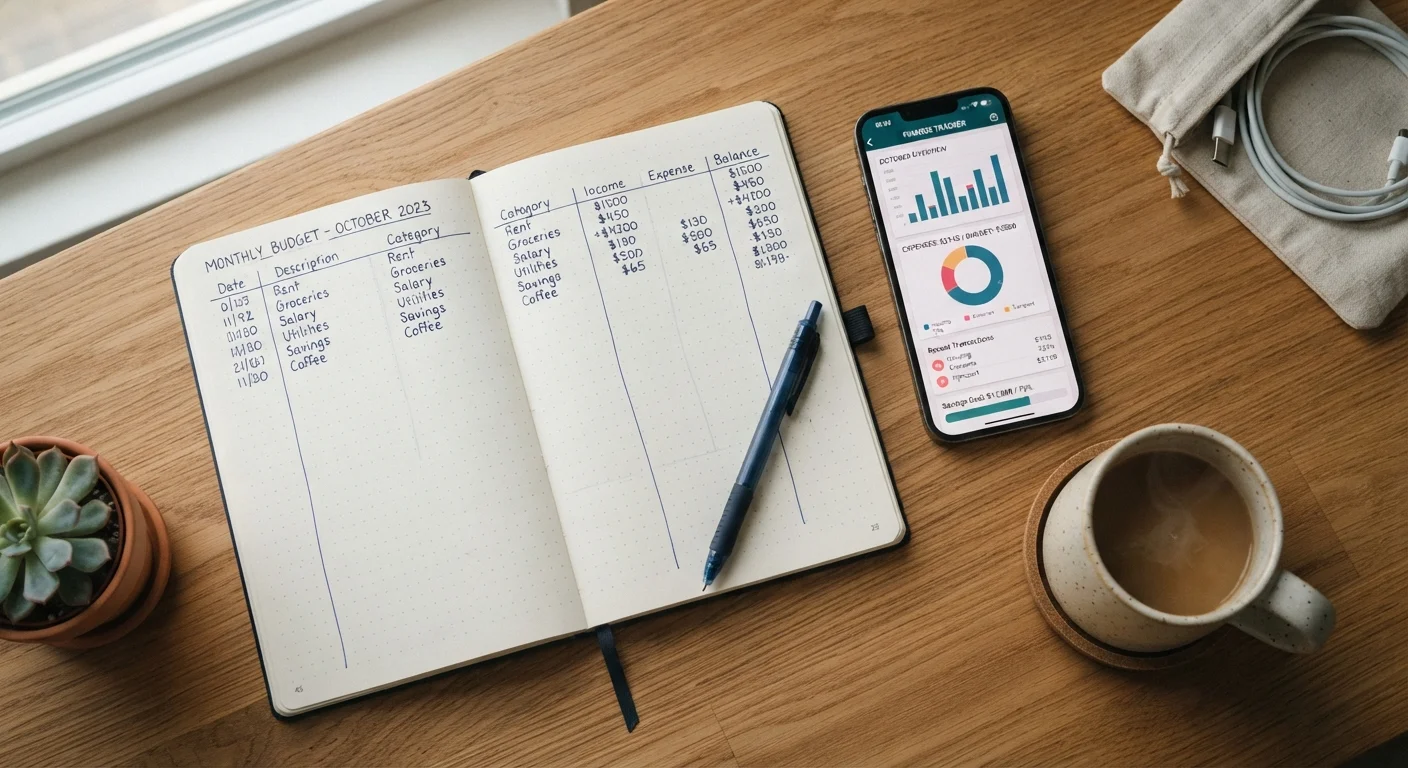
- Tracking by hand builds stronger awareness because writing each transaction forces active attention.
- Apps automate data entry and categorization, reducing the friction that causes people to quit tracking.
- Neither method works if you don't review your numbers regularly - consistency matters most.
- Your comfort with technology, privacy preferences, and financial complexity all influence which fits best.
- Many people find a hybrid approach - app for capture, notebook for reflection - works well long term.
Option A
Tracking Spending by Hand
The deliberate, low-tech method that keeps you close to every dollar.
Best for: People who want a tactile, distraction-free way to build spending awareness from scratch.
Option B
Using a Budgeting App
The automated, always-with-you approach that does the heavy lifting for you.
Best for: People with busy schedules who want real-time visibility without manual data entry.
If you're building a budget habit from scratch
Tracking Spending by Hand
Writing purchases down manually creates a moment of pause that reinforces awareness. That friction is actually useful early on.
If your spending happens across many accounts and cards
Using a Budgeting App
Apps that sync with financial accounts consolidate transactions automatically, giving you a complete picture without detective work.
If you're concerned about data privacy or bank account linking
Tracking Spending by Hand
Manual methods require no app permissions, no account credentials, and no third-party data sharing.
If you've tried budgeting before and quit due to the time it takes
Using a Budgeting App
Automation removes the daily burden of manual entry, making it far easier to stay consistent over weeks and months.
If you want to understand your spending patterns at a deeper level
Tracking Spending by Hand
The act of writing and reviewing each line item encourages reflection that passive app notifications rarely replicate.
Why How You Track Matters
Most people have a rough idea of where their money goes. Few have a precise one. Tracking your spending - whether in a notebook, a spreadsheet, or an app - closes that gap. But the method you choose shapes how likely you are to stick with it and what you actually learn along the way.
This isn't about finding a perfect system. It's about finding one that fits how your brain works. Both approaches are legitimate tools for the same goal: understanding your money well enough to make better decisions with it. If you're also trying to reduce debt or build savings, tracking is the foundation everything else sits on. See the Saving & Debt hub for related guidance.
How Each Method Works
By hand means recording each transaction yourself - in a notebook, a printed template, or a spreadsheet you update manually. You write down what you spent, where, and how much. At the end of the week or month, you tally categories and compare them to your budget. Some people use the envelope method alongside this; the envelope budgeting approach remains a useful framework for cash-based households.
Using an app typically means connecting the app to your bank accounts and credit cards. Transactions import automatically, are categorized by the software, and are displayed in dashboards or spending summaries. Most apps also let you set budget limits by category and send alerts when you're approaching them.
| Criterion | Tracking by Hand | Using an App |
|---|---|---|
| Data entry | Manual - you log each transaction | Automated - syncs with accounts |
| Setup effort | Low - notebook or spreadsheet | Moderate - account linking required |
| Privacy risk | Minimal - no third-party access | Varies - depends on app and data policies |
| Spending awareness | High - active engagement per transaction | Passive - requires deliberate review |
| Cost | Free (pen and paper) | Free to paid tiers available |
| Best for multiple accounts | Challenging - more to track manually | Strong - consolidates automatically |
| Consistency over time | Requires discipline and routine | Easier to maintain with automation |
The Real Strengths of Tracking by Hand
The manual method's biggest advantage is also its biggest inconvenience: you have to do it yourself. Research in behavioral finance consistently suggests that people who actively engage with financial information - rather than passively receiving it - develop stronger awareness of their habits. Writing a $47 restaurant charge into a notebook hits differently than watching it auto-populate in an app.
Hand tracking also has zero technology dependencies. No app subscriptions, no account-linking risks, no data breaches to worry about. If privacy is a concern for you, this matters. And for people just starting out, the simplicity of a notebook lowers the barrier to entry considerably.
The downside is time. If you use multiple accounts, forget to log something, or fall behind by a week, the system breaks. It also won't generate charts or catch patterns automatically - that analysis is on you.
The Real Strengths of Using a Budgeting App
Apps solve the friction problem. When transactions import automatically, you don't have to remember to log a gas station stop or a streaming charge. That consistency is valuable - especially for people who have tried manual tracking and found it unsustainable.
Apps also handle math and categorization in real time. You can see at a glance how much you've spent on groceries this month versus last month, without building your own formulas. For households with complex finances - multiple income sources, irregular bills, shared expenses - that automation can be genuinely useful.
~33%
Americans who follow a formal budget
Surveys from Gallup have found that roughly one in three U.S. adults maintains a detailed household budget, suggesting most people track spending loosely or not at all.
60%+
Budget app users who quit within 3 months
Industry analysts and app developers have noted high early dropout rates, often tied to the friction of setup or passive engagement with dashboards.
The trade-offs are real, though. Many full-featured apps require linking your bank or credit card credentials to a third-party service, which carries inherent privacy and security considerations. Some charge monthly fees. And because the tracking is passive, it's easy to glance at dashboards without actually changing your behavior. Automation removes willpower from the data entry, but not from the decision-making. If you're also looking at automating your savings, combining both habits - automated savings and active spending review - can work well together.
Choosing What Fits Your Life
The method you'll actually use consistently is the right method. A few questions can help you decide:
- How many accounts do you have? More accounts favor apps; fewer accounts make manual tracking manageable.
- How do you feel about tech and privacy? If linking financial accounts makes you uneasy, by-hand tracking removes that concern entirely.
- Have you tried budgeting before? If past attempts failed due to time, apps may help. If they failed due to lack of awareness, manual tracking may be the better teacher.
- What's your goal? Building a new habit benefits from the deliberate friction of writing. Maintaining a budget you've already built may be easier with automation.
Many people find that a hybrid works: use an app to capture transactions automatically, then sit down weekly with a notebook to reflect on what you actually spent and why. That combination pairs automation's convenience with the awareness that manual review creates. For more on turning good intentions into reliable systems, the Money Mindset hub covers the habits and attitudes behind lasting financial change.
And before any purchase - tracked or not - running a quick mental audit helps. The spending audit checklist is a practical companion to any tracking method.
This article is for general informational purposes only and does not constitute personalized financial advice. For guidance specific to your situation, consider speaking with a licensed financial professional.