

Key Takeaways
- Envelope budgeting assigns every dollar to a spending category before you spend it.
- Physical cash creates a psychological spending limit that digital balances often don't.
- The core principles work just as well in digital apps as with paper envelopes.
- Overspending in one category means consciously borrowing from another - making trade-offs visible.
- The method works best for variable, discretionary expenses like groceries and dining.
Envelope Budgeting
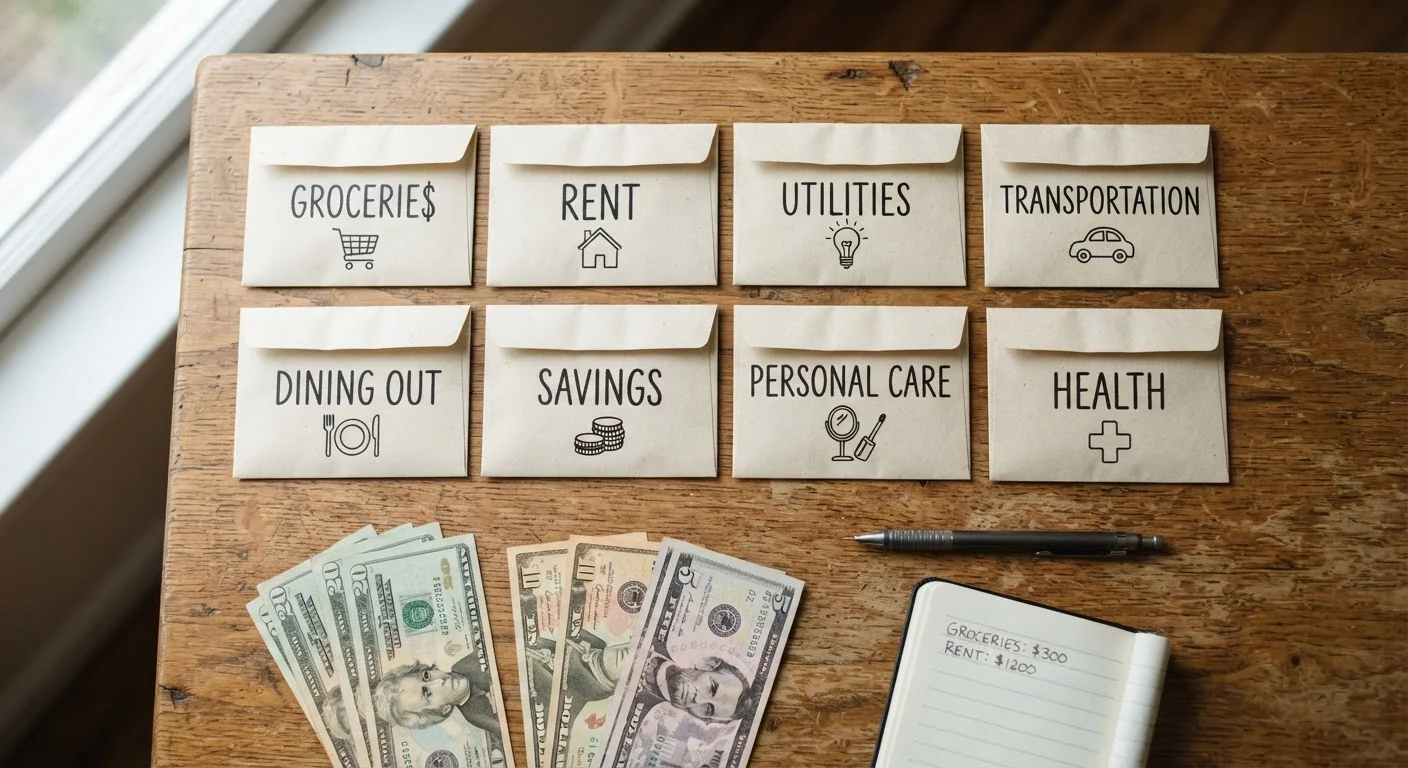
Envelope budgeting is a cash-based spending system where you divide your monthly income into physical envelopes, each labeled for a specific expense category - groceries, gas, dining out, and so on. Once an envelope is empty, spending in that category stops until the next budget period. The method makes your spending limits concrete and immediate rather than abstract.
The system is a form of zero-based budgeting: every dollar of income is allocated to a named category at the start of the period, leaving no unassigned funds.
Where the Method Came From
Long before budgeting apps existed, households managed money by separating cash into labeled envelopes at the start of each pay period. The practice became especially common in mid-20th century America, when cash was the dominant payment method and a family's spending limits had to be physically visible to be felt. The approach was simple by necessity: label an envelope, fill it with cash, spend from it, and stop when it was empty.
The method fell out of mainstream conversation as credit cards, direct deposit, and digital banking became universal - but the budgeting principles behind it never became obsolete. If anything, the psychological problem the envelopes were solving has gotten harder, not easier. Digital balances are abstract. A $900 grocery run barely registers when you tap a phone to pay. Cash in an envelope is immediate and finite.
For context on how the envelope approach fits alongside other frameworks, see our explainer on zero-based and percentage-based budgeting.
How It Actually Works
The setup follows the same basic steps whether you use paper or a phone:
- List your income for the month. Use your take-home pay - what actually lands in your account.
- Identify your fixed expenses. Rent, loan payments, and subscriptions with set amounts are handled first. They don't typically go into envelopes because they don't vary.
- Assign the remaining income to variable categories. Groceries, gas, dining out, clothing, household supplies, and entertainment are the usual candidates. Each category gets a specific dollar amount.
- Fund each envelope. Withdraw cash and physically divide it, or set limits in a digital tool. The total across all envelopes should equal your remaining income after fixed expenses.
- Spend only from each envelope's balance. When an envelope is empty, spending in that category is done for the month.
The visible limit is what makes the system effective. It converts an abstract monthly budget into a series of concrete, category-specific constraints you encounter in real time.
36%
Americans with a written monthly budget
Gallup polling has consistently found that fewer than four in ten American adults maintain a detailed household budget.
~20%
Average overspend on variable expenses
Consumer finance research broadly suggests households regularly underestimate variable category spending by around 15-20% compared to their stated budgets.
2x
Pain of paying with cash vs. card
Behavioral research, including work associated with MIT's Sloan School, has found that paying with cash produces measurably stronger psychological resistance to spending than card transactions.
Why Digital Hasn't Made It Obsolete
Behavioral economists have documented a well-established pattern: people spend more freely with cards than with cash, partly because handing over physical money triggers a stronger psychological response to loss. Envelope budgeting was designed to reproduce that friction intentionally.
“The pain of paying is real, and cash amplifies it. When you hand over a $20 bill, the loss feels tangible in a way that swiping a card simply does not.”
— Drazen Prelec, Professor of Management Science and Economics, MIT Sloan School of Management
Digital adaptations preserve the structure - pre-set limits per category, hard stops when a category is depleted - even when no physical cash changes hands. Several budgeting apps are built specifically around envelope-style logic, where users fund virtual envelopes at the start of each period and track deductions in real time. The method's core insight transfers cleanly to a screen.
That said, digital tools require more self-discipline to enforce the limits. An app can warn you that your dining envelope is empty; it can't stop you from eating out anyway. For households that struggle with overspending, some financial counselors still recommend using actual cash for the most problematic categories, even if the rest of the budget is managed digitally. For a balanced look at both sides, our piece on tracking spending by hand vs. using an app covers the trade-offs in detail.
Limitations Worth Knowing
Envelope budgeting isn't suited to every situation. A few honest limitations:
- Variable income is harder to manage. Freelancers and hourly workers whose paychecks fluctuate need to build a buffer before the system runs smoothly. Budgeting from a baseline income figure - your lowest expected paycheck - is one common workaround.
- Irregular large expenses need a separate strategy. Annual insurance premiums, car registration, or home repairs don't fit neatly into monthly envelopes. A dedicated savings category, sometimes called a sinking fund, handles these better.
- Cash management has its own friction. Making ATM runs, carrying cash, and making change adds real inconvenience. Most people who stick with the method long-term either go digital or limit cash envelopes to just two or three high-risk categories.
- It doesn't build wealth on its own. Envelope budgeting controls spending; it doesn't automate saving or investment. Pairing it with an automated savings transfer at the start of each month is the common complement.
For households looking to make any budgeting method stick over time, the principles in our guide on building a budget that lasts apply regardless of which system you choose.
Start With Just Two or Three Envelopes
If the full system feels overwhelming, pick only your most problematic spending categories - typically groceries, dining, or entertainment - and apply envelope limits there first. Once those feel manageable, you can expand to additional categories. A partial system done consistently beats a perfect system abandoned after two weeks.
This article is for general informational and educational purposes only. It is not personalized financial advice. For guidance specific to your circumstances, consider speaking with a licensed financial professional.