

Key Takeaways
- Crates work because they tap into a dog's natural instinct to seek small, enclosed resting spaces.
- Rushing the introduction is the most common reason crate training fails.
- Never use the crate as punishment — your dog must associate it with safety and reward.
- Most dogs can be comfortably crate-trained within one to three weeks with consistent daily sessions.
- Puppies under six months should not be crated longer than three to four hours at a stretch.
What you will need
Why Crates Make Sense for Dogs
Dogs are descended from animals that slept in dens — small, enclosed spaces that offered warmth and protection. A crate, introduced correctly, mirrors that instinct. It gives a dog a defined, predictable space that belongs entirely to them, which many dogs find genuinely calming rather than confining.
The key word is introduced correctly. A crate forced on a dog too quickly becomes a source of stress. A crate built up gradually — through positive associations and the dog's own choice — becomes a resting spot the dog returns to voluntarily, even when the door is open.
Crate training also serves a practical function: it supports housetraining by using a dog's instinct to avoid soiling their sleeping area, it prevents destructive behavior during unsupervised hours, and it gives dogs a safe retreat during travel, vet visits, or household disruptions. Understanding this dual purpose — comfort for the dog, management for the owner — makes the process feel less arbitrary and more worth the effort.
For a broader look at how reward-based approaches underpin tools like crate training, see our guide to positive reinforcement vs. correction-based training.
What you will need
Setting Up for Success: What You Need
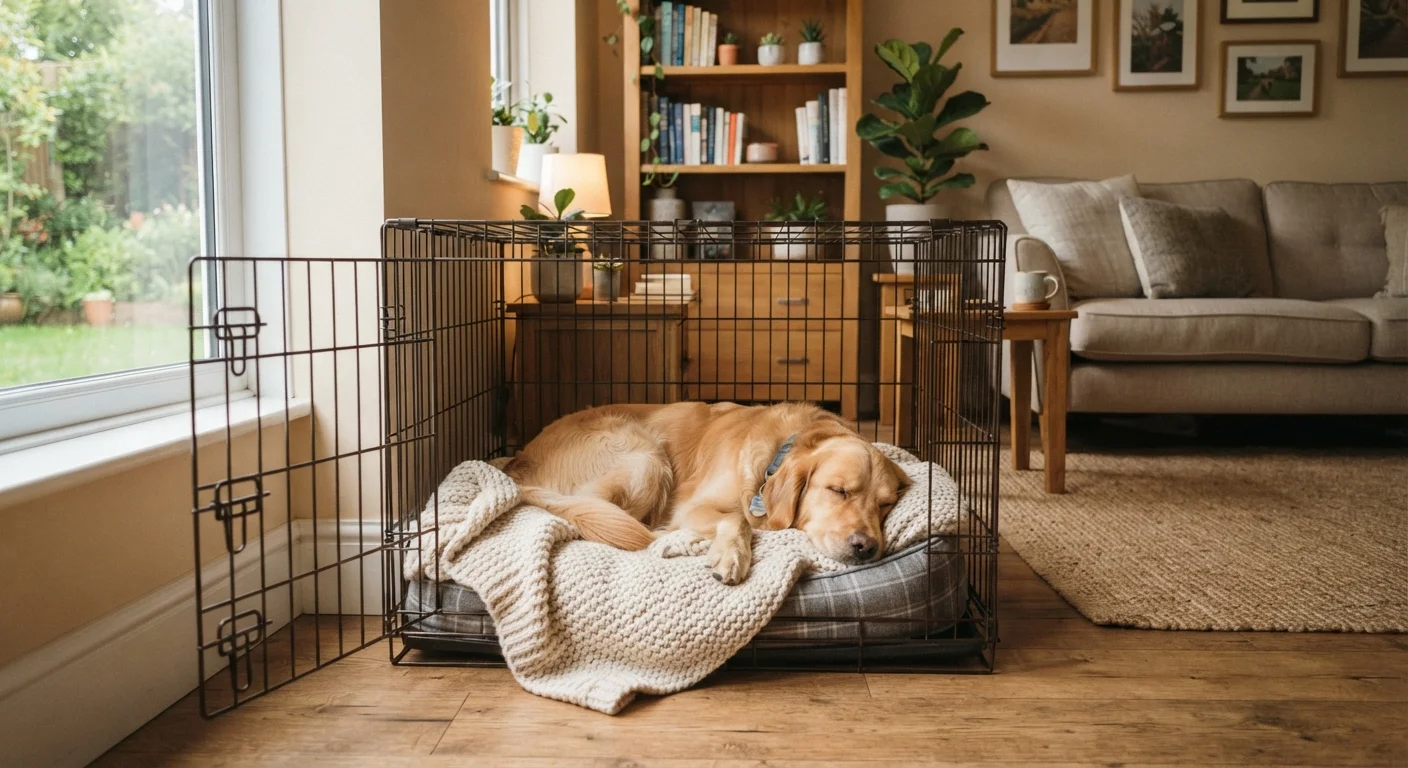
Before you begin, size matters. A crate that's too large lets a puppy eliminate in one corner and sleep in another, undermining housetraining. A crate that's too small is uncomfortable and stressful. Your dog should be able to stand, turn around, and lie down fully stretched — nothing more is needed at the start.
Appropriately Sized Crate
Provides a space large enough for your dog to stand, turn around, and lie down — but not so large that a puppy can eliminate in one corner and sleep in another.
Soft Bedding or Crate Mat
Makes the crate comfortable and encourages your dog to settle and rest inside.
High-Value Training Treats
Used to reward voluntary entry and calm behavior inside the crate during the introduction phase.
Chew Toy or Food-Stuffed Toy
Gives your dog something to focus on while the crate door is closed, helping build duration gradually.
Crate Cover or Blanket
Reduces visual stimulation and creates a den-like atmosphere that many dogs find calming.
Where you place the crate matters too. A corner of a frequently used room — not an isolated garage or basement — keeps your dog part of the household while still giving them a defined space. If your dog is anxious about visual stimulation, draping a blanket over three sides creates a calmer, more enclosed feel.
The Step-by-Step Introduction
Crate training is not a single event — it's a sequence of small, deliberate steps, each one building on the last. Skipping ahead is the most common mistake owners make, and it's the main reason some dogs end up associating the crate with fear rather than rest. Work through each step below only when your dog is visibly relaxed at the current stage.
Introduce the crate as a neutral object
Place the crate in a room where your family spends time. Leave the door open and let your dog investigate at their own pace. Drop a few treats near the entrance and just inside without any pressure to enter. Repeat this over one or two days until your dog approaches the crate without hesitation.
Reward any voluntary entry
Toss treats just inside the doorway so your dog has to step in to get them. Mark the moment they cross the threshold with a calm "yes" or a click if you use a clicker, then reward. You are not closing the door yet — the goal is simply building a positive association with the space itself.
Feed meals at the crate door, then inside
Place your dog's regular food bowl just outside the crate entrance for the first meal. Each subsequent meal, move it slightly further inside. Within a few days most dogs will walk fully in to eat. This turns the crate into a reliable source of something good — without any commands or pressure required.
Close the door briefly while your dog eats
Once your dog enters the crate comfortably for meals, gently close the door while they eat. Open it as soon as they finish — before any whining starts. Gradually extend the closed-door time by 30-second increments over multiple sessions. Your dog should remain visibly relaxed throughout.
Build duration with you present
Ask your dog to enter the crate using a cue word like "crate" or "bed," reward them, and close the door. Sit nearby and calmly increase time in five-minute increments across sessions. Offer a food-stuffed toy to give your dog something to do. The goal here is a dog who settles quietly — not one who tolerates the crate anxiously.
Practice with you out of the room
Once your dog is comfortable for 15–20 minutes with you present, step out of sight briefly. Return before any distress occurs and reward calmly. Gradually extend your absence. This step teaches your dog that being crated alone is equally safe — a critical distinction for real-world use.
Use the crate for genuine rest periods
Transition to using the crate as part of your dog's daily routine — nap times, quiet periods, or when you cannot supervise directly. Keep crating sessions within appropriate time limits for your dog's age and bladder capacity. Exit the crate should be calm, not exciting: a quiet release, then a short wait before any play begins.
Feed Meals Near and Inside the Crate
One of the fastest ways to build a positive crate association is to place your dog's regular meals just inside the doorway, then gradually move the bowl further in over several sessions. This creates a repeated, low-stakes reason for your dog to choose to enter voluntarily.
Watch for Signs of Distress
Persistent crying, frantic scratching, or refusal to eat treats near the crate are signals that you're moving too fast. Slow the process down rather than pushing through. If distress continues despite a gradual approach, consult a certified professional trainer or your veterinarian.
Common Mistakes and How to Avoid Them
The most frequent error is using the crate as punishment. Sending a dog to their crate after a scolding links the space to negative emotion and undoes weeks of careful conditioning. The crate must remain entirely separate from any correction.
The second most common mistake is releasing a dog the moment they whine. If whining is consistently rewarded with an open door, dogs learn that noise is the exit strategy. Wait for even a two-second pause before opening — that brief silence is what you are reinforcing.
Finally, many owners overestimate how long a dog can be comfortably crated. Puppies under six months generally shouldn't exceed three to four hours; adult dogs vary, but crating beyond six hours routinely is rarely appropriate as a long-term arrangement. Common training myths — including the idea that a dog will "just get used to it" — can lead owners to push past what's reasonable.
Crates Are Not for Extended Isolation
A crate is a short-term management tool, not a substitute for exercise, socialization, or companionship. Leaving a dog crated for eight or more hours routinely can cause anxiety, frustration, and behavioral problems. If your schedule requires long daily absences, speak with a veterinarian or certified trainer about appropriate alternatives.
If you're crate training as part of welcoming a new dog into your home, our guide on setting the foundation before day one covers the broader routines that make early training more effective.