

Key Takeaways
- Positive reinforcement works by rewarding desired behaviors, making them more likely to repeat.
- Correction-based training uses aversive consequences to reduce unwanted behaviors.
- Most major veterinary and animal behavior organizations endorse reward-based methods as the safer default.
- Research links correction-based methods to increased stress and aggression in some dogs.
- A qualified trainer can help you apply the right approach for your dog's individual needs.
- Neither approach is one-size-fits-all; your dog's history, temperament, and the behavior matter.
Option A
Positive Reinforcement Training
The reward-based, science-backed approach.
Best for: Dogs of all ages and temperaments, especially those prone to anxiety, and owners who want a collaborative, trust-building relationship.
Option B
Correction-Based Training
The consequence-focused, traditional approach.
Best for: Owners who have worked with experienced, qualified trainers and are navigating specific, stubborn behaviors in certain working or adult dog contexts.
If you're starting with a puppy or newly adopted dog
Positive Reinforcement Training
Reward-based methods build trust early and set a strong behavioral foundation without the risk of fear or stress responses.
If your dog has a history of anxiety or fear
Positive Reinforcement Training
Aversive techniques can intensify fear in sensitive dogs; rewards help build confidence and clear communication instead.
If you're dealing with a complex or long-standing behavior issue
Positive Reinforcement Training
Consult a certified applied animal behaviorist who typically uses reward-based protocols to address root causes rather than suppress symptoms.
If you're drawn to traditional training methods
Correction-Based Training
If you proceed, work exclusively with a credentialed, experienced professional who uses corrections sparingly and humanely — never as a first resort.
How Each Approach Works
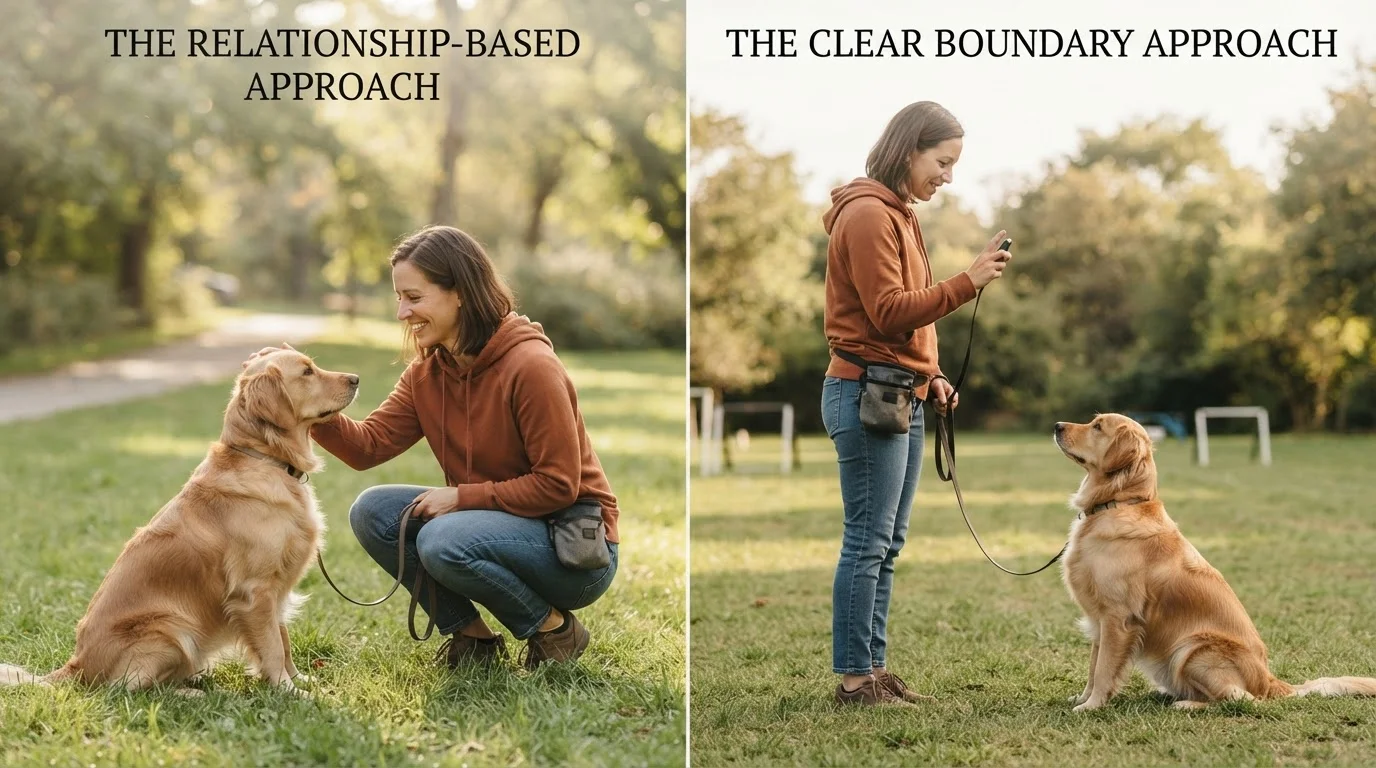
Positive reinforcement training adds something a dog values — a treat, praise, or play — immediately after a desired behavior occurs. That reward increases the likelihood the dog will repeat the behavior. It's grounded in operant conditioning research dating back decades and is the foundation of most contemporary, science-aligned dog training.
Correction-based training (also called aversive or punishment-based training) works differently: it introduces an unpleasant stimulus — a leash correction, a startling sound, or a shock from an e-collar — to interrupt or reduce an unwanted behavior. Some trainers blend both, rewarding good behavior while correcting bad behavior, in what's often called balanced training.
It's worth understanding the terminology. In behavioral science, "punishment" doesn't mean cruelty — it means any consequence that reduces a behavior. Likewise, "reinforcement" means any consequence that increases a behavior. The debate isn't about kindness alone; it's about which method produces reliable learning with the fewest risks. For a closer look at common misunderstandings in this space, see pet training myths that keep owners stuck.
| Criterion | Positive Reinforcement | Correction-Based Training |
|---|---|---|
| Core mechanism | Rewards desired behavior | Applies aversive to reduce behavior |
| Scientific support | Strong, broadly endorsed | Limited; more contested |
| Stress and welfare risk | Low when applied correctly | Moderate to high if misapplied |
| Speed of results | Gradual, builds retention | Can be fast; may not generalize |
| Handler skill required | Moderate — timing matters | High — errors can cause harm |
| Recommended by AVSAB | Yes, as first-line approach | Not as default; used with caution |
| Suitable for anxious dogs | Yes | Generally not recommended |
What the Research Shows
The scientific literature has grown substantially over the past two decades, and the weight of evidence generally favors reward-based methods — particularly for companion dogs. Studies published in peer-reviewed journals have found that dogs trained with aversive methods show higher rates of stress-related behaviors, including yawning, lip-licking, and avoidance, compared to dogs trained with positive reinforcement.
Research has also linked frequent use of aversive techniques to an increased risk of fear-based aggression — a dog that responds to corrections with fear may redirect that anxiety into biting. A widely cited study found that dogs subjected to punishment-based training were more likely to exhibit aggression toward their owners and strangers.
~25%
Higher aggression risk with punishment-based methods
A study published in Applied Animal Behaviour Science found dogs trained with aversive methods showed meaningfully higher rates of aggression compared to reward-trained dogs.
72%
Dogs showing stress signals under aversive training
Research by University of Porto scientists observed stress-related behaviors in the majority of dogs trained at schools using aversive techniques.
Organizations including the American Veterinary Society of Animal Behavior (AVSAB) have issued position statements recommending that reward-based methods be the first-line approach, citing both welfare concerns and efficacy data. That said, research in dog training is still evolving, and individual dogs, handler skill, and context all influence outcomes. For a more detailed look at why punishment can misfire, our article on why punishment often backfires in pet training explores the behavioral mechanisms involved.
The Tradeoffs to Weigh
Positive reinforcement training has strong safety credentials, but it does require patience, consistency, and clear timing. If rewards are delivered inconsistently or too late, the dog may not connect the reward to the behavior. It can also take longer to show results for dogs with deeply ingrained habits.
Correction-based training can produce fast behavioral suppression — a dog may stop a behavior quickly when an aversive consequence follows. But suppression is not the same as learning an alternative behavior. A dog that stops jumping because of a correction has not necessarily learned what to do instead. And when corrections are mistimed, too intense, or applied by an inexperienced handler, the consequences can include fear, confusion, and damaged trust.
The competence of the trainer matters enormously in both approaches — but the margin for error is narrower with aversive methods. If you're considering working with a trainer, explore how group classes, private trainers, and self-teaching compare before committing to a path.
The 'Balanced Training' Middle Ground
Some trainers use a mixed approach — rewarding desirable behaviors while applying corrections for unwanted ones. Proponents argue this mirrors how dogs experience natural consequences. Critics point out that adding aversives to a reward-based program increases stress risk without clear evidence of superior outcomes. If a trainer proposes a balanced approach, ask specifically how and when corrections would be used, and whether less aversive options have been tried first.
This article is for general informational purposes only and does not constitute professional veterinary or animal behavior advice. Consult a certified professional for guidance specific to your dog's needs.