

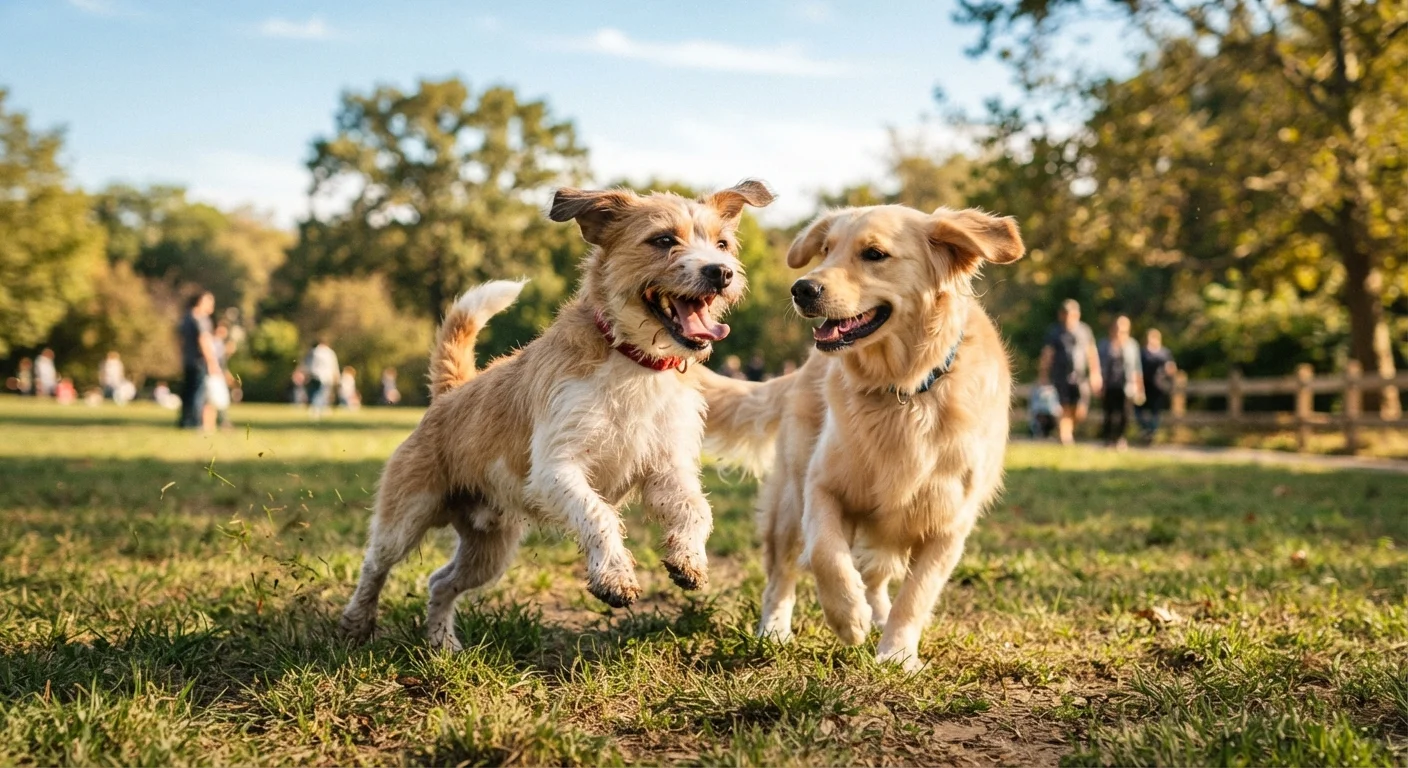
Key Takeaways
- Loose, bouncy body movements signal play; stiff, rigid posture signals potential aggression.
- Role reversal — where both dogs take turns chasing and being chased — is a reliable play indicator.
- Growling alone does not confirm aggression; context and accompanying body language determine meaning.
- One dog consistently trying to escape is a clear sign the interaction is no longer mutual.
- Brief, natural pauses during rough play are normal and healthy — their absence can be a warning sign.
- When in doubt, separate the dogs calmly and observe their responses before allowing interaction to resume.
Play vs. Aggression in Dogs
Dog play and dog aggression can look surprisingly similar — both involve chasing, wrestling, barking, and even mouthing. The difference lies in the body language, the flow of the interaction, and whether both dogs are willing participants. Learning to read these signals helps owners step in at the right moment and avoid unnecessary intervention or dangerous inaction.
Behaviorists distinguish between "affiliative" interactions (socially bonding, mutually enjoyed) and "agonistic" ones (competitive or conflict-driven). Many interactions contain elements of both, which is why reading the full context matters.
Why Play and Aggression Look So Similar
Dogs communicate through body language far more than through sound, and much of that language is fast-moving and layered. Chasing, wrestling, mouthing, and vocalizing all appear in both play and conflict — which is exactly why owners struggle to tell them apart at a glance.
The confusion is understandable. Rough play between dogs can be loud, physical, and chaotic. But most of what looks alarming — bared teeth, tumbling, mock biting — is normal when the dogs are genuinely playing. The key is learning to shift your attention from the actions themselves to the overall pattern of the interaction.
Understanding this distinction connects directly to broader body language literacy. Our practical body language reference covers the full range of signals across dogs and other pets — a useful foundation for any owner.
Play Styles Vary by Breed and Individual
Some breeds — particularly herding, terrier, and working breeds — have naturally more intense play styles involving body-slamming, chasing, or vocalizing. This doesn't make them aggressive; it means their signals need to be read in context of their normal baseline. Learning your dog's individual play style over time is one of the most useful things you can do as an owner.
The Body Language Signals That Tell the Real Story
Individual signals rarely tell the whole story. Read them in combination.
Signs the interaction is play
- Loose, bouncy movement: A dog at play moves in an exaggerated, almost floppy way. Strides are springy rather than deliberate.
- Play bow: Front legs extended forward, hind end raised. This is an explicit invitation to play and a social reset signal mid-interaction.
- Open mouth, relaxed face: A "play face" — soft, open mouth, relaxed jaw — differs visibly from a tense, lips-pulled-back threat display.
- Role reversal: Both dogs take turns chasing, being chased, pinning, and being pinned. Mutual give-and-take is the clearest play indicator.
- Voluntary pauses: Dogs at play naturally pause, shake off, and re-engage. These micro-breaks show both animals are choosing to continue.
Signals that warrant concern
- Stiff, rigid posture: A dog that freezes or moves in slow, deliberate, stiff-legged steps is signaling tension, not playfulness.
- Hard, fixed stare: Prolonged, unblinking eye contact directed at another dog is a challenge, not an invitation.
- One-sided pursuit: If one dog is doing all the chasing and the other is genuinely trying to escape — not playfully running away — the interaction has become unequal.
- Sustained low growl: Deep, continuous growling paired with stiff posture is different from the short, higher-pitched vocalizations common in play.
- Pinning without release: Holding another dog down and not letting them up, especially if the pinned dog yelps or goes still, is a red flag.
Use the "Both Dogs Willing" Test
After separating two dogs mid-interaction, watch what happens. If both dogs actively try to get back to each other, that's a strong indicator of mutual play interest. If one dog moves away or seems relieved, take that as information about whether the interaction should continue.
Context Clues That Change the Picture
Body language doesn't exist in a vacuum. Several contextual factors shape how to interpret what you're seeing.
Familiarity: Dogs that know each other well have established play styles and thresholds. Two dogs meeting for the first time need more supervision — miscommunication is more likely when they haven't yet learned each other's signals.
Arousal level: Play can escalate when dogs become overstimulated. A game that starts loose and fun can tip into conflict if the intensity builds and neither dog gets a natural break. Watch for escalating speed, louder vocalizations, and decreasing pauses.
Environment: Tight spaces, resource-rich areas (near food or toys), and the presence of unfamiliar people can add pressure that shifts an interaction from play toward tension.
Sudden changes in a dog's behavior patterns — including becoming more reactive or less tolerant of other dogs — can sometimes signal an underlying health issue rather than a training problem. See our article on when behavior changes may point to a medical cause for guidance on when a vet visit is the right first step.
When and How to Step In
Knowing when to intervene is as important as knowing how. Interrupting genuine play unnecessarily can disrupt healthy socialization. Waiting too long when signals turn serious can allow conflict to escalate.
Step in calmly if you observe:
- One dog consistently trying to leave and being physically prevented
- A dog that has gone flat, still, or is cowering
- Stiff posture combined with a hard stare from either dog
- Any snapping with contact, or yelping in distress
When intervening, use a neutral interrupter — a calm verbal cue or brief physical separation — rather than shouting or rushing in, which can increase arousal. Give both dogs a moment to settle before assessing whether to allow interaction to resume.
Keep in mind that dogs who are consistently anxious around other dogs may need a different approach entirely. Anxiety in pets is often misread as aggression or bad behavior — understanding the root cause matters before assuming a dog simply needs better socialization.
This article is for general informational purposes only and does not constitute veterinary or professional behavioral advice. If you have concerns about your dog's behavior or safety around other animals, consult a licensed veterinarian or a certified applied animal behaviorist.