

Key Takeaways
- Cats are capable learners — they respond well to positive reinforcement, not punishment.
- Short sessions of two to five minutes work far better than long, repetitive drills.
- Cats learn best when training feels like play and happens on their terms.
- Basic behaviors like sit, come, and carrier entry are achievable for most cats.
- Understanding your cat's body language helps you train at the right moment.
Start here
Can Cats Really Be Trained?
Build the foundation
How Cats Actually Learn
Set your goals
What You Can Realistically Teach a Cat
Put it into practice
How to Run a Training Session
Troubleshoot
Common Mistakes and How to Avoid Them
Can Cats Really Be Trained?
Most people assume training is for dogs. Cats, the thinking goes, are too independent, too aloof, or simply uninterested in cooperating. That assumption is outdated. Research in animal cognition consistently shows that cats learn through the same basic mechanisms as dogs — they just require a different approach.
Cats are not stubborn. They are selective. They will engage when training feels worthwhile to them, which means the setup, timing, and rewards all need to match how a cat naturally thinks. The good news: once you understand that, training becomes a genuinely enjoyable experience for both of you. Check out our guide to common pet training myths if you've ever been told cats are simply untrainable.
Positive reinforcement
Adding something a cat enjoys — like a treat or play — immediately after a desired behavior to make that behavior more likely to happen again.
Operant conditioning
A learning process where an animal changes its behavior based on the consequences that follow — rewarding outcomes increase a behavior, unpleasant ones reduce it.
Clicker
A small handheld device that makes a distinct clicking sound used to mark the exact moment a cat performs a desired behavior, before the treat is delivered.
Target training
Teaching a cat to touch a specific object — usually a finger or stick — with its nose or paw, used as a foundation for more complex behaviors.
Behavior shaping
Gradually rewarding small steps toward a final behavior rather than waiting for the perfect response — useful for teaching more complex actions.
How Cats Actually Learn
Cats learn primarily through operant conditioning — a process where behaviors followed by pleasant outcomes are repeated, and behaviors followed by unpleasant outcomes are avoided. Positive reinforcement, meaning adding something the cat enjoys immediately after a desired behavior, is the most effective and humane way to teach.
Timing is critical. The reward must arrive within one to two seconds of the behavior, or the cat will not connect the two. This is why a clicker — a small device that makes a distinct click sound — is a useful training tool. The click acts as a precise marker, telling the cat exactly which action earned the reward, even before the treat arrives.
Cats also rely heavily on their environment and emotional state. A cat that feels stressed, overstimulated, or simply full will not engage. Understanding your cat's mood before you begin is half the work. See what your cat's body language is telling you for a practical breakdown of signals to watch for.
What You Can Realistically Teach a Cat
With consistent positive reinforcement, most cats can learn the following:
- Sit — one of the easiest behaviors to shape; many cats pick it up within a few sessions.
- Come when called — invaluable for safety and veterinary visits.
- Target training — touching a finger or stick with their nose, which becomes a building block for more complex behaviors.
- Carrier entry — reducing stress around vet visits dramatically.
- Scratching post use — redirecting a natural behavior to an appropriate surface.
- High-five or wave — simple tricks that strengthen the training relationship.
Cats are unlikely to perform behaviors on demand the way many dogs do. They may choose not to respond if the motivation isn't there. This is normal, not failure. For broader guidance on keeping your cat thriving, the Pet Health & Wellness hub covers behavior alongside physical care.
Start with what your cat already does
Watch for natural behaviors your cat repeats — sitting, stretching, or raising a paw — and begin rewarding them the moment they happen. This 'capturing' technique lets you attach a cue to an existing behavior, which is far easier than teaching something entirely new from scratch.
How to Run a Training Session
Follow this simple structure for each session:
- Choose the right moment. Train before a meal, not after. Your cat should be calm but alert — not sleepy, not frantic.
- Pick one behavior. Focus on a single cue per session. Introducing too many things at once confuses the cat and slows progress.
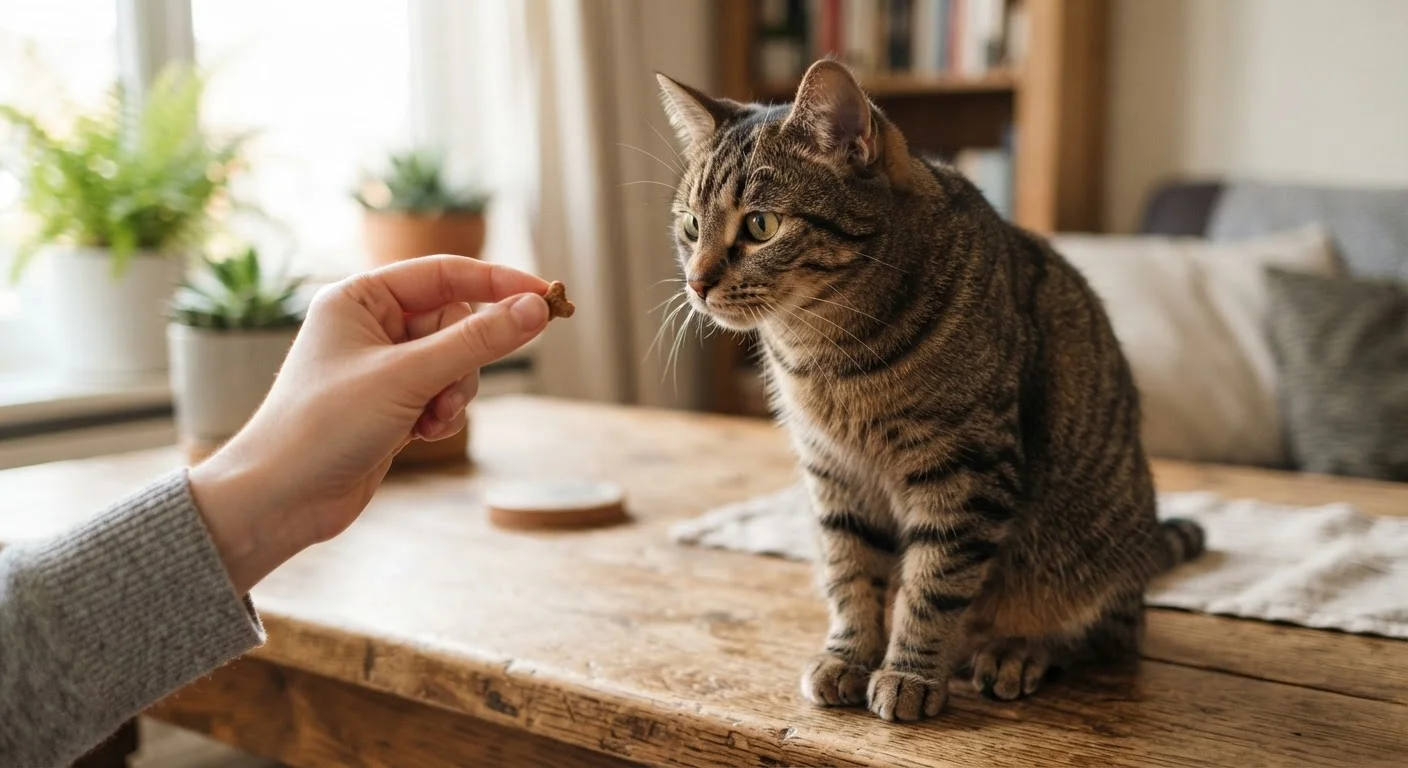
- Mark and reward immediately. The instant your cat performs the behavior, mark it (click or say "yes") and deliver a pea-sized treat within two seconds.
- Keep it short. Two to five minutes maximum. End on a success — ask for something the cat already knows before closing out.
- Repeat daily. Consistency across days builds lasting habits. Sporadic training produces slow results.
If your cat walks away, let them. Forcing engagement undoes trust. Try again in a few hours or the next day.
Common Mistakes and How to Avoid Them
Even well-meaning owners fall into patterns that stall progress:
- Using punishment
- Scolding, spraying water, or startling a cat damages trust and teaches nothing useful. It can also cause lasting anxiety. Stick to positive reinforcement exclusively.
- Sessions that run too long
- A cat that walks away mid-session has hit its limit. Shorter sessions end on a positive note and keep motivation high for next time.
- Inconsistent cues
- Using "sit" one day and "sit down" the next creates confusion. Every person in the household should use the same word and hand signal.
- Ignoring the cat's emotional state
- A tail lashing or flattened ears means stop immediately. Pushing through stress does not build resilience — it builds avoidance. Review your cat's room-by-room body language signals to recognize when your cat is ready versus overwhelmed.
Never use punishment in cat training
Physical corrections, loud noises, or spray bottles may suppress a behavior temporarily, but they do not teach the cat what to do instead. More importantly, they erode the trust that makes training possible. Cats that associate training with fear will simply disengage — or develop anxiety. Positive reinforcement is both more effective and kinder.
This article provides general educational information about cat training and is not a substitute for advice from a qualified veterinarian or certified animal behaviorist. If your cat displays sudden behavioral changes, consult a veterinary professional.