

Key Takeaways
- Leash pulling is driven by instinct and natural curiosity, not stubbornness or dominance.
- Dogs move at roughly twice the natural walking pace of humans, creating a built-in speed mismatch.
- Every successful pull that gets a dog closer to something interesting reinforces the behavior.
- Understanding the 'why' behind pulling makes training strategies far more effective.
- Consistent, reward-based training is generally more effective than aversive equipment or corrections.
Leash Pulling
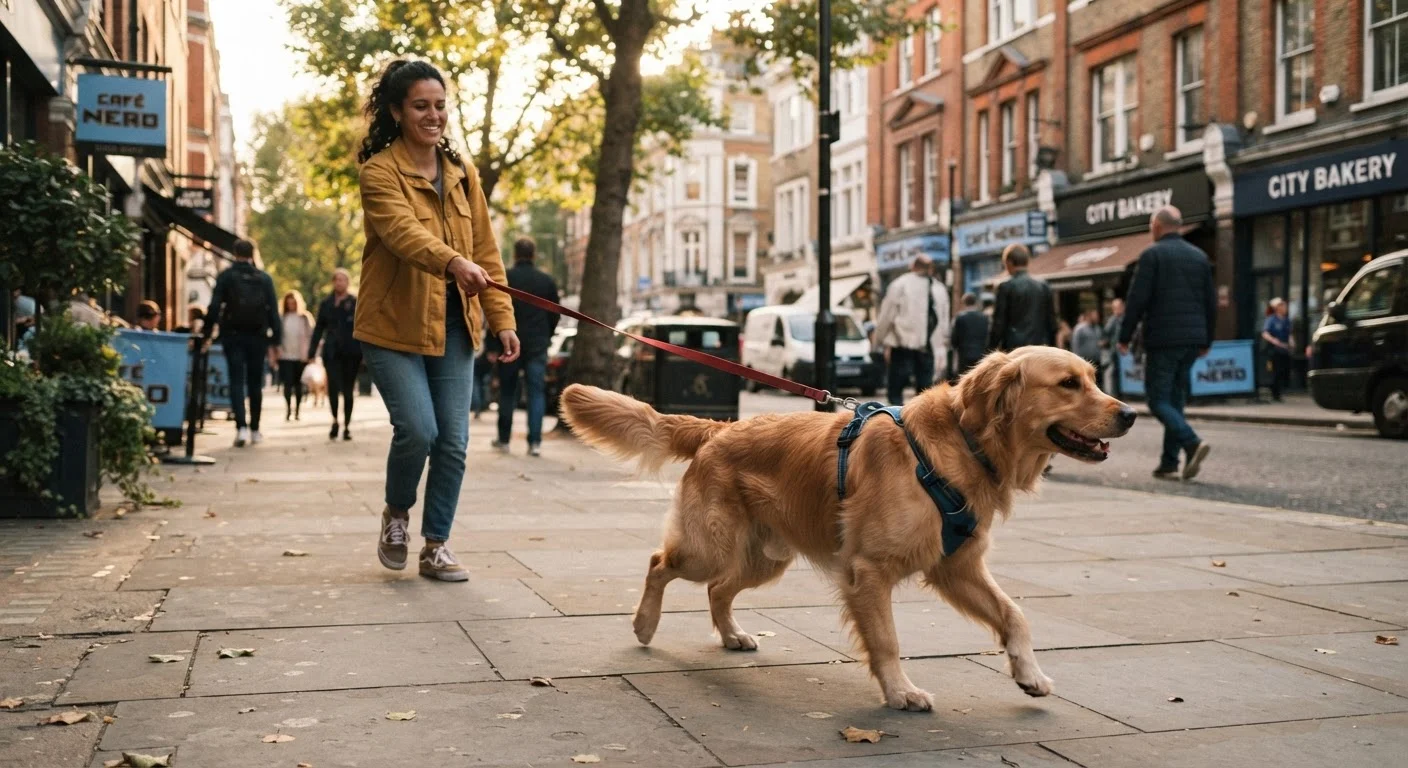
Leash pulling is when a dog consistently moves forward faster than its owner during a walk, creating tension on the lead. It's not a sign of dominance or bad manners — it's a natural behavior rooted in how dogs experience the world. Dogs are wired to follow their nose and explore their environment, and walking slowly beside a human doesn't come naturally to them.
From a behavioral science perspective, leash pulling is often maintained by negative reinforcement: the dog moves forward, reaches the interesting smell or object, and the forward motion is rewarded. This creates a self-reinforcing loop that strengthens the behavior over time.
The Instinct Behind the Pull
When your dog lunges toward a fire hydrant or drags you across the sidewalk toward another dog, it can feel like a deliberate challenge. It isn't. What you're seeing is the product of millions of years of evolution expressing itself the moment a leash clips on.
Dogs are built to move, sniff, and investigate. Their sense of smell is estimated to be tens of thousands of times more sensitive than a human's, and the world they experience on a walk is rich with constantly changing chemical information. Every patch of grass is a message board. Every passing dog leaves a scent trail. The pull isn't defiance — it's urgency. Your dog genuinely wants to get to that information now.
There's also a straightforward speed mismatch at play. The average dog's comfortable trotting pace is roughly twice as fast as a human's relaxed walking speed. Left to their own rhythm, most dogs would naturally outpace their owners without any intention of causing conflict.
~10,000x
How much more sensitive a dog's nose is than a human's
Widely cited estimate from comparative anatomy studies on canine olfactory receptor counts versus human olfactory receptors.
2x
A dog's natural trot vs. human walking pace
General biomechanics finding that dogs' preferred trot speed significantly exceeds a typical human's comfortable walking pace.
#1
Most common dog behavior complaint reported by owners
Leash pulling is consistently cited as the top behavioral issue in surveys of dog owners and veterinary behavior consultations.
Why the Behavior Keeps Getting Stronger
Understanding why pulling persists is just as important as understanding where it starts. The core mechanism is simple: pulling works. Every time a dog lurches forward and reaches something interesting — a smell, a person, a squirrel — that forward motion is immediately rewarded. The dog's brain registers a clear cause-and-effect: pull → get to thing. Over dozens or hundreds of walks, this becomes deeply practiced behavior.
This is why well-meaning corrections often have little lasting impact. If a dog pulls, gets corrected, then pulls again and still eventually reaches the goal, the reward of reaching the goal can outweigh the momentary discomfort of the correction. Punishment-based approaches often backfire for exactly this reason — the timing, consistency, and competing rewards make them unreliable.
Try the 'Stop and Wait' Approach
When your dog pulls, stop walking completely and wait for the leash to go slack before moving forward again. This removes the reward (forward progress) from the pulling behavior without any correction needed. It requires patience and consistency, but it directly addresses the reinforcement loop that keeps pulling alive.
What's Actually Happening in Your Dog's Head
Dogs don't plan to pull you down the street. They're not thinking several steps ahead or testing your authority. What's happening is more immediate: they notice something interesting, feel the pull of curiosity and excitement, and move toward it. The leash registers as friction, not a social signal.
This distinction matters enormously for training. If pulling were about dominance or spite, the solution would look very different than if it's about instinct and learned reinforcement. The behavioral science strongly supports the latter. As noted in research on dog cognition, dogs respond to immediate environmental feedback — what happens right after they act — far more than to abstract social dynamics. This is also why so many popular training myths lead owners in the wrong direction.
Using This Understanding to Train More Effectively
Once you recognize that pulling is instinct reinforced by results, the training path becomes clearer. The goal is to make staying close to you — or at least not pulling — more rewarding than rushing ahead. This means rewarding check-ins, stopping forward movement the moment the leash goes taut, and giving your dog frequent, sanctioned opportunities to sniff and explore.
Sniff breaks aren't indulgences — they're strategic. A dog that gets regular, controlled opportunities to investigate its environment often has a lower overall drive to bolt toward every distraction. Think of it as meeting the underlying need in a structured way.
Dogs that struggle with reactivity or anxiety on walks may also be dealing with something beyond simple instinct. Anxiety-driven behavior can look like excitement but has different roots, and most behavioral issues have identifiable causes worth exploring before assuming simple leash training will resolve everything.
This article is for general informational purposes only. If your dog displays intense or sudden changes in behavior on walks, consult a qualified veterinarian or certified animal behaviorist for personalized guidance.