

Key Takeaways
- Boredom can trigger destructive behavior, anxiety, and physical health decline in indoor pets.
- Enrichment works differently across species — dogs, cats, birds, and small animals have distinct needs.
- Consistent, varied routines are more effective than occasional enrichment bursts.
- Many effective enrichment strategies cost little to nothing and use household items.
- Behavioral problems linked to under-stimulation often improve once enrichment is added consistently.
Why Indoor Enrichment Is Non-Negotiable
Indoor pets live in controlled, predictable environments — which sounds comfortable but can quietly work against their wellbeing. Without enough mental stimulation, animals of nearly every species can develop anxiety, destructive habits, excessive vocalization, or compulsive behaviors. These aren't personality flaws; they're communication. Your pet is signaling that their mind isn't getting enough to work with.
Enrichment — broadly defined as any activity that engages a pet's instincts, problem-solving ability, or senses — addresses this gap directly. It doesn't require expensive gear or hours of dedicated time. What it does require is consistency and variety. The strategies below cover dogs, cats, birds, and small caged animals, so you can apply what fits your household. For a deeper look at how enrichment fits into daily pet care, see our guide to building enrichment into daily routines.
Use Food to Make Pets Work and Think
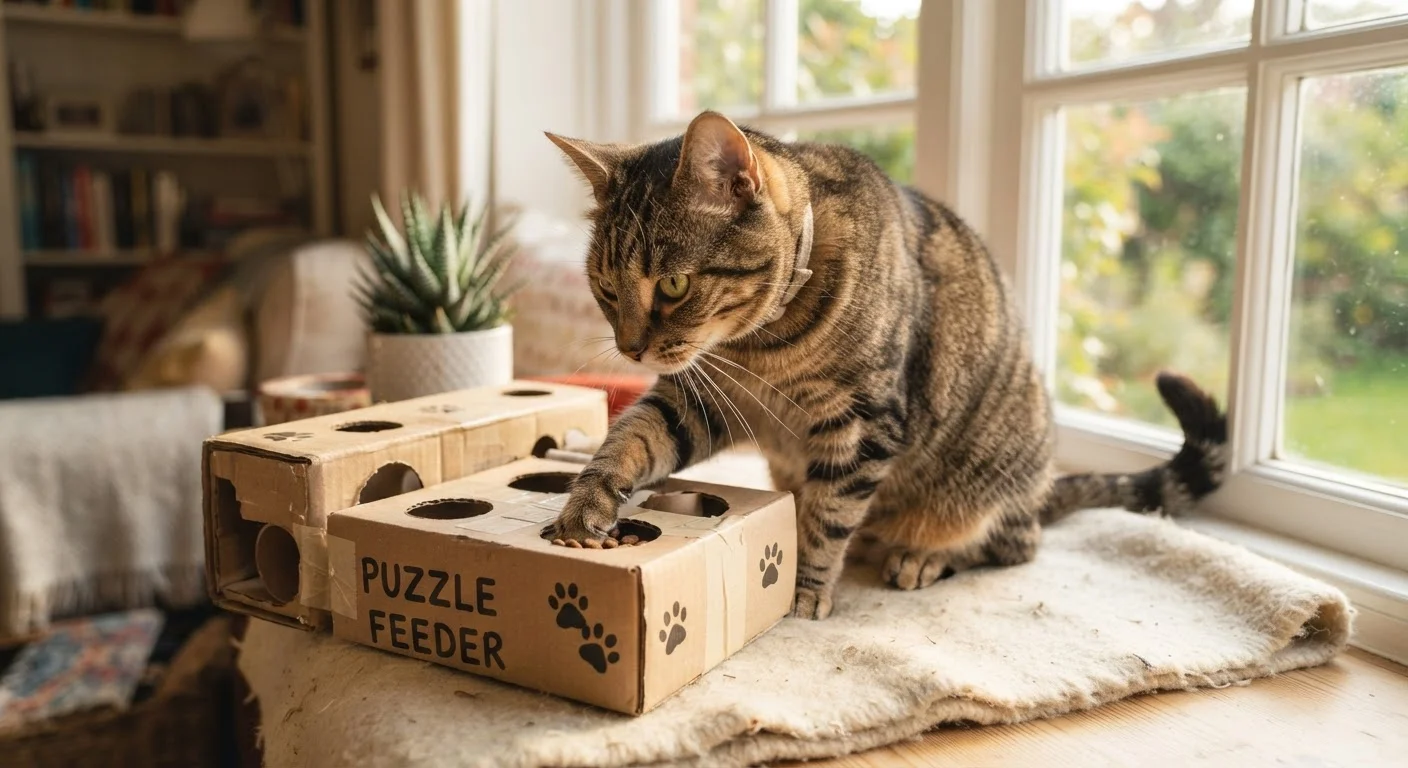
Feeding time is one of the most underused enrichment opportunities. Instead of placing food in a bowl, use puzzle feeders, snuffle mats, or scatter feeding to turn a meal into a problem-solving session. Dogs can work through a frozen stuffed toy; cats can hunt kibble hidden in cardboard tubes; birds can forage through shredded paper for seeds; small rodents thrive when food is buried in bedding or tucked into foraging toys.
The core principle is the same across species: engaging natural foraging instincts reduces frustration and gives the animal a productive outlet for energy and focus.
Turning feeding time into a foraging activity is one of the simplest, highest-impact enrichment shifts you can make.
Rotate Toys and Environments Regularly
A toy left out indefinitely loses its novelty within days. A simple rotation — cycling through a set of toys on a weekly or bi-weekly schedule — makes each item feel new again when it reappears. The same logic applies to the physical environment: rearranging climbing structures, adding a new perch, or placing a cardboard box in a fresh location can reinvigorate exploration in cats and small animals alike.
For birds, introducing novel safe objects (wooden spools, paper cups, unscented natural materials) supports natural investigative behaviors that help prevent feather-destructive habits linked to boredom.
Rotating toys on a schedule costs nothing but dramatically extends their enrichment value.
Train Daily — Even for Just Five Minutes
Training isn't only about obedience. Short, consistent training sessions give pets a structured mental challenge and strengthen the bond between animal and owner. Dogs benefit from learning new cues or practicing impulse control; cats can be clicker-trained to target, sit, or navigate obstacle courses; birds are highly capable learners who thrive with daily interaction and novel tasks.
Even small caged animals like rats respond well to reward-based training and can learn to navigate simple mazes. Daily sessions of five to ten minutes are more effective than longer, infrequent ones because they maintain a learning rhythm without overtaxing attention spans.
A consistent five-minute training session each day delivers more cognitive benefit than occasional longer sessions.
Engage the Senses Beyond Sight and Sound
Pets experience the world through senses humans often overlook. Scent enrichment is particularly powerful: dogs benefit from nosework games where treats or scented objects are hidden around the home; cats are stimulated by safe herbs like valerian or silver vine; birds appreciate varied textures and food items that introduce new tastes and smells.
Olfactory enrichment is low-effort and high-reward. Placing a few drops of a safe, unfamiliar food scent on a paper towel or hiding scented items in a foraging activity can occupy a dog or cat for significantly longer than a standard toy would.
Scent-based enrichment engages instincts that visual toys simply cannot reach.
Create Safe Observation and Exploration Zones
For cats especially, access to a window with outdoor views provides hours of passive stimulation — birds, movement, and changing light all engage predatory instincts in a harmless way. Window perches, bird feeders placed where cats can observe safely, and secure outdoor enclosures (commonly called catios) expand a cat's perceived territory without the risks of outdoor exposure. For more on balancing indoor and outdoor access, see our overview of what research says about indoor vs. outdoor cats.
For small caged animals like guinea pigs and rabbits, supervised floor time in a safe, enclosed space allows natural exploration. Birds benefit from out-of-cage time in a bird-proofed room. These exploration sessions support psychological health and reduce the frustration of confinement.
Access to a window view or safe exploration space can dramatically reduce stress-driven behaviors in cats and small animals.
Offer Social and Species-Appropriate Interaction
Some pets are inherently social and experience genuine distress when isolated for long periods. Parrots and other highly social bird species, for instance, need consistent daily interaction to remain psychologically healthy — a mirror alone is not a substitute. Guinea pigs and rabbits generally benefit from companionship with a bonded animal of the same species. Dogs are social by nature and need consistent human engagement beyond basic care tasks.
Matching the type of social interaction to the animal's species-specific needs is as important as the interaction itself. Understanding those needs is part of responsible, enrichment-minded ownership and connects directly to the broader principles outlined in our Pet Health & Wellness hub.
Species-appropriate social interaction is a form of enrichment that no toy or puzzle can fully replace.
Building Enrichment Into Your Routine
The most effective enrichment isn't a one-off event — it's woven into everyday life. Rotating activities every few days maintains novelty, which is key to sustained engagement. Even small changes, like a new hiding spot for food or a rearranged enclosure, can re-spark curiosity in a pet that had gone quiet or withdrawn.
Start Small, Stay Consistent
You don't need to overhaul your pet's routine overnight. Pick one or two enrichment strategies from this list and practice them consistently for two weeks before adding more. Consistency creates the predictable novelty that keeps pets engaged. Gradual buildup also helps you observe which activities genuinely excite your individual animal — because enrichment preferences vary even within the same species.
If you're noticing behavioral problems alongside signs of boredom, enrichment is an important first step — but some issues have layered causes. Our article on why pets develop behavioral problems breaks down what's usually driving common issues. And for a broader picture of habits that support long-term health, explore the everyday habits that support a longer, healthier life for your pet.
This article is for general informational purposes only and is not a substitute for professional veterinary advice. If your pet shows sudden or severe behavioral changes, consult a licensed veterinarian or certified animal behaviorist.