

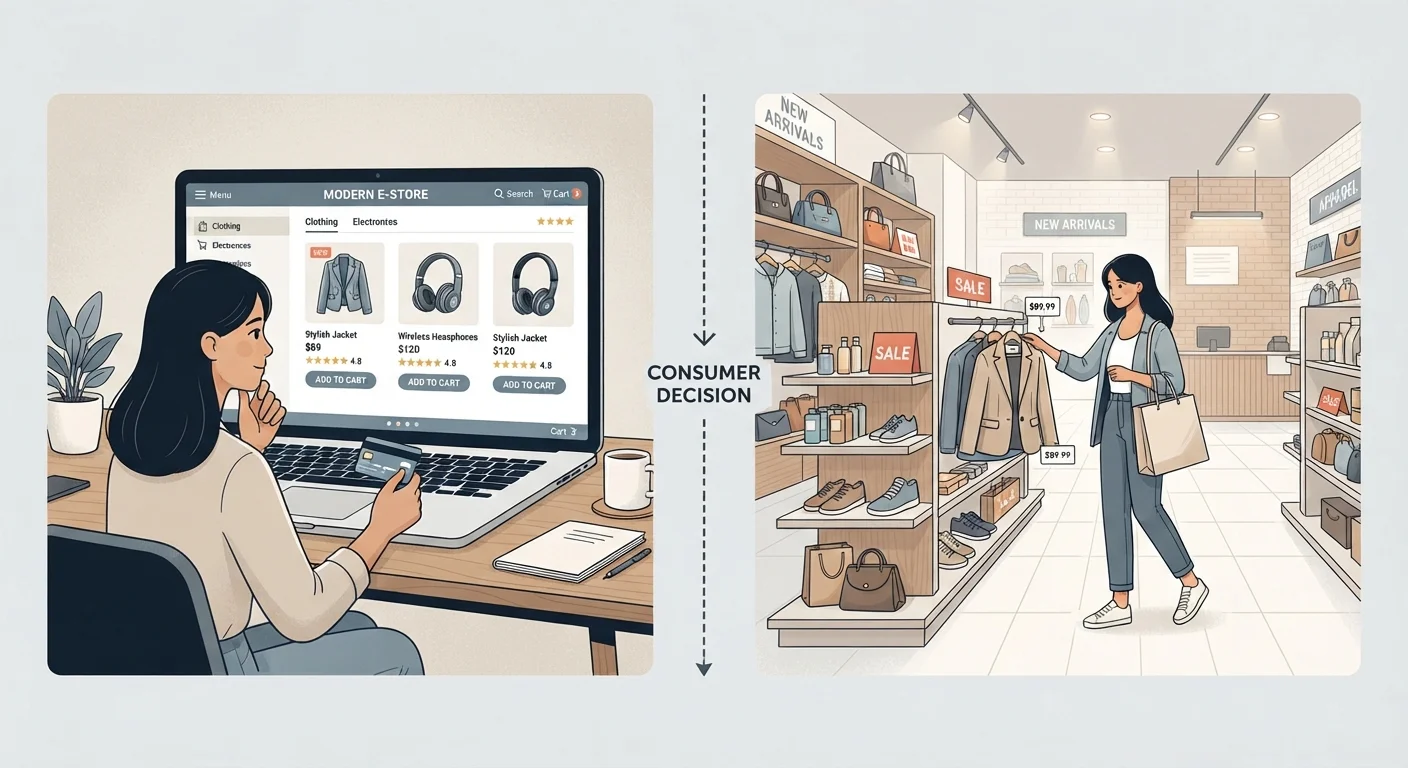
Key Takeaways
- Online channels typically offer wider selection and easier price comparison across many sellers.
- Physical stores let you inspect, try on, or test products before committing to a purchase.
- Return processes and costs differ significantly between channels and can affect your total value.
- Shipping timelines and instant gratification remain clear advantages for in-store shopping.
- The right channel often depends on the product category, not personal preference alone.
Option A
Digital Storefronts (Online Marketplaces)
The always-open, inventory-deep shopping channel.
Best for: Shoppers who know what they want, value price comparison, and prioritize convenience over immediacy.
Option B
Physical Retail (Brick-and-Mortar Stores)
The tactile, immediate, hands-on shopping experience.
Best for: Shoppers who want to evaluate a product in person, need it today, or prefer face-to-face service.
If you're buying a familiar, standardized product like a cable or household staple
Digital Storefronts (Online Marketplaces)
Standardized items carry little purchase risk online, and you can compare prices across multiple sellers in minutes.
If you need clothing, shoes, or anything where fit and feel matter
Physical Retail (Brick-and-Mortar Stores)
Trying before buying drastically reduces the chance of a return trip and the hassle of restocking fees or shipping costs.
If you need the item today or within hours
Physical Retail (Brick-and-Mortar Stores)
Even the fastest same-day delivery services aren't guaranteed, and in-store pickup eliminates shipping uncertainty entirely.
If you're researching a big-ticket or complex purchase
Physical Retail (Brick-and-Mortar Stores)
Hands-on evaluation and staff expertise help clarify differences that product pages can't always convey.
If you're buying gifts or stocking up on items you use regularly
Digital Storefronts (Online Marketplaces)
Subscription or bulk options, delivery scheduling, and broader variety make repeat or planned purchases more efficient online.
Price and Selection: Who Wins on Value?
Online marketplaces aggregate inventory from multiple sellers, which creates natural pricing competition. A shopper searching for a specific item can often see a range of prices from various vendors on a single page — something a physical store simply cannot replicate within four walls. That competition tends to keep prices lower on commodity products.
Physical retailers, however, offer value in less obvious ways. Staff expertise, curated assortment, and the ability to evaluate quality firsthand can prevent costly mistakes. Buying the wrong size mattress online and returning it is far more disruptive than testing one in a showroom. Selection at a brick-and-mortar store is typically narrower, but it's often pre-vetted for regional demand and relevance.
| Criterion | Digital Storefronts | Physical Retail |
|---|---|---|
| Price competition | High — multiple sellers visible | Limited to store's own pricing |
| Product selection | Typically very broad | Curated, regionally focused |
| Ability to inspect item | Photos and reviews only | Full tactile evaluation |
| Speed of acquisition | Hours to days (shipping) | Immediate takeaway |
| Return process | Varies; often requires shipping | Usually immediate, in person |
| Customer service | Chat or email; async | Real-time, face-to-face |
| Shopping hours | 24/7 availability | Fixed store hours |
| Risk of shipping damage | Present | None |
For a deeper look at how these dynamics play out by product type, see which product categories suit each channel.
The Experience Factor: Convenience vs. Confidence
Shopping online removes nearly every friction point from the browsing stage — no parking, no crowds, no store hours. Filters, reviews, and comparison tools let a consumer narrow thousands of options in minutes. That efficiency is genuinely valuable when you already know what you want.
Physical retail earns its place by delivering something digital channels cannot: sensory confirmation. You can check a jacket's weight, test a mattress firmness, or hear how a speaker sounds at volume. For categories where tactile quality or fit drives satisfaction, that hands-on moment materially reduces buyer's remorse.
~20%
Average online return rate for apparel
Industry research consistently estimates that clothing and footwear return rates online are roughly double those of in-store purchases, reflecting fit and quality uncertainty.
70%+
Shoppers who research online before buying in store
Multiple consumer behavior surveys have found that a substantial majority of in-store purchases are preceded by online research, blurring the line between channels.
Customer service also diverges sharply. In-store staff can answer questions in real time, demonstrate products, and resolve issues on the spot. Online support, while often available 24/7 via chat, tends to be slower for complex questions. As the same product can feel entirely different depending on where you buy it, channel choice is rarely neutral.
Returns, Delivery, and the True Cost of Convenience
Returns are where channel differences hit consumers hardest. Many online sellers offer free return shipping, but policies vary widely — restocking fees, limited return windows, and the inconvenience of repackaging and dropping off a parcel can erode apparent savings. Physical stores generally allow you to walk a product back in and receive an immediate refund or exchange, though their windows and exceptions vary too.
Delivery timelines have improved dramatically, but they still introduce uncertainty. Damaged shipments, delayed packages, and porch theft are real risks that don't apply to in-store purchases. On the other hand, in-store shopping requires your time and transportation, which carry their own hidden costs.
The Hybrid Approach Is Increasingly Common
Many consumers now blend both channels — researching online for price and reviews, then purchasing in store to avoid shipping risk, or vice versa. Click-and-collect (buy online, pick up in store) is one formalized version of this approach. Neither channel needs to be your default for every purchase; matching the channel to the product category and your specific priorities tends to produce the best outcomes.
Understanding these trade-offs in full is covered in our complete consumer's guide to online vs. in-store shopping, which walks through every major factor in detail. For a decision framework you can apply before any purchase, the Smarter Decisions hub is a useful starting point.