
Key Takeaways
- The word 'free' activates an emotional response that bypasses rational cost-benefit thinking.
- Free offers still carry costs — in time, data, subscriptions, or future behavior.
- BOGO and free-shipping promotions often increase total spending rather than reduce it.
- Awareness of the zero price effect doesn't eliminate it, but creates a useful pause.
- Asking 'what am I actually exchanging?' reveals the real terms of any free offer.
The Zero Price Effect
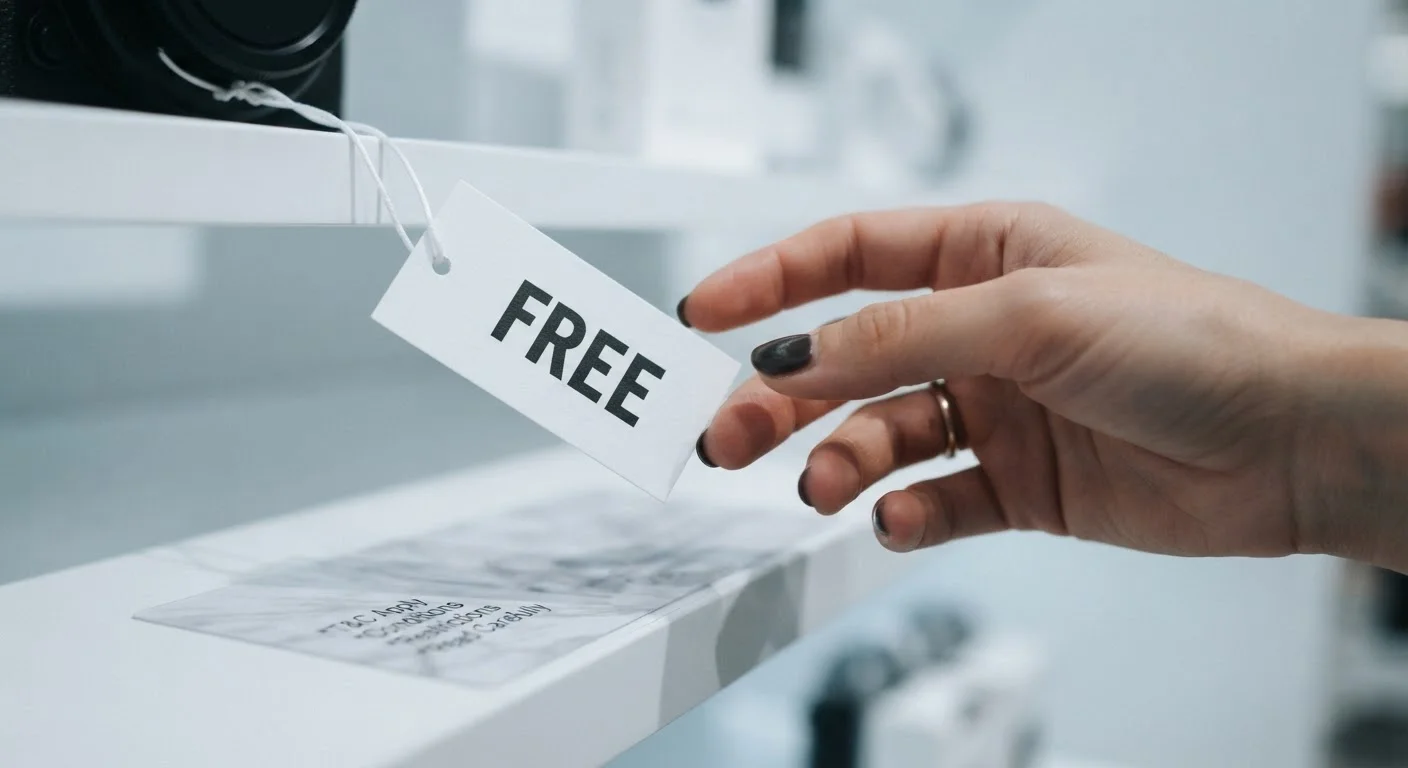
The zero price effect is a cognitive bias where people dramatically overvalue something simply because it costs nothing. When the price drops to zero, the perceived benefit spikes far beyond what a small discount would produce — even if the item or offer itself hasn't changed. This response is instinctive and affects nearly everyone, regardless of financial sophistication.
First documented by behavioral economists Dan Ariely, Kristina Shampaner, and Nina Mazar in a 2007 paper in the Journal of Marketing Research, the effect shows that 'free' triggers an emotional rather than rational valuation response, bypassing normal cost-benefit analysis.
Why 'Free' Hits Differently Than 'Cheap'
Dropping a price from $1 to $0 produces a far bigger behavioral response than dropping it from $2 to $1 — even though both represent the same dollar reduction. That gap is the zero price effect in action, and it's not a quirk limited to naive shoppers. Research in behavioral economics confirms that the response is nearly universal and largely automatic.
The reason is psychological architecture. Most purchase decisions involve a mental weighing of gain against potential loss. But when the price reaches zero, that loss-side of the scale appears to vanish. There's no financial downside to consider, so the perceived upside inflates unchecked. The result is that people acquire things they wouldn't have sought out at any positive price.
This is why marketers don't just use 'free' to move excess inventory. They use it to reshape how you evaluate the entire offer around it. Understanding this mechanism is the starting point for evaluating any zero-cost promotion on its actual terms. For a broader look at how cognitive shortcuts influence spending, see the psychology behind why we overspend.
“Zero is not just another price. It turns out that zero is an emotional hot button — a source of irrational excitement.”
— Dan Ariely, Behavioral economist and author of 'Predictably Irrational'
The Hidden Exchange in Every Free Offer
Nothing is exchanged without cost — only the currency changes. When an offer is 'free,' you're typically paying with one or more of the following: your time, your attention, your personal data, your future subscription payments, or your sense of obligation to reciprocate.
Free trials are a clear illustration. A no-cost trial period is genuinely useful when you approach it with intention — but the business model depends on a predictable percentage of users not canceling. Auto-renewal defaults, buried cancellation flows, and trial lengths calibrated to when people forget they signed up are all structural features, not accidents.
Free shipping thresholds operate differently but follow the same logic. A $35 minimum to unlock free shipping can turn a $22 purchase into a $45 one, netting the retailer more revenue while you feel you've avoided a cost. Our article on why online isn't always cheaper explores how shipping costs fold into pricing in ways that aren't always visible.
Run the $2 Test Before You Claim It
When you encounter a free offer, mentally replace $0 with $2 and ask if you'd still want it. If the appeal disappears at a nominal price, the zero price effect is doing most of the work. This simple reframe helps separate genuine interest from automatic excitement about cost.
BOGO, Bundles, and the Second-Item Illusion
Buy-one-get-one promotions are among the most effective applications of the zero price effect because they layer it onto an existing purchase decision. The second item — priced at zero — creates an emotional momentum that makes the first feel more justified. Spend $30, get $30 free feels like a win. But consider: would you spend $30 on both items combined if they were sold as a bundle labeled that way? Often the answer is no.
Bundles and add-on freebies work similarly. A 'free gift with purchase' shifts attention away from whether the purchase itself is worthwhile. The gift becomes the mental anchor, and the purchase becomes the means to claim it.
2007
Year the zero price effect was formally documented
Ariely, Shampaner, and Mazar published foundational research in the Journal of Marketing Research showing 'free' triggers disproportionate preference shifts.
~48%
Free trial subscribers who forget to cancel
Industry estimates vary, but subscription analytics firms have reported that a significant portion of trial conversions result from inertia rather than active intent to subscribe.
The practical test for any BOGO or bundle: evaluate each item independently. Would you buy it alone, at its implied price, because you actually want it? If the honest answer is no, the 'free' component is doing work your rational judgment wouldn't otherwise approve. See how this connects to impulse patterns in our piece on deliberate vs. one-click shopping.
Using Awareness to Make Clearer Decisions
Research consistently shows that knowing about a cognitive bias doesn't fully neutralize it — but it does create space for a more deliberate pause. When you recognize that your enthusiasm for a free offer may be inflated, you can run a simple reframe: mentally substitute a small positive price and notice whether your interest holds.
If a free sample, trial, or add-on would still interest you at $2, it likely has genuine value to you. If your interest evaporates the moment a nominal price appears, the appeal was almost entirely about the zero — not the product.
Also worth considering: what you give up. 'Free' offers funded by data collection, attention, or behavioral tracking represent a real exchange — just one priced in a currency that's harder to see on a receipt. The question 'what am I actually giving here?' is more useful than 'what does this cost?' For a related look at what 'free' return policies can obscure, see what free returns really means. And for a wider view of how seemingly great deals can mislead, traps that turn good deals bad is worth a read.
Awareness Has Limits — and That's Normal
Even people who study behavioral economics professionally report being influenced by zero-cost framing. The goal isn't to become immune to 'free' offers but to create a brief, deliberate pause before acting on them. Small friction — like waiting 10 minutes before adding a free-triggered item to your cart — is often enough to let a more considered judgment surface.