

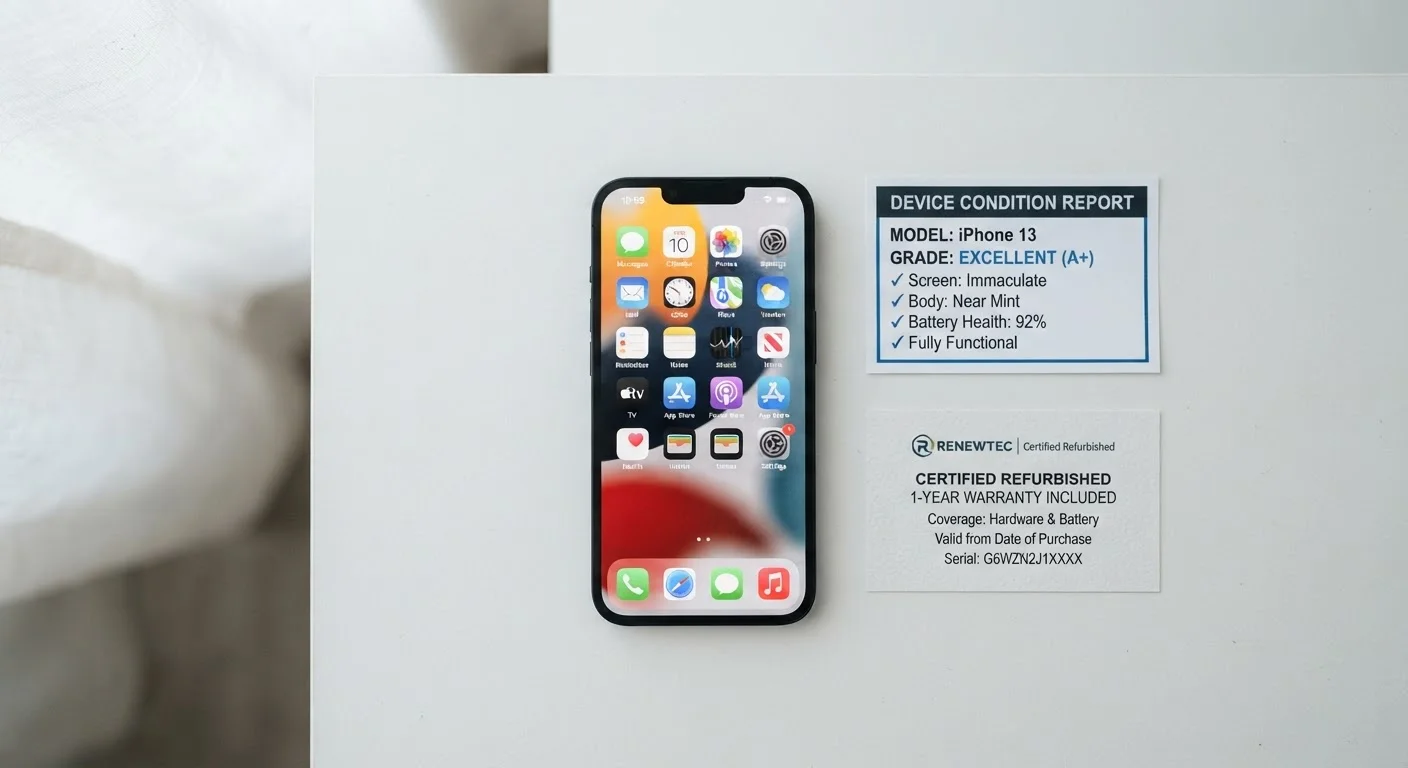
Key Takeaways
- Grading labels like "Grade A" are not standardized — each seller defines them differently.
- Manufacturer-certified refurbished devices generally offer stronger quality assurance than seller-refurbished ones.
- Warranty length and what it covers matter more than the grade letter alone.
- "Unlocked" means the phone works on any compatible carrier, not that it is in better condition.
- Battery health is often the most important condition detail to ask about before buying.
Refurbished Phone
A refurbished phone is a previously owned or returned device that has been inspected, repaired if needed, and tested before being resold. It is not the same as a used phone sold as-is — a refurbished device has gone through some level of quality review. The depth of that review, however, varies enormously depending on who did it and what standards they applied.
"Manufacturer-refurbished" means the original maker or an authorized partner handled the process; "seller-refurbished" means a third-party retailer did — the two carry very different quality implications.
Why the Refurbished Market Is Confusing — and How to Navigate It
The refurbished phone market has grown significantly as consumers look for ways to stretch their budgets on devices that often cost several hundred dollars new. But the labeling on refurbished listings can feel like a foreign language: Grade A, Grade B, CPO, unlocked, seller-refurbished, certified. None of these terms are regulated by a central authority, which means each seller gets to define them however they choose.
That lack of standardization is the single most important thing to understand before shopping refurbished. A "Grade A" phone from one seller might have zero scratches; from another, it might have a hairline crack on the frame. Reading the fine print — not just the grade letter — is the only way to know what you are actually getting.
For a broader grounding in retail terminology that affects your purchases, see our plain-language guide to shopping terms.
~15%
Typical price discount vs. new equivalent
Industry analysts generally estimate refurbished smartphones sell at a 15–30% discount compared to their new counterparts, though the range varies by model age and condition grade.
500+
Charge cycles before notable battery degradation
Most lithium-ion phone batteries are rated to retain about 80% capacity after 500 full charge cycles, per published battery research and manufacturer documentation.
1 year
Typical warranty on manufacturer-certified refurbs
Manufacturer-certified refurbished programs from major phone brands commonly include a one-year limited warranty, comparable to new device coverage.
Decoding Condition Grades: A, B, C, and Beyond
Most refurbished sellers use a letter or descriptor system to communicate cosmetic and functional condition. Here is what those grades generally mean — keeping in mind that definitions shift by seller:
- Grade A / Like New / Excellent: Little to no visible wear. Screen and body are typically scratch-free or have only micro-abrasions invisible from normal viewing distance. Fully functional.
- Grade B / Good: Light cosmetic wear — minor scratches on the body or faint marks on the screen. All core functions work. This grade often represents strong value if cosmetics are not a priority.
- Grade C / Fair / Acceptable: Noticeable scratches, scuffs, or wear marks. May have a replaced screen or other component. Works as expected, but shows its age visually.
Some sellers also use descriptors like "scratch and dent" or "open box." Open box usually means the device was returned unused or barely used and still has most original packaging. Scratch and dent typically signals cosmetic damage with no functional issues.
Always Read the Seller's Grade Definitions
Before interpreting any grade letter, scroll to the seller's own description of what each grade means. Responsible sellers define their grading criteria clearly — including whether screens have been replaced, what level of scratches is acceptable, and whether the original charger is included. If a listing does not include this information, that itself is a signal worth noting.
Certified Refurbished vs. Seller-Refurbished: A Critical Distinction
The word "certified" carries real weight — but only when it comes from the manufacturer or an authorized partner. Manufacturer-certified programs typically involve a defined inspection checklist, replacement of faulty components with genuine parts, a factory reset to remove prior data, and a warranty that mirrors what you would get with a new device (often around one year).
Seller-refurbished devices are inspected and repaired by a third-party retailer using their own standards. That does not automatically make them inferior — some third-party refurbishers have rigorous processes — but it means you need to investigate the seller's reputation and their specific warranty offer rather than relying on the label alone.
Understanding what warranty terms actually protect you is essential. Our glossary of major-purchase terms explains warranty language in plain terms. Also worth reading: how to read durability signals across product categories.
What "Unlocked" Means — and What It Doesn't
"Unlocked" refers to carrier compatibility, not condition. A phone sold locked to a specific carrier will only accept that carrier's SIM card. An unlocked phone accepts a SIM card from any compatible carrier — useful if you want to switch providers or travel internationally with a local SIM.
Refurbished phones are often sold unlocked because they have been reset and had carrier restrictions removed. This is genuinely useful, but it tells you nothing about the physical condition of the device. Do not let the word "unlocked" substitute for condition information in a listing.
If you want to compare what the phone's screen and hardware specs actually deliver day to day, our guide to reading a phone spec sheet and our display specs explainer can help you evaluate listings more confidently.
Network Compatibility Is Separate From Being Unlocked
An unlocked phone can accept any carrier's SIM, but it still needs to support that carrier's specific network bands (the radio frequencies used to transmit data). Before buying a refurbished unlocked phone, confirm that the device model supports the bands used by your intended carrier — especially if you are switching from a phone on a different network technology. Your carrier's website or customer support can confirm compatibility.
The Battery Question: What Sellers May Not Highlight
Battery health is arguably the most consequential factor in a refurbished phone's long-term usability, and it is also one of the details sellers are least likely to advertise unless it reflects well on the device. Lithium-ion batteries — the type used in virtually all smartphones — degrade with charge cycles. A phone that has been in service for two years may retain only 80% of its original battery capacity.
What that means practically: shorter time between charges, slower peak performance in some devices, and an eventual need to replace the battery. Before purchasing any refurbished phone, look for listings that disclose battery health as a percentage, or contact the seller to ask. A reputable refurbisher should be able to provide this information. If a seller cannot or will not, factor that uncertainty into your decision.
This article is for informational and educational purposes only. It does not constitute personalized purchasing or financial advice. Warranty terms, product availability, and seller policies vary; always verify details directly with the seller before making a purchase decision.