

| Typical 4G LTE download speed | 10–50 Mbps (Federal Communications Commission (FCC) broadband definitions) |
| Average home Wi-Fi speed (U.S.) | ~230 Mbps (Ookla Speedtest Global Index, approximate national average) |
| Data used by one hour of HD video streaming | ~3 GB (General industry estimate; varies by platform and quality setting) |
| Hotspot sessions limited by | Your mobile plan's data cap (Carrier-dependent; check your specific plan terms) |
| 5G latency (ideal conditions) | ~1–10 ms (GSMA technical specifications; real-world results vary) |
| Wi-Fi standard used in most modern devices | Wi-Fi 6 (802.11ax) (Wi-Fi Alliance certification program) |
Why These Terms Matter on Your Phone Every Day
Every time you open an app, stream a video, or send a message, your phone is making a silent decision: use mobile data or connect via Wi-Fi? The icons in your status bar — those signal bars, the 'LTE' or '5G' label, the Wi-Fi fan — are telling you exactly what's happening. But for most people, those symbols are background noise.
This glossary cuts through the clutter. Whether you're trying to avoid burning through your data plan, troubleshoot a dropped connection, or simply understand what your carrier means by 'hotspot included,' the definitions below give you a working vocabulary — no engineering degree required.
For a deeper look at how Wi-Fi behaves inside your home — including why signal drops in certain rooms — see our home network explainer.
| Typical 4G LTE download speed | 10–50 Mbps (Federal Communications Commission (FCC) broadband definitions) |
| Average home Wi-Fi speed (U.S.) | ~230 Mbps (Ookla Speedtest Global Index, approximate national average) |
| Data used by one hour of HD video streaming | ~3 GB (General industry estimate; varies by platform and quality setting) |
| Hotspot sessions limited by | Your mobile plan's data cap (Carrier-dependent; check your specific plan terms) |
| 5G latency (ideal conditions) | ~1–10 ms (GSMA technical specifications; real-world results vary) |
| Wi-Fi standard used in most modern devices | Wi-Fi 6 (802.11ax) (Wi-Fi Alliance certification program) |
Core Terms: Mobile Data, Wi-Fi, and Hotspots Defined
These are the three concepts that come up most often and cause the most confusion when they overlap.
Mobile Data vs. Wi-Fi
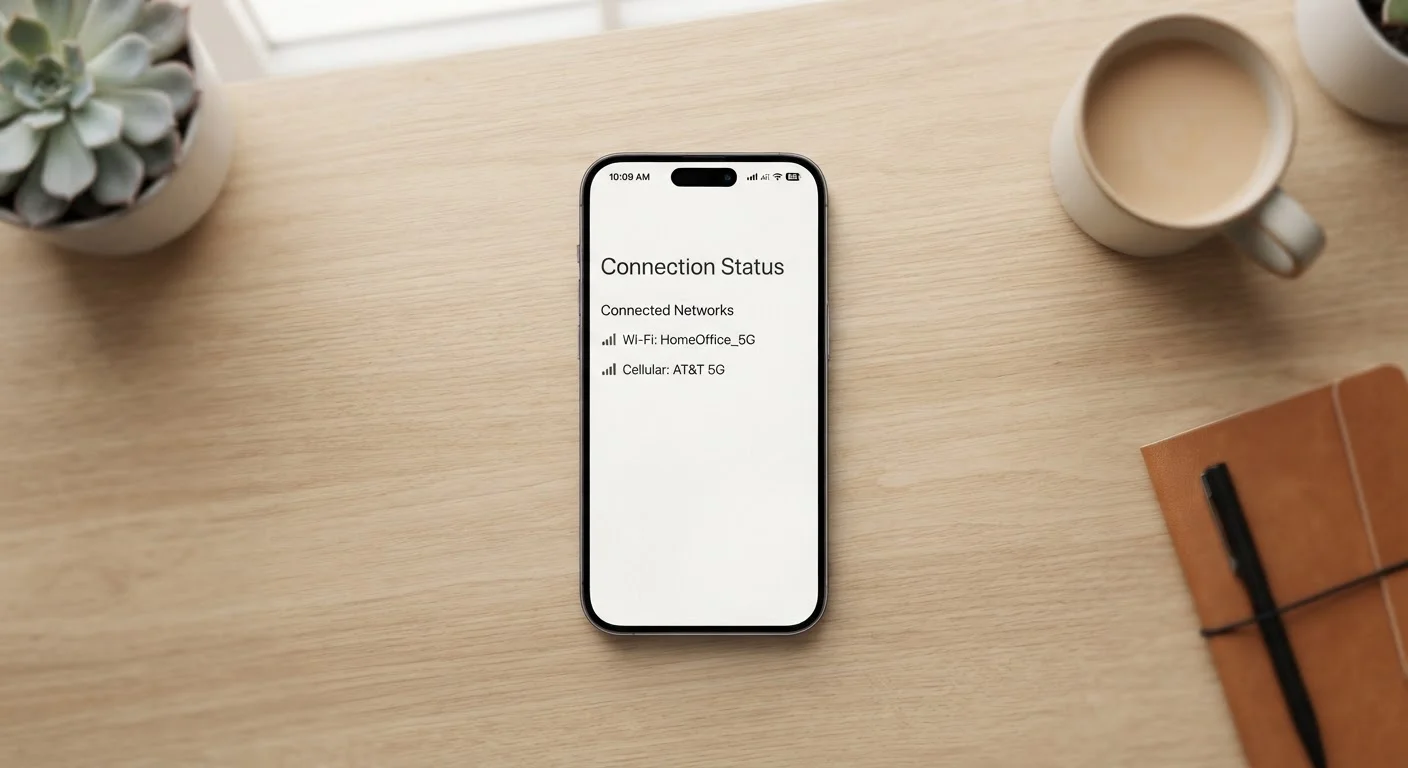
Mobile data travels through your carrier's cell towers. It follows you anywhere you have a signal. Wi-Fi is local — it comes from a router tethered to a building's internet connection. When both are available, your phone typically prefers Wi-Fi because it's usually faster and doesn't eat into your monthly data allowance.
The practical distinction matters most when your Wi-Fi signal is weak. A phone clinging to a poor Wi-Fi signal can actually feel slower than switching to mobile data. Some phones handle this automatically; on others, you may need to disable Wi-Fi manually in a weak-signal area.
Hotspots and Tethering
A personal hotspot turns your phone into a mobile router. Other devices — a laptop, a tablet, even a friend's phone — connect to your phone's Wi-Fi broadcast and share your mobile data connection. This is called tethering. It draws from your data plan, so streaming video through a hotspot can exhaust a monthly allowance quickly. Check your carrier plan before relying on it heavily.
Understand the real-world tradeoffs between these two connection types in our article on when to use Wi-Fi vs. mobile data.
Public Hotspots Carry Security Risks
Connecting to a public Wi-Fi hotspot — at a café, airport, or hotel — means your traffic passes through a network you don't control. Avoid logging into financial accounts or entering sensitive information on unsecured public networks. Using a VPN (Virtual Private Network) can add a layer of protection, though it does not eliminate all risk.
Network Generations and Speed: LTE, 4G, and 5G
The letters next to your signal bars — LTE, 4G, 5G — refer to the generation of cellular network your phone is currently using. Each generation is broadly faster and more efficient than the last, though what you actually experience depends heavily on your location, your carrier's infrastructure, and how many people are using the network at the same time.
- LTE / 4G LTE: The most widespread standard in the U.S. Handles everyday tasks — streaming, browsing, video calls — reliably in most populated areas.
- 5G: Newer and faster in ideal conditions, but coverage is still expanding. Millimeter-wave 5G (found in dense urban areas) offers very high speeds over short distances. Sub-6 GHz 5G covers more ground but at speeds closer to strong LTE.
For a grounded look at what 5G actually changes for the average user, see what 5G means for your everyday phone experience.
~3 GB
Data consumed per hour of HD video streaming
A general industry estimate; actual usage varies by streaming platform and selected quality setting.
10–50 Mbps
Typical 4G LTE download speed
According to FCC broadband speed benchmarks; real speeds depend on location, network load, and device.
1 ms
Target latency for 5G networks
Per GSMA technical specifications; real-world latency is typically higher depending on coverage and conditions.
Full Glossary Reference
Use this section as a quick lookup when a connectivity term appears in your phone's settings, on your carrier's website, or in a support article. Definitions are written for everyday use, not technical documentation.
Mobile Data
Internet access delivered through your carrier's cellular network — the same network your phone calls travel on. It works wherever you have a cell signal, without needing a Wi-Fi password.
Wi-Fi
A wireless connection to the internet routed through a local router, typically inside your home, office, or a public venue. Your phone connects to the router, and the router connects to the internet via a cable or fiber line.
Hotspot
A feature that lets your phone share its mobile data connection with other devices — like a laptop or tablet — by broadcasting a small Wi-Fi signal. The phone acts as a portable router.
Data Cap / Data Limit
The maximum amount of mobile data your plan allows each billing cycle before speeds are reduced or extra charges apply. Measured in gigabytes (GB).
Bandwidth
The maximum amount of data that can travel through a connection at once. Higher bandwidth generally means faster downloads and smoother video streaming.
LTE (4G LTE)
A widely used cellular network standard that offers reliable speeds for streaming, browsing, and video calls. The '4G' label refers to the fourth generation of mobile network technology.
5G
The fifth generation of cellular network technology, designed to deliver faster speeds and lower latency than LTE in areas where it is deployed. Coverage varies significantly by location and carrier.
Latency
The time it takes for data to travel from your device to a server and back — measured in milliseconds. Lower latency feels snappier for gaming, video calls, and real-time apps.
Tethering
Sharing your phone's internet connection with another device, either via Wi-Fi (hotspot), a USB cable, or Bluetooth. Tethering uses your mobile data plan.
SSID
The name of a Wi-Fi network as it appears in your device's connection list (for example, 'HomeNetwork_2G'). SSID stands for Service Set Identifier.
Data Throttling
A deliberate slowdown of your mobile data speeds by your carrier, typically after you have used a set amount of high-speed data in a billing cycle or during network congestion.
Roaming
Using your phone on a network other than your home carrier's — often when traveling internationally or in areas not covered by your carrier. Roaming can incur extra charges depending on your plan.
If you encounter smart home connectivity terms — such as Zigbee, Z-Wave, or Matter — those fall under a different set of standards. Our smart home tech glossary covers those in the same plain-English format.
Once you're comfortable with these basics, a natural next step is understanding how your phone collects and shares data in the background. Our guide to mobile privacy and data collection explains what the settings actually do and how to make informed choices.