

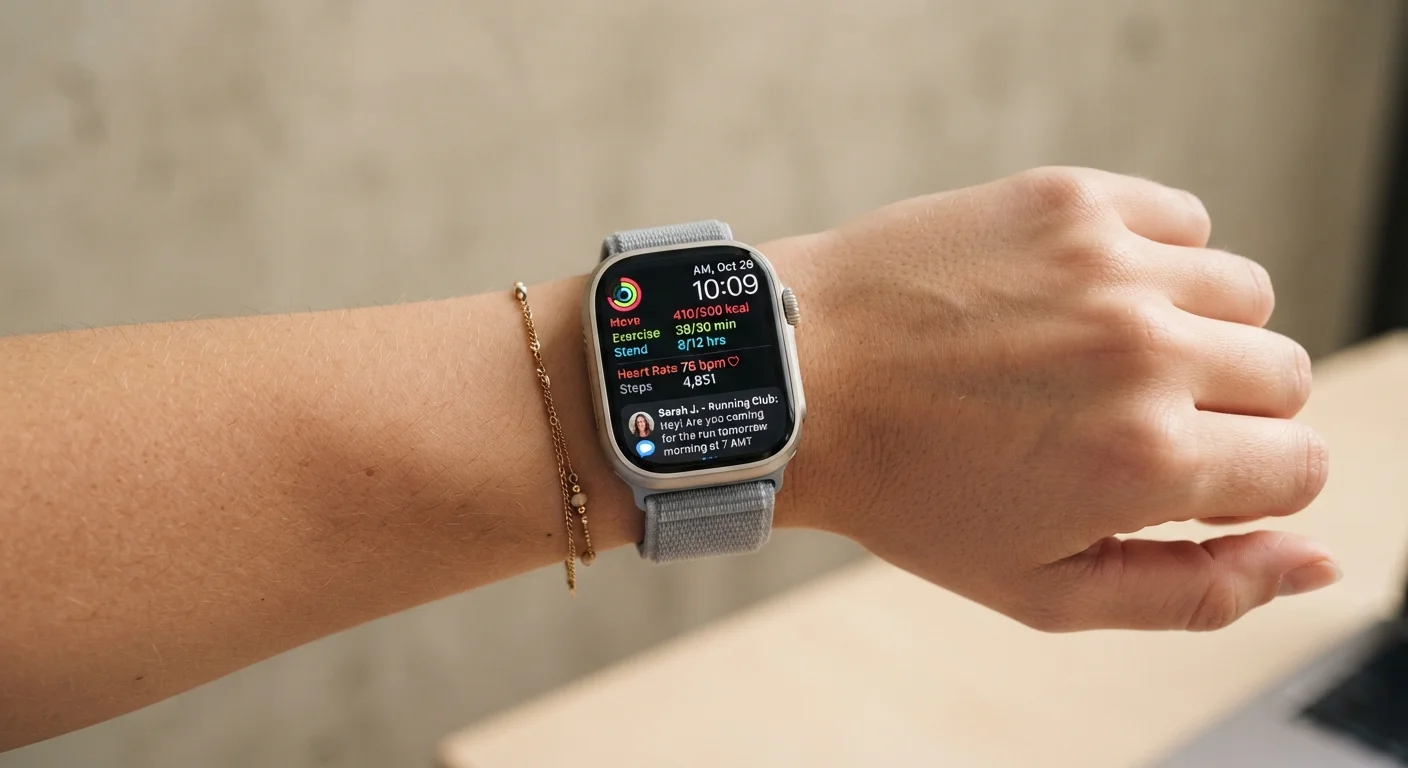
Key Takeaways
- Smartwatch features fall into clear categories: health sensors, safety tools, connectivity, and productivity.
- ECG and blood oxygen sensors generate data but are not substitutes for clinical medical diagnosis.
- GPS on a smartwatch lets you track routes without carrying your phone.
- NFC enables tap-to-pay directly from your wrist at supported terminals.
- Battery life varies significantly depending on which features you use most actively.
- Matching the feature set to your daily routine matters more than chasing the longest spec list.
Health & Fitness Monitoring
Health tracking is the defining feature category for most people shopping for a smartwatch. Understanding what each sensor actually measures — and what it cannot do — prevents frustration later.
Heart rate monitoring uses optical sensors (LEDs that detect blood flow through the skin) to report beats per minute continuously or on demand. It is useful for understanding exercise intensity and resting trends over time.
ECG (electrocardiogram) goes a step further by recording the electrical activity of your heart in a single-lead reading. This can flag irregular rhythms such as atrial fibrillation for follow-up with a doctor. It is not a diagnostic tool — a cardiologist interprets clinical ECGs with far more leads and context.
Blood oxygen (SpO2) sensors estimate the percentage of oxygen in your bloodstream by shining light through the skin. Consumer-grade accuracy varies, and these readings should never replace a medical-grade pulse oximeter for clinical decisions.
Sleep tracking uses motion detection and heart rate data to estimate light, deep, and REM sleep stages. The results are useful for spotting broad patterns, though the methodology differs from clinical sleep studies.
Stress and recovery scores are typically derived from heart rate variability (HRV) — the tiny fluctuations in time between heartbeats. Higher variability generally correlates with readiness; lower variability can indicate fatigue or stress.
Treat wearable health data as a trend tool, not a diagnostic report. Week-over-week patterns in resting heart rate or sleep quality are far more meaningful than any single reading.
Consumer sensor accuracy fluctuates based on skin tone, fit, movement, and ambient light. Longitudinal patterns smooth out these variables and surface genuinely actionable insights.
Before enabling continuous GPS tracking, test your watch's battery drain rate on a short outing first — some models lose charge four times faster with GPS active.
GPS is one of the heaviest power draws on a smartwatch. Knowing actual battery behavior under your real usage conditions prevents a dead watch mid-workout.
This article is for informational purposes only and does not constitute medical advice. Always consult a qualified healthcare professional before making decisions based on health data from a consumer wearable.
Safety & Emergency Features
Several smartwatch features exist specifically to protect you during emergencies — and they work in ways many owners never fully explore.
Fall detection uses accelerometers and gyroscopes to identify the motion signature of a hard fall followed by stillness. If you don't respond within a short window, the watch can automatically call emergency services and share your location. It's particularly relevant for older adults or those with medical conditions.
Crash detection, available on some newer models, applies similar logic to vehicle collisions — detecting the sharp deceleration and impact forces associated with a serious crash.
Emergency SOS allows you to trigger a call to emergency services directly from your wrist, often by holding a side button. Some watches can also share your location with emergency contacts.
Emergency Features Need Cellular to Work
Fall detection, crash detection, and Emergency SOS all depend on a live network connection to contact emergency services automatically. If your watch lacks its own LTE chip, it needs your phone nearby. In remote areas with poor coverage, these features may be unable to complete a call even when triggered correctly.
These safety features rely on a cellular connection (either through the watch's own LTE chip or a tethered phone). In areas with no signal, automatic emergency calls may not connect. Understand the limitations before relying solely on your watch in remote locations.
Navigation & Connectivity
Built-in GPS records your location and route data independently — without your phone in your pocket. This matters for runners, hikers, and cyclists who want accurate distance and pace without carrying extra devices. Some watches also include multi-band GPS (sometimes called L5 GPS), which improves accuracy in urban areas where tall buildings can reflect satellite signals.
NFC (Near Field Communication) is the short-range wireless technology that powers contactless payments. A watch with NFC can store your payment card credentials and let you tap to pay at any compatible terminal — the same terminals that accept tap-to-pay from a phone.
LTE/cellular connectivity means the watch has its own SIM (or eSIM) and can make calls, send messages, and stream data without being near your phone. This comes with an additional monthly plan cost through your carrier.
Bluetooth and Wi-Fi handle the watch's routine connection to your phone and home network. Bluetooth streams audio to wireless earbuds; Wi-Fi enables faster syncing and software updates. For more context on how wearables fit alongside your phone, see our smartphones and tablets guides.
Notifications & Productivity
A smartwatch acts as a filtered extension of your phone's notification stream. Calls, texts, calendar alerts, and app notifications can appear on your wrist, letting you decide whether to reach for your phone or ignore the interruption.
Voice assistants (the software-based assistants built into phone operating systems) can be invoked from the watch to set timers, send messages by dictation, or answer quick questions hands-free.
On-device storage and music playback let some watches store playlists locally and stream to Bluetooth headphones — a meaningful feature if you exercise without your phone. See how this pairs with personal audio gear in our practical shopping decision frameworks.
Reduce Notification Fatigue Right Away
When you first set up a smartwatch, resist the urge to mirror every phone notification to your wrist. Start with only calls and calendar alerts, then add app notifications selectively over a week. Most users find they want fewer, not more, interruptions once they experience the full stream on their wrist.
Battery Life & Hardware Considerations
Battery life is the trade-off that shapes almost every other feature decision. Always-on displays, continuous GPS, LTE, and active health sensors all draw power aggressively. A watch running all features simultaneously may need nightly charging; one with GPS disabled and heart rate checked periodically can last several days.
Display type matters too. AMOLED screens (a type of display that only lights individual pixels when needed) produce vivid color but consume more power. Transflective memory-in-pixel (MIP) displays, common on activity-focused watches, are far more battery-efficient and readable in bright sunlight.
Water resistance is rated in ATM (atmospheres of pressure) or to specific depths. A 5 ATM rating suits swimming; higher ratings are intended for water sports and diving.
5 ATM
Standard water resistance for swim-safe watches
ATM (atmosphere) ratings indicate the pressure a device can withstand; 5 ATM equates to approximately 50 meters of static water depth.
1–14 days
Typical smartwatch battery range across models
Battery life varies widely depending on display type, sensor use, GPS activity, and cellular connectivity — always check real-world estimates, not lab maximums.
How to Match Features to Your Actual Needs
The most capable watch isn't automatically the right one. The difference between fitness trackers and smartwatches often comes down to which feature categories you'll actually use week to week.
Start by identifying your primary use case. If daily health monitoring and emergency safety matter most, prioritize ECG capability, fall detection, and reliable LTE coverage. If you're a runner or cyclist, built-in GPS accuracy and battery endurance during long sessions should rank highest. If seamless phone integration and payment convenience are the goal, NFC and notification management become the differentiating factors.
Consider how features interact with your habits. Always-on display is genuinely useful in meetings; it drains the battery faster for someone who rarely glances at their wrist. Spend time auditing the features you'd realistically use before letting the spec sheet drive a decision you'll wear on your wrist every day.
Feature Availability Varies by Region and Model
Some health features — including ECG and certain irregular rhythm notifications — require regulatory clearance that varies by country. A watch sold in the US may have features disabled or absent in other markets, and vice versa. Always verify which capabilities are active in your region before purchase.