

Key Takeaways
- Fitness trackers prioritize health sensors and battery life over connectivity and apps.
- Smartwatches function as wrist-worn extensions of your smartphone, with fitness tracking added on.
- The two categories have converged significantly, with overlap in heart rate, sleep, and GPS features.
- Battery life remains one of the clearest practical differences between the two device types.
- Your intended daily use — health focus vs. productivity — is the most reliable guide to choosing.
Option A
Fitness Tracker
The focused, wear-all-day health monitoring companion.
Best for: People who want continuous health and activity data with minimal distractions and long battery life.
Option B
Smartwatch
The versatile wrist computer with health features built in.
Best for: People who want notifications, apps, and connectivity alongside fitness tracking on a single device.
If you want to monitor sleep, activity, and heart rate without smartphone distractions
Fitness Tracker
Fitness trackers are designed around continuous health monitoring and typically last days longer on a single charge, making them easier to wear around the clock.
If you want to handle calls, messages, and apps directly from your wrist
Smartwatch
Smartwatches connect deeply to your phone's ecosystem, letting you respond to notifications, use apps, and even pay for purchases without reaching for your phone.
If you exercise seriously and want detailed workout and recovery metrics
Fitness Tracker
Dedicated fitness trackers often offer more granular workout modes, recovery scores, and sensor accuracy tuned for athletic use cases.
If you want one device that handles both daily productivity and basic health tracking
Smartwatch
A smartwatch consolidates notifications, calendar alerts, and health data in one place, reducing how often you need to check your phone.
If battery anxiety is a concern and you dislike daily charging
Fitness Tracker
Most fitness trackers run five to fourteen days on a single charge, compared to one to two days for most smartwatches with active displays.
How Each Device Is Actually Designed
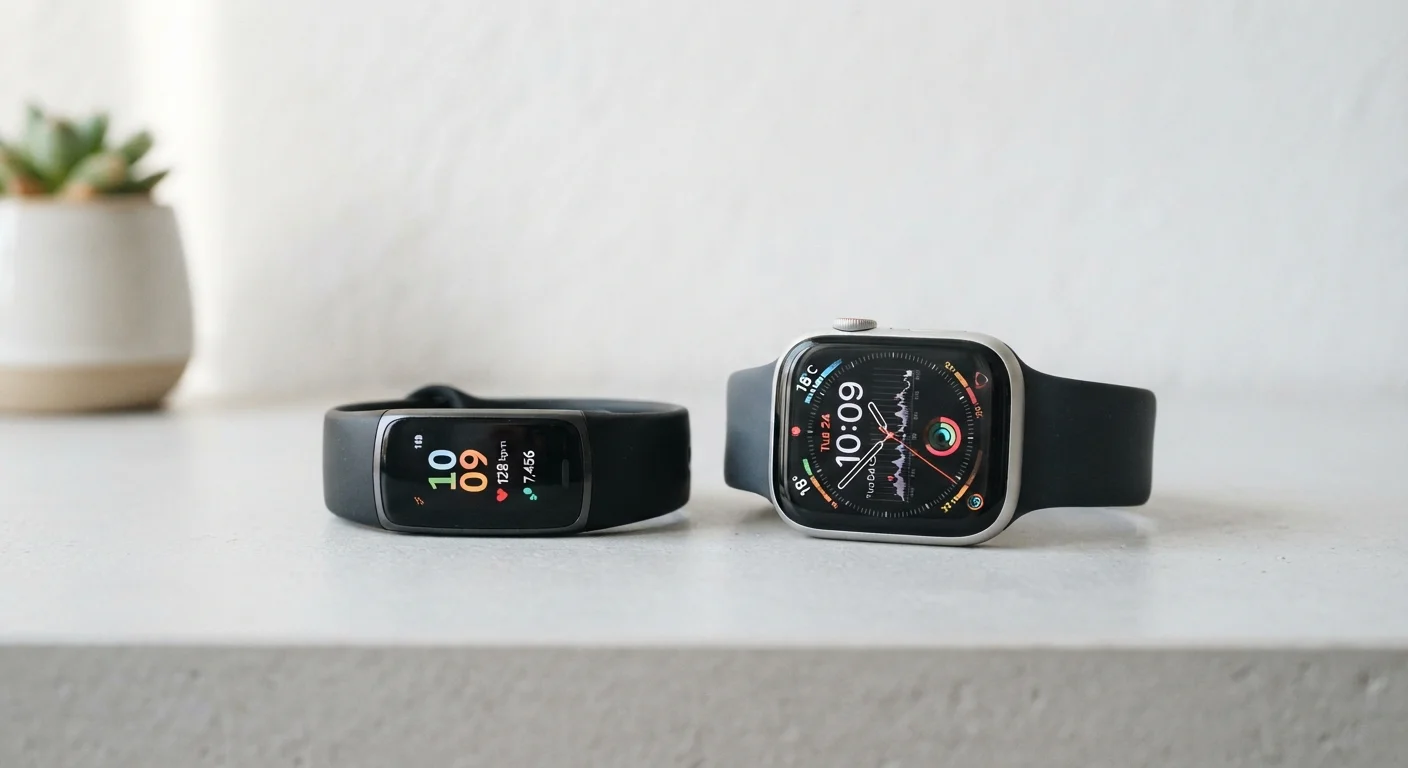
Despite looking similar on the wrist, fitness trackers and smartwatches are built around different priorities. A fitness tracker is engineered first and foremost as a health sensor platform. Its hardware centers on capturing biometric data — steps, heart rate, sleep stages, blood oxygen levels — as continuously and efficiently as possible. Everything about its design, from the slim form factor to the power-sipping processor, is optimized to keep that data flowing without constant charging.
A smartwatch, by contrast, starts from the premise of being a wearable computer. It runs a full operating system, supports third-party apps, and maintains a persistent connection to your smartphone. Health and fitness features are genuine and increasingly sophisticated, but they sit alongside a broader feature set that includes notifications, voice assistants, contactless payments, and in some cases cellular connectivity independent of your phone.
The result is a meaningful trade-off: smartwatches offer more versatility, while fitness trackers tend to offer more endurance and sensor focus. For a deeper look at what fitness tracker sensors actually capture — and where they fall short — see what a fitness tracker actually measures.
| Criterion | Fitness Tracker | Smartwatch |
|---|---|---|
| Primary purpose | Health and activity monitoring | Connected wrist computer |
| Battery life (typical) | 5–14 days | 1–2 days |
| App support | Limited or none | Full third-party app ecosystem |
| Notification handling | Basic mirroring or alerts | Full read and reply capability |
| Display size | Small, glanceable | Larger, interactive touchscreen |
| GPS | Built-in on many models | Built-in on most models |
| Sleep tracking | Core feature, detailed | Available, varies by model |
| Contactless payments | Rare | Common |
| Form factor | Slim, lightweight | Bulkier, watch-like |
Where the Lines Have Blurred
The honest complication is that both categories have moved toward each other over time. Many fitness trackers now include small color displays, smartphone notification mirroring, and GPS chips that were once exclusive to smartwatches. Smartwatches, meanwhile, have adopted features like continuous heart rate monitoring, sleep tracking, and multi-day workout logging that used to distinguish trackers.
That convergence makes the decision harder — but the underlying design philosophy still separates them. A fitness tracker with notification support is still optimized for health data collection first. A smartwatch with excellent fitness tracking is still optimized for connectivity and interactivity first. Knowing which priority matters more in your day-to-day life cuts through most of the marketing overlap.
Both Can Sync With Your Phone — But Differently
Fitness trackers typically sync data to a companion app for review after the fact. Smartwatches maintain a live, ongoing connection to your phone, enabling real-time interactions like replying to texts or streaming music. If you value reviewing data on your own schedule rather than managing a constant connection, that distinction changes how intrusive the device feels day-to-day.
If you want a comprehensive look at what smartwatch feature categories actually exist and what each does, this category-by-category breakdown covers everything from ECG to crash detection in plain language.
Battery Life, Display, and Everyday Feel
Battery life is the most tangible daily difference. Most dedicated fitness trackers run between five and fourteen days on a charge, depending on features enabled. Most smartwatches with always-on displays run one to two days. If you track sleep and don't want to remove your wearable each night to charge it, this distinction matters considerably.
Display size and interaction also differ. Smartwatches typically have larger, touch-enabled screens built for reading and tapping through apps. Fitness trackers generally have smaller screens intended for glanceable data — a step count, a heart rate, an incoming caller ID — rather than extended interaction.
5–14 days
Typical fitness tracker battery range
Battery endurance is a consistent advantage cited across consumer wearable reviews and manufacturer specifications.
1–2 days
Typical smartwatch battery range
Most smartwatches with always-on displays require nightly charging, a common trade-off noted in wearable usability research.
~30%
Wearable owners who use all purchased features
Industry surveys consistently find that a significant portion of smartwatch features go largely unused after the initial setup period.
Wrist comfort and form factor vary too. Fitness trackers are usually lighter and lower-profile, which some wearers prefer for overnight use or all-day wear in active environments. Smartwatches are bulkier but often more customizable in appearance, with interchangeable bands and watch faces. Before committing, it's worth reviewing what to check before committing to any wearable, including compatibility with your phone's operating system.
Choosing Based on How You Actually Live
The most useful question isn't which device has more features — it's which device fits the way you actually use your wrist every day. If your goal is to understand your health patterns, improve sleep, or track workout recovery without your wrist becoming a second notification screen, a fitness tracker is likely the more purposeful choice.
If you regularly miss calls or messages when your phone is in another room, want to leave your phone behind during short errands, or simply want one device that handles both productivity and wellness, a smartwatch earns its added complexity. Just be aware that more features often means more to set up, more to learn, and more frequent charging.
It's also worth being realistic about which features you'll actually engage with. Many smartwatch features go unused after the novelty wears off — an honest look at your habits before buying is more valuable than any spec sheet. And if you want a more detailed checklist for fitness trackers specifically, this practical guide walks through the key questions before you decide.
This article is for general informational purposes only. Health metrics provided by consumer wearables are not medical-grade measurements and should not be used to diagnose or treat any condition. Consult a qualified healthcare professional for any health concerns.