

Key Takeaways
- All-season tires are engineered for moderate conditions, not sustained ice or heavy snow.
- Winter tires use a softer rubber compound that stays pliable below 45°F for better grip.
- Stopping distances on ice can be significantly longer with all-season versus winter tires.
- Swapping to winter tires seasonally extends the life of both tire sets.
- Your climate, not just your driving habits, should determine which tire is right for you.
Option A
All-Season Tires
The year-round convenience compromise.
Best for: Drivers in mild climates who encounter occasional light snow or rain but rarely face sustained freezing temperatures.
Option B
Winter Tires
The purpose-built cold-weather performer.
Best for: Drivers in regions with regular snowfall, ice, or temperatures that frequently drop below 45°F.
If you live in a Sun Belt state or mild coastal region
All-Season Tires
Temps rarely drop below freezing, so all-season tires offer a practical, cost-effective solution without the hassle of seasonal swaps.
If you live where winter temperatures regularly fall below 45°F
Winter Tires
Below that temperature threshold, all-season compounds stiffen and lose grip. Winter tires maintain pliability and traction where it counts most.
If you commute daily through snow-prone mountain or northern states
Winter Tires
The safety margin winter tires provide on packed snow and ice is meaningful enough that many safety organizations recommend them for these conditions.
If you want one tire set for all twelve months without seasonal changes
All-Season Tires
All-season tires are a reasonable trade-off for drivers who accept moderate limitations in extreme cold or heavy snow.
The Core Difference Isn't the Tread Pattern - It's the Rubber
Most drivers look at tire tread and assume the more aggressive the pattern, the better it handles snow. That intuition isn't entirely wrong, but it misses the more critical factor: rubber compound.
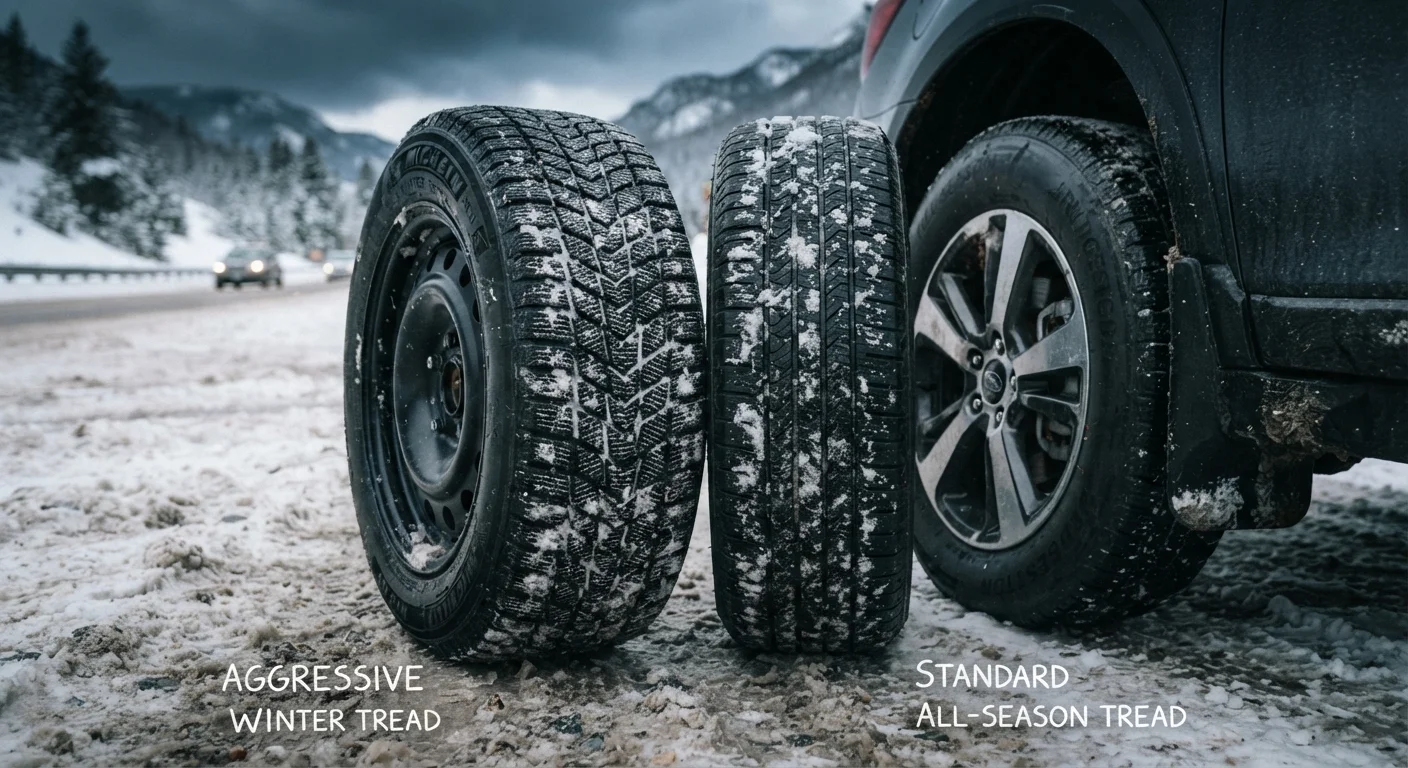
All-season tires use a compound formulated to perform across a wide temperature range - roughly 40°F and above. Below that threshold, the rubber gradually stiffens, reducing its ability to conform to road irregularities and maintain friction. Winter tires use a softer, silica-enriched compound specifically engineered to stay flexible in cold temperatures, giving them a measurable grip advantage on snow and ice.
Winter tires also feature sipes - thousands of tiny slits cut into each tread block - that create additional biting edges on ice surfaces. All-season tires have sipes too, but typically fewer and shallower. The combination of compound and siping is why winter tires consistently outperform all-season tires in controlled stopping-distance tests conducted in sub-freezing conditions.
For a deeper look at what the numbers and symbols on your sidewall actually mean, see our guide to tire pressure, tread depth, and sidewall markings.
| Criterion | All-Season Tires | Winter Tires |
|---|---|---|
| Optimal temperature range | Above ~45°F | Below 45°F and colder |
| Rubber compound | Harder, multi-season blend | Softer, silica-enriched |
| Ice braking performance | Moderate | Significantly stronger |
| Snow traction | Adequate in light snow | Superior in heavy or packed snow |
| Wet/rain performance | Strong | Good, but optimized for cold |
| Tread life expectancy | Year-round use; wears steadily | Seasonal use; longer per-mile life |
| Seasonal changeover required | No | Yes (typically twice per year) |
| Upfront cost | One set purchase | Second set plus possible wheels |
What the Safety Data Suggests
Independent testing by automotive safety organizations and consumer groups has consistently shown meaningful differences in braking performance between tire types in winter conditions. While specific numbers vary by tire model and test setup, the general pattern is clear: on ice and compacted snow, vehicles equipped with winter tires tend to stop in shorter distances than the same vehicles on all-season tires.
~25-30%
Shorter stopping distance on ice
Independent tire testing organizations have reported that winter tires can reduce stopping distances on ice by roughly 25-30% compared to all-season tires in sub-freezing conditions.
45°F
Temperature threshold for grip loss
Tire engineers and safety researchers generally cite 45°F (7°C) as the point where all-season rubber begins to stiffen and lose meaningful cold-weather grip advantage.
3PMSF
Snow traction certification symbol
The three-peak mountain snowflake symbol confirms a tire passed standardized snow traction testing, but does not reflect ice performance or rubber compound flexibility in extreme cold.
The 3PMSF symbol (three-peak mountain snowflake) on a tire sidewall indicates it has passed a standardized snow-traction test - but don't assume it guarantees ice performance. Many all-season tires now carry this symbol, yet still underperform dedicated winter tires in icy conditions because the rubber compound advantage remains.
For a comprehensive side-by-side breakdown of how these tires stack up in real-world winter scenarios, see our detailed comparison of all-season and winter tires.
Practical Considerations: Cost, Convenience, and Climate
Switching to winter tires each season involves upfront costs - purchasing the tires, possibly a second set of steel wheels for easier swapping, and installation fees twice a year. Many drivers weigh this against the convenience of staying on all-season tires year-round.
There's a counterintuitive financial argument worth considering: running two sets of tires means each set wears more slowly, potentially extending the total lifespan of both. Whether that offsets the purchase cost depends on local tire prices and how many miles you drive annually - something worth calculating for your own situation rather than assuming either way.
Climate is the deciding variable. If you live in a region where winters are consistently cold and snowy - the Upper Midwest, New England, mountain West - the case for winter tires is strong on safety grounds alone. If your winters are mild and snow is rare, all-season tires are a reasonable and widely used choice.
Check Local Regulations and Chain Requirements
Some states and Canadian provinces mandate winter tires or tire chains on certain roads during winter months. Requirements vary by jurisdiction, road type, and vehicle class. Check with your state's department of transportation before traveling through mountain passes or regions with seasonal driving laws.
This article provides general vehicle information for educational purposes and does not constitute professional automotive or safety advice. Consult a qualified tire professional for guidance specific to your vehicle, driving conditions, and local regulations.