

Key Takeaways
- All-season tires are a compromise - capable in light winter conditions but not optimized for heavy snow or ice.
- Winter tires use a softer rubber compound that stays pliable in cold temperatures, improving grip significantly.
- Stopping distances on ice and packed snow can be meaningfully shorter with winter tires compared to all-seasons.
- Drivers in northern states or high-altitude regions often benefit most from switching to a dedicated winter set.
- Running winter tires year-round wears them prematurely and reduces summer performance.
Option A
All-Season Tires
The year-round convenience choice.
Best for: Drivers in mild climates who occasionally encounter light rain, frost, or a dusting of snow.
Option B
Winter Tires
The dedicated cold-weather performance choice.
Best for: Drivers in regions with prolonged snow, ice, or sustained temperatures regularly below 45°F.
If you live in a Sun Belt state with rare, light winter weather
All-Season Tires
Occasional frost or a light dusting of snow doesn't justify the cost and effort of a seasonal tire swap. All-seasons handle those conditions adequately.
If you drive in a region with regular snowfall and sub-freezing temperatures
Winter Tires
Dedicated winter tires are engineered specifically for cold pavement, packed snow, and ice - conditions where all-season tires measurably underperform.
If you commute daily during a snowy winter and can't avoid driving in poor conditions
Winter Tires
Daily exposure to ice and snow compounds the risk of running all-seasons. A dedicated set provides a consistent safety margin that matters across many trips.
If your budget limits you to one set of tires for the entire year
All-Season Tires
All-season tires remain the practical single-set solution for most Americans, provided winter conditions in your area are mild and infrequent.
What 'All-Season' Actually Means
The term all-season sounds reassuring, but it reflects a trade-off rather than a triumph. All-season tires are engineered to perform reasonably well across a wide range of conditions - dry summer roads, wet autumn pavement, and light winter weather. That versatility, however, requires compromises in every category.
The rubber compound in an all-season tire is designed to stay functional across a broad temperature range. But it begins to stiffen noticeably once temperatures consistently fall below roughly 45°F. A stiffer compound grips pavement less effectively, which means braking distances extend and cornering becomes less predictable - even on dry, cold roads.
All-season tires carry the M+S (Mud and Snow) marking on their sidewalls, but that designation has a relatively low bar. A tire only needs to pass a moderate traction test in light snow to earn it. For a full breakdown of tire sidewall markings, including what those symbols actually certify, those details matter when shopping.
| Criterion | All-Season Tires | Winter Tires |
|---|---|---|
| Cold-weather rubber compound | Stiffens below ~45°F | Stays pliable in freezing temps |
| Snow traction rating | M+S (lower threshold) | 3PMSF (rigorous standard) |
| Sipe density (ice grip) | Moderate | High - engineered for ice |
| Stopping distance on ice | Longer | Measurably shorter |
| Year-round usability | Designed for year-round use | Wears prematurely in warm temps |
| Cost (single purchase) | One set needed | Requires second set plus storage |
| Best climate match | Mild winters, rare snow | Regular snow, sustained cold |
How Winter Tires Are Built Differently
Winter tires - sometimes called snow tires - aren't simply all-season tires with deeper tread. They differ in two fundamental ways: rubber compound and tread architecture.
The compound in a winter tire is formulated to remain soft and pliable at low temperatures, maintaining contact and conforming to road irregularities even when pavement is near freezing. That pliability is the core of what makes them grip better. A harder compound, by comparison, essentially skims over the micro-texture of cold asphalt rather than biting into it.
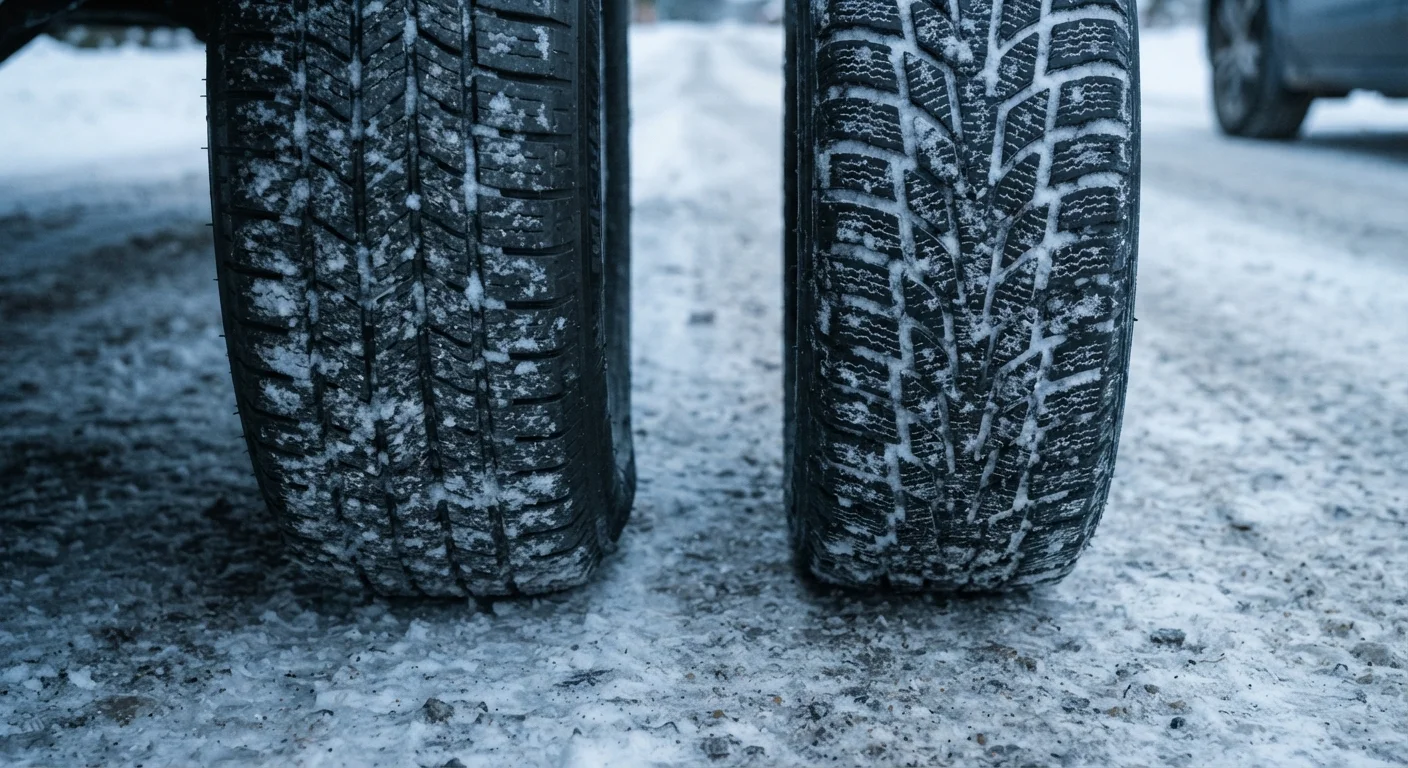
Tread design matters too. Winter tires use dense networks of small slits called sipes that create edges for gripping ice and channeling water away from snow. The tread blocks themselves are typically larger and more widely spaced to push snow aside and allow the tire to self-clean rather than pack up with slush.
Tires that meet the Three-Peak Mountain Snowflake (3PMSF) standard - a symbol showing a snowflake inside a mountain outline - have passed a more rigorous acceleration test in packed snow conditions. That symbol is the meaningful marker to look for if you're evaluating traction performance in serious winter conditions. What the safety data actually suggests about these differences is worth reviewing before making a decision.
45°F
Temperature threshold for all-season compound stiffening
Tire engineers and industry testers generally identify this as the point where all-season compounds begin losing meaningful compliance and grip.
3PMSF
Winter tire standard for severe snow traction
The Three-Peak Mountain Snowflake symbol indicates a tire passed a standardized acceleration test on packed snow - a higher bar than the basic M+S designation.
4 tires
Recommended minimum winter tire installation
Safety organizations and tire manufacturers consistently advise installing winter tires on all four wheels to avoid handling imbalances.
When the Distinction Becomes a Safety Issue
Performance data from tire testing organizations and road safety researchers consistently shows meaningful differences in stopping distances between all-season and winter tires in cold and snowy conditions. While exact figures vary by tire model, vehicle, and road surface, the pattern is consistent: winter tires stop shorter on snow and ice.
That gap matters most in real-world situations where a few extra feet of stopping distance is the difference between a near-miss and a collision. It matters less if you live in Atlanta, Georgia, where snow is rare and short-lived. It matters considerably more if you're navigating a Minnesota winter commute or mountain roads in Colorado.
The practical consideration is also about what happens when an unexpected storm hits. Drivers caught on all-seasons in a sudden whiteout are at a genuine disadvantage compared to those on a dedicated winter set. Being prepared for roadside emergencies complements tire safety but doesn't substitute for it.
One important caveat: winter tires should be installed as a full set of four. Running them only on the drive wheels creates handling imbalances that can make a vehicle less predictable, not more.
This article provides general vehicle information for educational purposes only. Tire performance varies by specific product, vehicle, and conditions. Consult a qualified tire professional for guidance specific to your vehicle and region.