
Fats in Food: Saturated, Unsaturated, and Trans - a Plain-Language Breakdown

| Fat calories per gram | 9 calories (USDA Dietary Guidelines) |
| Saturated fat daily limit (general guidance) | Less than 10% of total daily calories (2020-2025 U.S. Dietary Guidelines for Americans) |
| Artificial trans fat status (U.S.) | Effectively banned by the FDA (FDA final rule, effective 2018) |
| Essential fatty acids | Omega-3 and omega-6 (must be obtained from food) (National Institutes of Health) |
| Fat-soluble vitamins fat helps absorb | A, D, E, and K |
Why Dietary Fat Gets Complicated
For decades, "fat" was treated as the villain of the American diet. Shelves filled with low-fat products, and many people cut butter and oil without a second thought. Then the science shifted - and confusion followed. Today, most nutrition researchers agree that the type of fat matters far more than the total amount.
This guide breaks down each category of dietary fat in plain language: what it is chemically, how it affects the body, and where you actually encounter it in food. Think of it as a lookup reference you can return to whenever a food label or headline leaves you puzzled. For a broader foundation, see our guide to nutrition basics.
| Fat calories per gram | 9 calories (USDA Dietary Guidelines) |
| Saturated fat daily limit (general guidance) | Less than 10% of total daily calories (2020-2025 U.S. Dietary Guidelines for Americans) |
| Artificial trans fat status (U.S.) | Effectively banned by the FDA (FDA final rule, effective 2018) |
| Essential fatty acids | Omega-3 and omega-6 (must be obtained from food) (National Institutes of Health) |
| Fat-soluble vitamins fat helps absorb | A, D, E, and K |
The Three Main Types of Dietary Fat
Saturated Fat
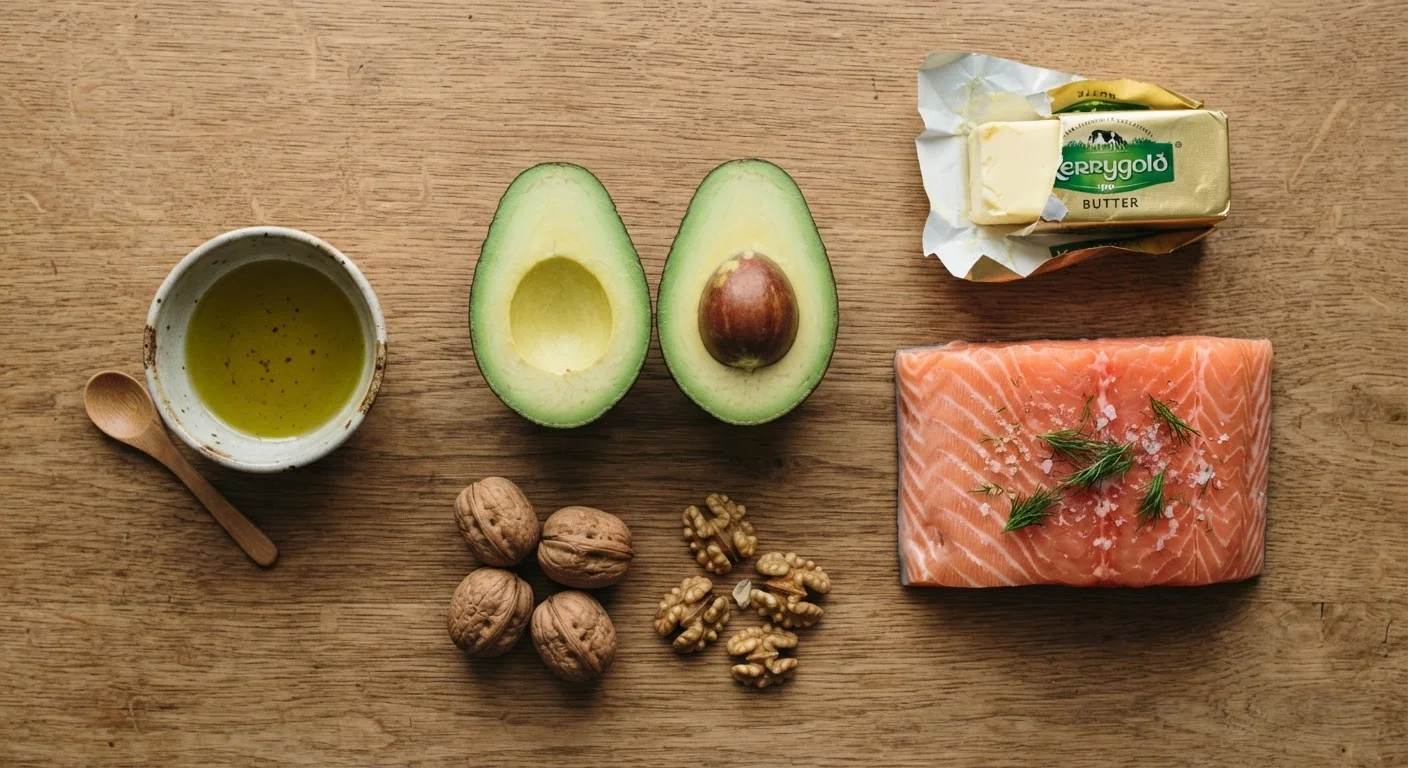
Saturated fats have no double bonds between their carbon atoms - their structure is fully "saturated" with hydrogen. This makes them solid at room temperature. Common sources include butter, full-fat dairy, red meat, coconut oil, and palm oil.
Research consistently links high saturated fat intake with raised LDL (low-density lipoprotein) cholesterol, a recognized risk factor for cardiovascular disease. Major health organizations - including the American Heart Association - generally recommend limiting saturated fat to a modest share of daily calories. However, emerging research suggests the picture may be nuanced depending on the overall dietary pattern. When in doubt, discuss your individual intake with a healthcare provider.
Unsaturated Fat
Unsaturated fats contain one or more double bonds, making them liquid at room temperature. They split into two families:
- Monounsaturated fats (MUFAs) - one double bond. Found in olive oil, avocados, almonds, and peanut butter. Associated in research with supporting healthy cholesterol levels.
- Polyunsaturated fats (PUFAs) - multiple double bonds. Found in fatty fish, walnuts, flaxseed, and vegetable oils such as sunflower and soybean. This group includes the well-known omega-3 and omega-6 fatty acids, which the body cannot make on its own and must obtain from food.
Trans Fat
Trans fats occur naturally in small amounts in some animal products, but the kind most linked to harm is artificial trans fat - created when liquid vegetable oils are partially hydrogenated to extend shelf life. This type raises LDL cholesterol and lowers HDL (high-density lipoprotein) cholesterol simultaneously, a double negative for cardiovascular health. The FDA effectively banned artificial partially hydrogenated oils from the U.S. food supply, though trace amounts may still appear under certain labeling rules. Check ingredient lists for the phrase "partially hydrogenated oil."
Saturated fat
A type of dietary fat whose carbon chain has no double bonds, making it solid at room temperature. Found mainly in animal products and some tropical oils. High intake is associated with elevated LDL cholesterol.
Unsaturated fat
Dietary fat containing one or more double bonds in its carbon chain. It is liquid at room temperature and includes both monounsaturated and polyunsaturated varieties, generally considered more heart-favorable than saturated fat.
Trans fat
A fat created when vegetable oils are partially hydrogenated. Artificial trans fat raises harmful LDL cholesterol while lowering beneficial HDL cholesterol, and has been largely removed from the U.S. food supply.
LDL cholesterol
Low-density lipoprotein, often called "bad" cholesterol. High levels are associated with increased risk of cardiovascular disease. Saturated and trans fats tend to raise LDL.
HDL cholesterol
High-density lipoprotein, often called "good" cholesterol. Higher levels are generally associated with lower cardiovascular risk. Trans fats tend to lower HDL.
Omega-3 fatty acids
A family of polyunsaturated fats the body cannot produce on its own. Found in fatty fish, flaxseed, and walnuts. Associated with supporting heart and brain health in research.
Partially hydrogenated oil
A processed oil created by adding hydrogen to liquid vegetable oil to make it more solid and shelf-stable. It is the primary source of artificial trans fat and is listed by this name in ingredients.
Reading Fat on a Nutrition Label
On a standard U.S. Nutrition Facts panel, total fat is listed in grams per serving, with saturated and trans fat broken out beneath it. Unsaturated fats are sometimes listed voluntarily but are not required. A simple way to estimate: subtract saturated fat and trans fat from total fat grams to get an approximate unsaturated fat figure.
"0g Trans Fat" Doesn't Always Mean Zero
FDA labeling rules allow products to list "0g trans fat" if a serving contains less than 0.5 grams. If a product has multiple small servings, trace amounts can add up. Scanning the ingredient list for "partially hydrogenated oil" is the most reliable check, regardless of what the front label says.
For a full walkthrough of every row on a nutrition label, reading a nutrition label without getting lost covers serving sizes, percent daily values, and what each number actually means for everyday decisions.
Fat also plays important roles beyond cardiovascular health - it helps absorb fat-soluble vitamins (A, D, E, and K), supports cell membrane structure, and contributes to satiety. This is why very low-fat diets can sometimes backfire nutritionally. To see how fat fits alongside carbohydrates and protein in the bigger picture, macronutrients explained is a useful companion read.
This article is for general informational and educational purposes only and is not a substitute for personalized medical or dietary advice. Consult a qualified healthcare provider or registered dietitian for guidance specific to your health needs.