

Key Takeaways
- Serving size is the foundation of every number on the label - always check it first.
- % Daily Value tells you whether a nutrient amount is high or low relative to a general daily target.
- Ingredients are listed by weight, so the first few ingredients dominate the product.
- Added sugars and saturated fat are the two numbers nutrition experts most commonly flag for attention.
- Front-of-package claims are often marketing - the Nutrition Facts panel is the reliable source.
What you will need
Why Labels Feel Confusing - and Why They Don't Have to Be
The Nutrition Facts label was designed to help consumers make informed decisions, but between the rows of numbers, percentage columns, and fine-print ingredient lists, it can feel like decoding a technical document. Add in the bold front-of-package claims competing for your attention, and it's easy to see why many shoppers give up and rely on shortcuts.
The good news is that the label follows a consistent structure - and once you understand that structure, reading it takes less than a minute. This guide walks through each section in the order it appears on a standard U.S. Nutrition Facts panel, so you know exactly what you're looking at and which parts matter most for everyday decisions. For a broader look at how nutrients work together in your diet, see our overview of macronutrients and micronutrients.
This Is General Nutrition Information
This article explains how to read and interpret a standard Nutrition Facts label for general educational purposes. It is not personalized dietary or medical advice. If you have a health condition, food allergy, or specific dietary need, consult a registered dietitian or your healthcare provider before making significant changes to what you eat.
What you will need
How to Read a Nutrition Label Step by Step
A Quick Rule of Thumb for % Daily Value
The FDA offers a simple guideline: 5% DV or less is considered low for a nutrient, while 20% DV or more is considered high. Use this to quickly gauge whether a food is a meaningful source of beneficial nutrients - or whether it's heavy on things to limit.
Start with serving size - not calories
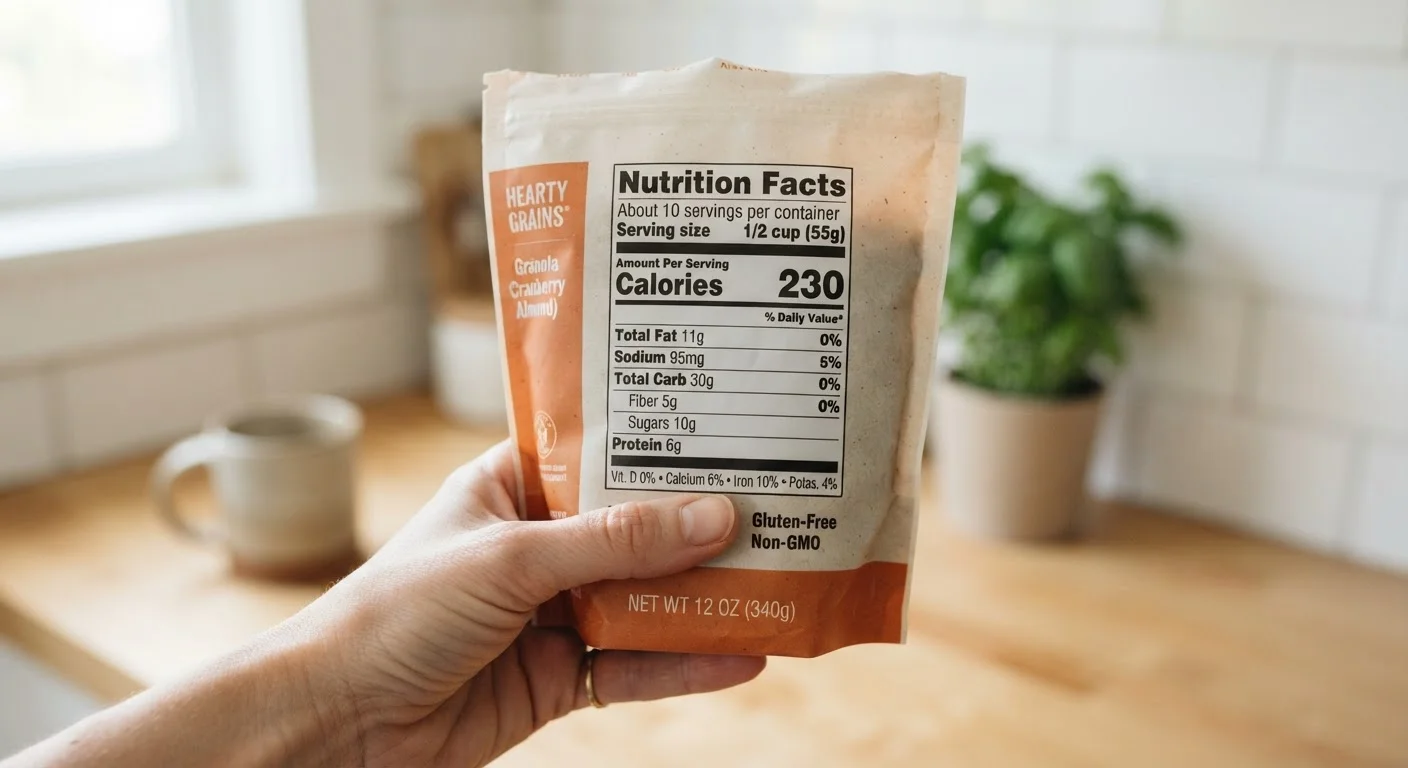
Every number on a Nutrition Facts label is tied to one serving, not the whole package. The serving size is listed at the very top in a larger font under the "Nutrition Facts" header. It shows both a household measure (e.g., "1 cup") and a gram weight.
Before reading anything else, ask: how much of this do I actually eat? If a bag of crackers lists a serving as 10 crackers but you typically eat 20, every number on the label doubles for your portion. Many single-serving packages actually contain two or more servings - a common source of confusion.
Check the calories per serving
Calories measure the total energy a serving provides. This number is displayed prominently just below the serving size. Once you know your actual portion relative to the listed serving, you can estimate the calories you're consuming.
Calories alone don't tell the full story - a 200-calorie item could be nutrient-dense or nearly empty of vitamins and minerals. Use the calorie count as a reference point, not a sole judgment criterion.
Identify nutrients to limit
The label separates nutrients into two broad groups. The first group - typically listed toward the top of the panel - includes nutrients most Americans consume in excess: saturated fat, sodium, and added sugars. Trans fat is also listed here; the goal for trans fat is to keep intake as low as possible.
Added sugars (distinct from naturally occurring sugars in fruit or dairy) are now required to be listed separately. This distinction matters because added sugars contribute calories without additional nutritional benefit.
For more on how dietary fat types differ, see our plain-language breakdown of saturated, unsaturated, and trans fats.
Look for nutrients to prioritize
Lower on the panel, you'll find nutrients many Americans fall short on: dietary fiber, vitamin D, calcium, iron, and potassium. These are flagged because inadequate intake is associated with health concerns at a population level.
A food with a higher % Daily Value for fiber, for example, can meaningfully contribute to your intake - which matters given that most Americans don't meet general fiber recommendations. Our article on dietary fiber covers why this nutrient deserves more attention.
Use % Daily Value as a compass, not a calculator
The % Daily Value (% DV) column shows what percentage of the general daily recommended amount one serving provides, based on a 2,000-calorie reference diet. You don't need to hit exactly 100% for each nutrient - it's a relative guide.
Use it to quickly compare two similar products, or to spot when a single serving is disproportionately high in sodium or saturated fat. It's a directional tool, not a precise prescription.
Read the ingredient list from top to bottom
Ingredients are listed in descending order by weight - the first ingredient makes up the largest proportion of the product. If refined flour or added sugar appears in the first two or three positions, those are dominant components.
A short ingredient list isn't inherently better, but it can be easier to evaluate. Look for ingredients you recognize. When a form of sugar appears under multiple different names (e.g., corn syrup, dextrose, cane juice), those amounts are distributed across the list - a detail worth noting.
Understanding ingredient lists is a skill that also applies to other product categories. For example, our guide to reading a skincare ingredient list follows similar logic.
Front-of-Pack Claims Are Not Regulated the Same Way
Words like "natural," "wholesome," or "light" on the front of a package are not always tightly defined by the FDA. The Nutrition Facts panel on the back is the standardized, regulated source of information. See our guide to packaging claims that mean something - and the ones that don't for a fuller breakdown.
Reading labels is one practical piece of building more informed eating habits. If you're looking to put this knowledge into action, our guide to building a balanced plate without counting calories offers a proportion-based approach that complements label literacy. You can also explore related everyday habits at the Daily Health Habits hub.