
The Nutrition Claims on Packaging That Mean Something - and the Ones That Don't

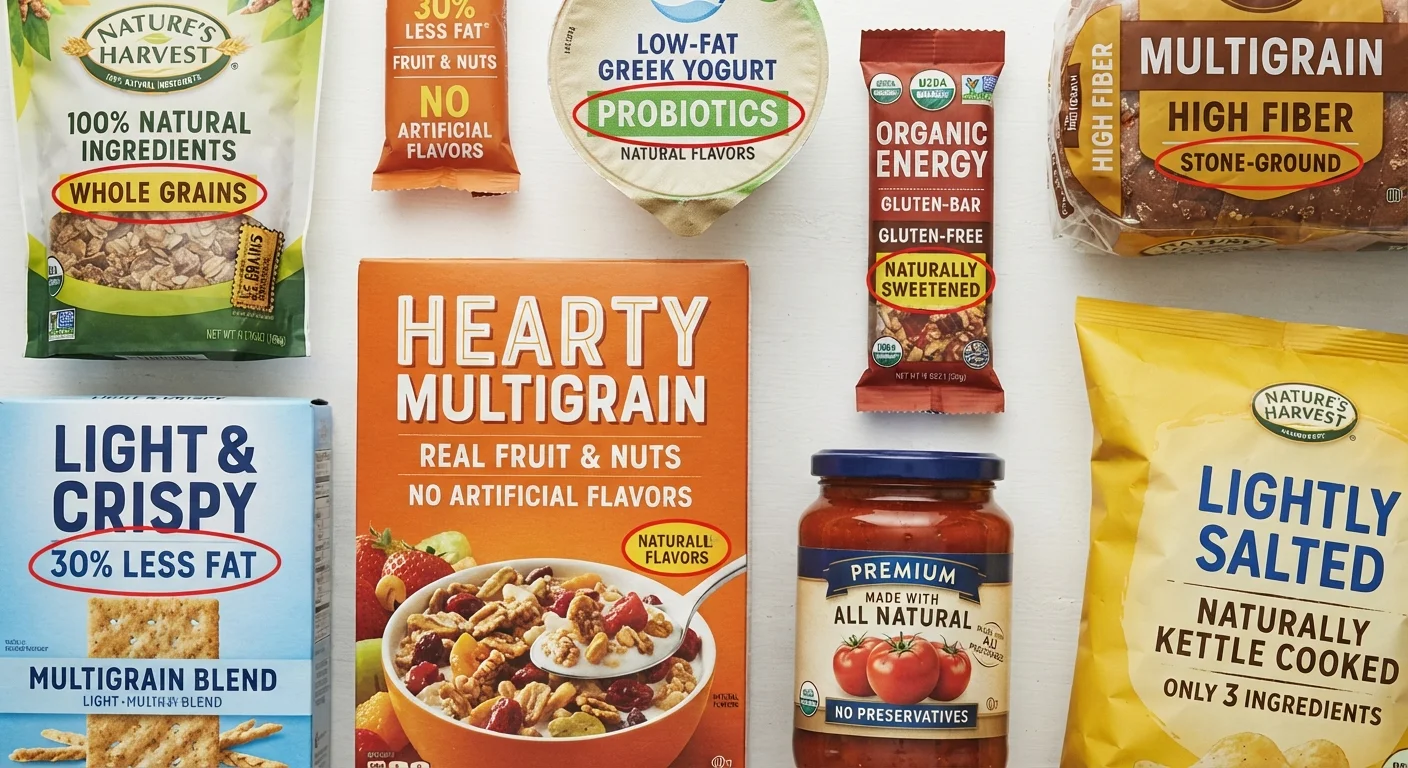
Key Takeaways
- FDA regulates specific claims like 'low sodium' and 'reduced fat,' but many front-of-pack terms have no legal definition.
- 'Natural' and 'multigrain' are largely unregulated and tell you little about a product's actual nutritional value.
- Health claims linking food to disease reduction require FDA authorization; structure/function claims do not.
- The nutrition facts panel and ingredient list are more reliable guides than front-of-pack marketing language.
Why Front-of-Pack Language Is a Mixed Bag
Grocery shopping means running a daily gauntlet of bold claims: "All Natural," "Made with Whole Grains," "Light," "No Artificial Flavors." Some of these phrases carry precise, FDA-regulated definitions. Others are essentially marketing copy with no enforceable nutritional standard behind them.
Understanding which is which gives you a meaningful advantage at the shelf. The key distinction is between nutrient content claims (regulated), health claims (regulated), and implied or unregulated claims (not regulated). Once you know the categories, the language stops feeling like noise and starts giving you actual information - or flagging where it's missing. For a deeper look at what the back of the package tells you, see our guide to reading a nutrition label.
Myth
"Natural" on a food label means the product is minimally processed and nutritionally sound.
Fact
"Natural" has no formal FDA definition and no nutritional requirements. A product can be high in sugar, sodium, or fat and still carry the term.
The FDA has not established a regulatory definition for "natural" on food labels. Its informal guidance only restricts added color, artificial flavors, and synthetic substances - leaving room for products that are heavily sweetened, salted, or calorically dense to carry the term freely. Don't treat "natural" as a proxy for healthy or minimally processed.
Myth
"Multigrain" means a bread or cereal is a good source of whole grains.
Fact
"Multigrain" only means more than one grain type is present - those grains can be entirely refined.
Multigrain products often list enriched wheat flour or other refined grains as the primary ingredient, with small amounts of additional grains mixed in. To confirm whole grain content, look specifically for "100% whole grain" or verify that a whole grain (such as whole wheat flour or oats) appears first in the ingredient list. The presence of multiple grains says nothing about their processing level.
Myth
"Low fat" means a food is a healthier choice overall.
Fact
"Low fat" is an FDA-regulated nutrient content claim, but reduced fat doesn't automatically make a food nutritionally preferable.
"Low fat" does have a legal definition: 3 grams of fat or less per serving. However, manufacturers sometimes compensate for reduced fat by increasing sugar, sodium, or refined starch to maintain flavor and texture. A low-fat product can still be high in added sugars or calories. The regulated claim tells you one fact about one nutrient - the full nutrition panel gives you the complete picture. For more on how added sugars fit into this equation, see natural sugar vs. added sugar.
Myth
A health claim on packaging - like linking calcium to bone health - is just marketing language.
Fact
Authorized health claims on food labels require FDA approval and must reflect significant scientific agreement.
Unlike unregulated terms such as "natural," health claims that explicitly link a nutrient or food to a disease or health condition require prior FDA authorization. They must be supported by significant scientific agreement. A separate tier - qualified health claims - allows for emerging research but must include a disclaimer noting the limited evidence. If you see a health claim on a label, it has cleared a regulatory bar; the question is how strong the underlying evidence actually is.
Myth
"Made with whole grains" guarantees a meaningful amount of whole grain in the product.
Fact
"Made with whole grains" sets no minimum quantity - the actual whole grain content could be negligible.
This phrase is an implied claim with no FDA-defined threshold. A product could contain a token amount of whole grain - say, 2% of total flour - and still display the claim. Consumers looking to increase whole grain intake should look for products where a whole grain is the first or second ingredient, or that carry a "100% whole grain" designation with certification from organizations like the Whole Grains Council, which sets its own voluntary criteria.
Claims That Actually Carry Weight
Nutrient content claims are the most straightforwardly regulated. The FDA sets specific thresholds for terms like "low fat" (3 grams or less per serving), "low sodium" (140 mg or less per serving), "reduced calorie" (at least 25% fewer calories than the reference food), and "high fiber" (5 grams or more per serving). These aren't suggestions - manufacturers must meet the criteria or they can't use the term.
Health claims go a step further, linking a nutrient or food to a reduced risk of disease - for example, the established connection between calcium and osteoporosis risk. These require FDA authorization and must be supported by significant scientific agreement. A separate category, qualified health claims, can be used for emerging evidence but must include a disclaimer about the limited nature of the science.
~12,000
Front-of-pack claims reviewed by FDA
The FDA has reviewed thousands of label submissions and maintains ongoing guidance on which nutrient content and health claims manufacturers may use on packaging.
25%+
Calorie reduction required for 'reduced calorie' claim
FDA regulations require that a 'reduced calorie' claim reflect at least a 25% calorie reduction compared to the standard reference food.
The practical upshot: if a front-of-pack claim uses a specific quantity word - "low," "high," "reduced," "free" - it almost certainly falls under FDA rules and reflects a real nutritional threshold. Those are the claims worth reading.
Claims That Are Mostly Marketing
Several popular terms exist in a regulatory gray zone. "Natural" is perhaps the most prominent example. The FDA has not established a formal definition for "natural" on food labels, though it has informally stated it does not object to the term when a food contains no added color, artificial flavors, or synthetic substances. That's a low bar - a product can be high in added sugar, sodium, or saturated fat and still carry the label "natural."
"Multigrain" simply means a product contains more than one type of grain. It says nothing about whether those grains are whole or refined. A multigrain bread can be made almost entirely from refined flours with trace amounts of other grains added. If whole grains are your goal, look for "100% whole grain" or check that a whole grain is the first ingredient listed. Our explainer on whole versus refined grains breaks down exactly what processing removes.
"Made With" Claims Set No Minimum Bar
Phrases like "made with real fruit," "made with whole grains," or "contains vegetables" have no minimum quantity requirement under FDA rules. A product can contain a trace amount of the featured ingredient and still display the claim prominently. Always cross-check the ingredient list to see where that ingredient actually ranks - ingredients are listed in descending order by weight.
"Light" is partially regulated - it can mean one-third fewer calories or half the fat of the reference food - but it can also refer to texture, color, or flavor ("light in taste") without any caloric difference. Context matters. Similarly, "made with real fruit" or "made with whole grains" sets no minimum quantity, so these claims are largely decorative. For a broader look at how nutrition research shapes these claims, see popular nutrition claims that science doesn't fully back.
This article is for informational purposes only and does not constitute medical or dietary advice. Consult a registered dietitian or qualified healthcare professional for guidance specific to your health needs.