

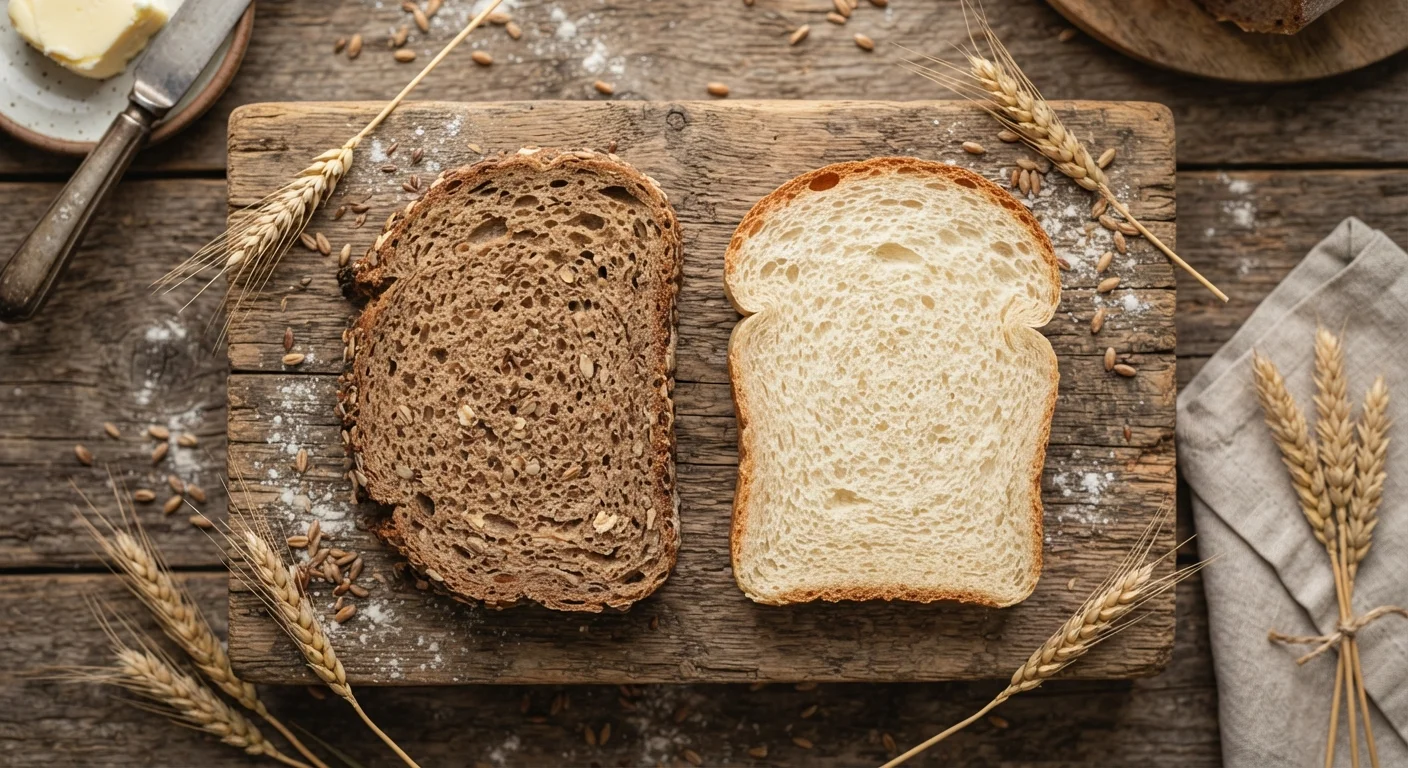
Key Takeaways
- Milling removes the bran and germ from whole grains, leaving mostly starchy endosperm.
- Fiber, B vitamins, iron, and beneficial plant compounds are significantly reduced during refining.
- Enriched refined grains have some vitamins added back, but fiber and phytonutrients are not restored.
- Whole grains are associated with steadier blood sugar responses compared to most refined grains.
- "Multigrain" and "wheat bread" labels do not automatically mean the product contains whole grains.
- Most dietary guidelines recommend making at least half of daily grain intake whole grains.
Option A
Whole Grains
The complete, minimally processed original.
Best for: People seeking fuller nutritional value, more fiber, and slower-digesting carbohydrates in their diet.
Option B
Refined Grains
The stripped-down, shelf-stable staple.
Best for: Situations where texture, shelf life, or palatability take priority - though nutritional trade-offs apply.
If you want to maximize fiber and nutrient density from grain foods
Whole Grains
Whole grains retain bran and germ, delivering fiber, B vitamins, and minerals that are largely absent in refined alternatives.
If digestive sensitivity or medical needs make high-fiber foods difficult
Refined Grains
In some clinical situations, lower-fiber refined grains may be easier to tolerate - always discuss dietary changes with a healthcare provider.
If you're navigating confusing food labels at the grocery store
Whole Grains
Look for "whole grain" or "whole wheat" as the first ingredient; terms like "multigrain" don't confirm the grain is unrefined.
If you are feeding young children or picky eaters transitioning to better habits
Whole Grains
Gradual substitution - such as blending whole-grain pasta with refined - can ease the transition while improving the overall nutritional profile of meals.
The Three Parts of a Grain - and What Milling Takes Away
Every grain - whether wheat, oats, rice, or corn - is naturally structured in three layers. Understanding those layers is the key to understanding what changes during processing.
- Bran: The tough outer shell. Rich in dietary fiber, B vitamins (like thiamin, niacin, and folate), and trace minerals such as magnesium and iron.
- Germ: The embryo of the seed. Contains healthy fats, vitamin E, B vitamins, and various antioxidant plant compounds called phytonutrients.
- Endosperm: The starchy inner core. Mostly carbohydrate with some protein - and very little else nutritionally.
When grains are refined, milling strips away the bran and germ entirely, leaving only the endosperm. The result is a finer-textured, longer-lasting flour - and a food that has lost the majority of its fiber, vitamins, minerals, and protective plant compounds in a single step.
| Criterion | Whole Grains | Refined Grains |
|---|---|---|
| Parts retained | Bran, germ, endosperm | Endosperm only |
| Dietary fiber | High (bran intact) | Very low (bran removed) |
| B vitamins | Naturally present | Mostly removed; some added back |
| Iron & minerals | Naturally present | Mostly removed; iron added back |
| Phytonutrients | Present (germ and bran) | Largely absent |
| Blood sugar response | Generally more gradual | Generally faster |
| Shelf life | Shorter (oils in germ) | Longer |
| Texture | Denser, heartier | Lighter, finer |
What "Enriched" Really Means
Most refined grain products sold in the U.S. are labeled enriched. After milling, manufacturers add back a handful of the nutrients that were removed - specifically thiamin, riboflavin, niacin, folic acid, and iron. This practice, mandated for many grain products since the 1940s, helped eliminate widespread deficiency diseases like pellagra and beriberi in the American population.
Enrichment is genuinely useful - but it doesn't make a refined grain nutritionally equivalent to its whole-grain counterpart. Fiber is not replaced. Neither are the dozens of naturally occurring phytonutrients, antioxidants, and beneficial plant compounds found in the bran and germ. Think of enrichment as partial restoration, not full recovery.
"Enriched" Is Not the Same as "Whole"
Enriched flour has had four B vitamins and iron added back after milling - but fiber, vitamin E, and dozens of phytonutrients are not restored. Enrichment addresses the most severe nutrient-deficiency risks but does not replicate the full nutritional profile of an unrefined grain. When comparing two products, checking the ingredients list for "whole" as the first word remains the most reliable indicator.
This distinction also matters when reading food labels. As our guide to nutrition claims on packaging explains, terms like "multigrain" or "made with whole grain" do not guarantee a product's primary grain is unrefined - always check the ingredients list.
How Refining Affects Blood Sugar and Satiety
Dietary fiber does more than support digestive health. It also slows the rate at which carbohydrates are broken down and absorbed into the bloodstream. Because refined grains have had most of their fiber removed, they tend to be digested more quickly - a pattern that can lead to faster rises in blood glucose following a meal.
Whole grains, by contrast, produce a comparatively more gradual blood sugar response in most people. The fiber also contributes to feelings of fullness (satiety), which may help with overall calorie management - though individual responses vary and are influenced by many factors beyond grain type alone.
25%
Lower risk of cardiovascular disease
A 2016 meta-analysis published in The BMJ found whole grain consumption was associated with roughly a 25% lower risk of cardiovascular disease compared to low intake.
~75%
Fiber lost during wheat refining
Refining whole wheat into white flour removes approximately 75% of its naturally occurring fiber, according to nutritional analyses of milling processes.
50%
Recommended grain intake as whole grains
The U.S. Dietary Guidelines for Americans recommend that at least half of all grains consumed daily be whole grains.
It's worth noting that cooking method, food combinations, and portion size all influence how a grain food affects blood sugar. A registered dietitian can help translate these general patterns into guidance suited to your individual health needs.
For a broader look at how grain processing fits into the wider picture of food quality, see our comparison of whole foods vs. processed foods.
This article is for general informational and educational purposes only and is not a substitute for personalized medical or dietary advice. Consult a qualified healthcare provider or registered dietitian before making significant changes to your diet, especially if you have a chronic health condition.