

Key Takeaways
- Processing exists on a spectrum - canned beans and packaged cookies are both 'processed' but nutritionally worlds apart.
- Whole foods tend to retain more fiber, vitamins, and minerals that are lost or diluted during heavy processing.
- Ultra-processed foods, not minimally processed ones, are most consistently linked to poorer health outcomes in research.
- Reading ingredient lists - not just front-of-pack claims - gives a clearer picture of how processed a food really is.
- A practical diet can include both whole and minimally processed foods without compromising overall nutritional quality.
Option A
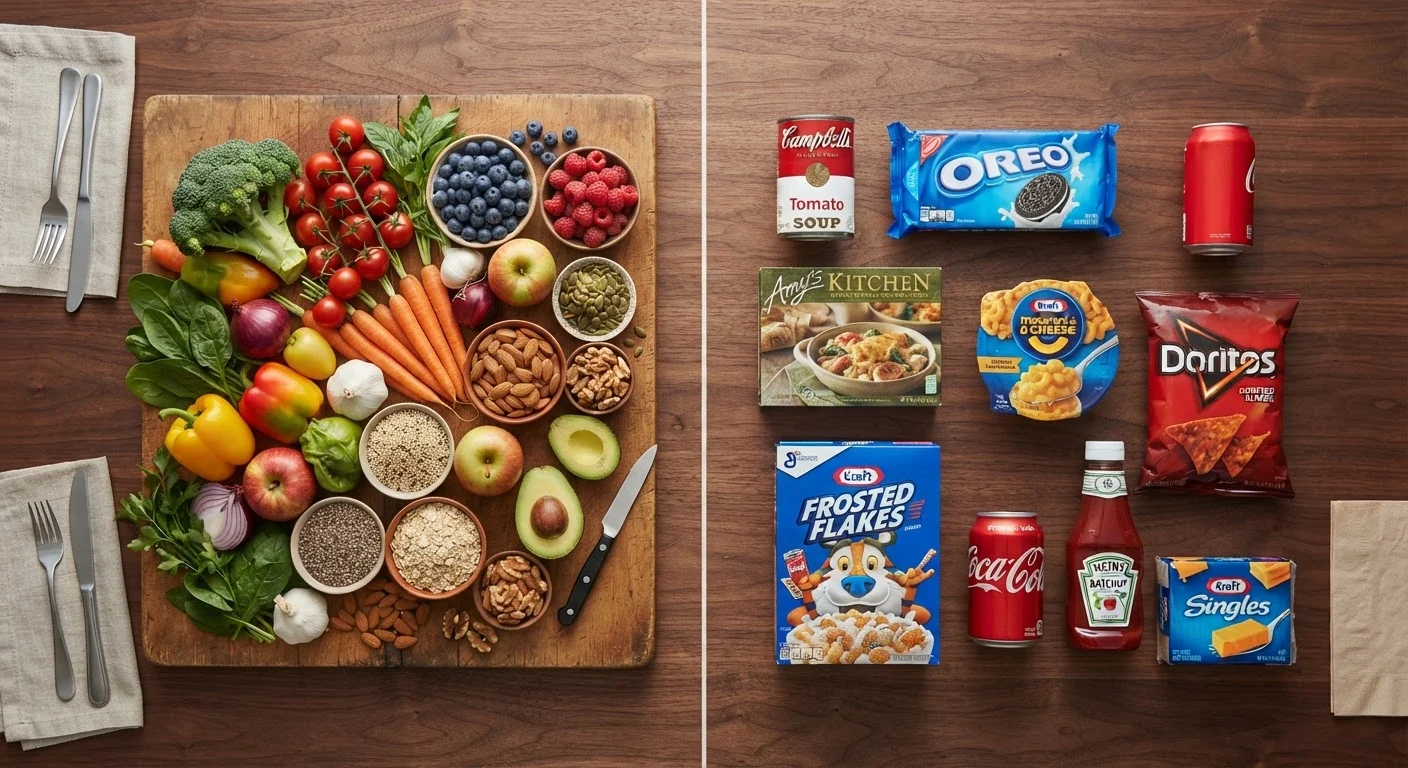
Whole Foods
Foods in or close to their natural, unaltered state.
Best for: People seeking to maximize nutrient density and minimize additives in their everyday diet.
Option B
Processed Foods
Foods altered from their natural state through preparation, preservation, or formulation.
Best for: Anyone navigating convenience, affordability, or shelf life - though the type and degree of processing matter significantly.
If you want to maximize nutrient density at every meal
Whole Foods
Whole foods deliver vitamins, minerals, fiber, and phytonutrients in their most intact form, with little to no dilution from additives or refining.
If convenience and shelf life are genuine constraints in your life
Processed Foods
Minimally processed options like canned legumes, frozen vegetables, or plain oats offer solid nutrition without sacrificing practicality.
If you're trying to reduce added sugars, sodium, and artificial additives
Whole Foods
Whole foods contain naturally occurring compounds rather than added ingredients, making it easier to keep dietary extras in check.
If you're building a realistic, long-term eating pattern on a budget
Processed Foods
Strategically chosen minimally processed foods - dried grains, canned fish, frozen produce - can anchor a nutritious diet at lower cost.
What 'Whole' and 'Processed' Actually Mean
The terms whole foods and processed foods are used constantly in nutrition conversations, but they're rarely defined clearly. Whole foods are foods eaten in, or very close to, the state they exist in nature - think an apple, a handful of walnuts, a piece of salmon, or dry lentils. They haven't been significantly altered from their original form before you eat them.
Processed foods cover a far broader range. Technically, any food that has been changed from its natural state - washed, cut, cooked, canned, frozen, or fermented - has been processed. Under that definition, pasteurized milk, bagged spinach, and plain rolled oats are all processed. This is why the blanket label can mislead more than it clarifies.
Nutrition researchers often find it more useful to talk about the degree of processing. The NOVA classification system, developed by researchers at the University of São Paulo, groups foods into four categories: unprocessed or minimally processed, processed culinary ingredients, processed foods, and ultra-processed foods. That last category - products formulated from industrial substances, with multiple additives - is what most health concerns are actually directed at, not a jar of plain tomato paste or a bag of frozen peas.
The NOVA System Is a Research Tool, Not a Label
The NOVA classification is widely used in nutritional epidemiology to study diet patterns and health outcomes, but it doesn't appear on food packaging. It's a framework for researchers and an educational lens for consumers - not an official regulatory label in the United States. The FDA has its own definitions for certain terms like 'organic' or 'fortified,' which differ from NOVA categories. Knowing both systems exist helps you read nutrition reporting more critically.
What Processing Changes - and What It Doesn't
When food is heavily refined or reformulated, certain nutritional properties shift. Fiber is often reduced; this is especially visible with grains. Milling removes the bran and germ from a grain, stripping away much of its fiber, B vitamins, and minerals in the process. Manufacturers sometimes add select nutrients back - a process called fortification - but the full nutritional matrix of the original food isn't entirely restored.
Heavily processed foods also frequently contain significant amounts of added sodium, added sugars, saturated or trans fats, and artificial preservatives or colorings. Understanding the difference between natural and added sugar is one concrete example of how processing changes what's actually in your food, even when calories look similar on paper.
That said, some processing improves safety or even nutrition. Cooking destroys harmful pathogens. Fermentation creates beneficial probiotics. Canning and freezing preserve nutrients that would otherwise degrade during shipping and storage. The method and extent of processing determines the outcome - not the act of processing itself.
| Criterion | Whole Foods | Processed Foods |
|---|---|---|
| Definition | Eaten close to natural state | Altered from natural state in some way |
| Fiber content | Generally intact and high | Often reduced in heavy processing |
| Added ingredients | None or minimal | Varies widely; ultra-processed may have many |
| Sodium and sugar | Naturally occurring only | Frequently added, especially in ultra-processed |
| Shelf life | Often shorter; requires refrigeration | Typically longer due to preservation |
| Convenience | May require more preparation | Often ready to eat or quick to prepare |
| Nutrient density | Generally high relative to calories | Varies; ultra-processed often lower |
| Cost | Variable; fresh can be expensive | Often lower cost, especially in bulk |
Navigating Real-World Food Choices
For most people, a diet built entirely of unprocessed whole foods is neither realistic nor necessary. The research concern is concentrated around ultra-processed foods - packaged snacks, sugar-sweetened beverages, reconstituted meat products, and fast food made primarily from industrially derived ingredients. These are meaningfully different from a can of chickpeas or a tub of plain Greek yogurt, even though all four are technically processed.
A practical approach is to treat whole and minimally processed foods as the foundation of your meals, while being selective about highly processed additions. Learning to read ingredient lists - rather than relying on front-of-pack marketing language - gives a far more honest picture. Front-of-pack claims like 'natural' or 'multigrain' are often loosely regulated and can obscure what's really inside.
If you're exploring broader eating patterns, related comparisons can also help clarify your priorities - for example, how plant-based and omnivorous approaches stack up nutritionally, or how whole food protein sources compare to supplements. The whole-vs.-processed question intersects with all of these.
57%
Share of U.S. calorie intake from ultra-processed foods
A study published in BMJ Open estimated that ultra-processed foods accounted for approximately 57% of caloric intake among U.S. adults, based on national dietary survey data.
4 groups
NOVA food processing classification categories
Researchers at the University of São Paulo developed the NOVA system to classify all foods into four groups based on the extent and purpose of processing, moving beyond simple 'whole vs. processed' binaries.
~28g
Daily fiber recommended for adults (general guidance)
The U.S. Dietary Guidelines for Americans reference approximately 28 grams of dietary fiber per day for a 2,000-calorie diet - a target most Americans fall significantly short of, partly due to low whole food intake.
This article is for general informational and educational purposes only. It is not medical or dietary advice. Consult a qualified healthcare professional or registered dietitian for guidance specific to your health needs.