

Key Takeaways
- Caulk works best on stationary gaps - surfaces that don't flex or move when used.
- Weatherstripping is designed for doors and operable windows that open and close repeatedly.
- Using the wrong material in the wrong place leads to faster failure and wasted effort.
- Both materials are affordable DIY options, but they require different application techniques.
- Many drafty homes need both caulk and weatherstripping working together to fully seal air leaks.
Option A
Caulk
The permanent, flexible filler for stationary gaps.
Best for: Sealing fixed cracks and gaps around window frames, baseboards, and other surfaces that don't move.
Option B
Weatherstripping
The compressible seal designed for moving parts.
Best for: Creating a tight seal along the edges of doors and operable windows that open and close regularly.
If you're sealing around a window frame, baseboard, or fixed wall penetration
Caulk
These surfaces don't move, so caulk's rigid-yet-flexible bond holds well without cracking or peeling under normal conditions.
If you're sealing gaps around an exterior door or operable window sash
Weatherstripping
Weatherstripping is designed to compress and rebound with each open-and-close cycle, while caulk would crack and fail quickly in that same role.
If you're tackling a full draft-proofing project throughout your home
Both
Most homes need both materials - caulk for fixed gaps and weatherstripping for moving parts - to comprehensively reduce air infiltration.
Why the Gap Type Determines the Fix
Not all drafts come from the same source, and that distinction matters more than most homeowners realize. A gap around a fixed window frame behaves completely differently from the gap that appears when you close your front door. Applying the wrong sealing material to either one is a common mistake that results in wasted time and a fix that fails within a season or two.
The core rule is straightforward: caulk is for stationary surfaces, and weatherstripping is for moving parts. When you understand why each material works the way it does, choosing between them becomes much easier. Caulk cures into a flexible but adhesive seal - it bonds to surfaces and holds. That's ideal when nothing is moving. Weatherstripping, on the other hand, is a compressible material (foam, felt, vinyl, or rubber) that gets squeezed into place when a door or window closes, then springs back when it opens. Ask it to bond permanently to a surface and it won't; ask it to cushion a repeated mechanical action and it excels.
Air infiltration - the technical term for drafts entering your home - is one of the more common contributors to uneven indoor temperatures and higher heating and cooling loads. Addressing it with the right material in the right location is one of the more practical upkeep tasks a homeowner can tackle. For related moisture concerns in enclosed spaces, see our guide on keeping a crawl space dry.
Where Caulk Belongs - and Where It Fails
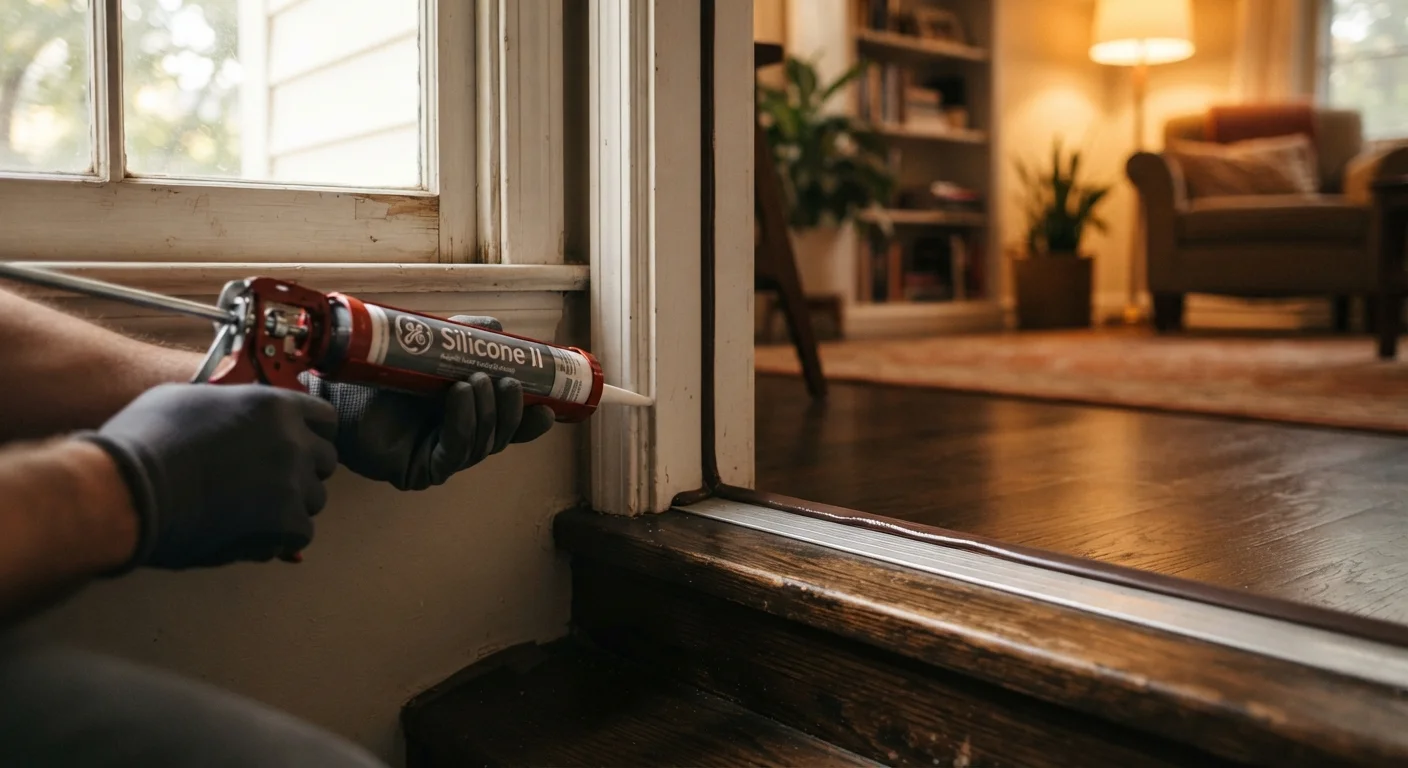
Caulk earns its place along any gap where two stationary surfaces meet and where that junction isn't expected to open or shift. Common applications include:
- The perimeter of window frames against exterior siding or interior drywall
- Gaps where baseboards meet the floor or wall
- Utility penetrations - pipes, conduit, or ductwork passing through walls or floors
- Exterior gaps where siding meets trim or foundation
For interior wet areas like bathrooms, a mold-resistant silicone or siliconized latex caulk is the right choice. Our article on bathroom caulk and tile maintenance covers that application in detail.
Where caulk fails: never apply it along the hinge side, latch side, top, or bottom of a door - or along the sash of an operable window. The movement will cause it to crack, peel, and lose adhesion quickly, usually within one season. Likewise, very wide gaps (anything over about half an inch) typically need a backer rod or other filler material first; caulk alone won't bridge them reliably.
| Criterion | Caulk | Weatherstripping |
|---|---|---|
| Best application | Fixed, stationary gaps and joints | Moving parts - doors and operable windows |
| Bond type | Adhesive - bonds permanently to surfaces | Compressive - seals by contact pressure |
| Typical lifespan | 5-10+ years if properly applied | 2-5 years depending on use frequency |
| DIY difficulty | Low - requires a caulk gun and steady hand | Low - peel-and-stick or simple fastener install |
| Fails when used on | Door edges or operable window sashes | Fixed wall, floor, or frame gaps |
| Material options | Latex, silicone, siliconized latex | Foam tape, V-strip, door sweeps, rubber bulb |
Where Weatherstripping Works - and Its Limits
Weatherstripping belongs wherever a door or operable window closes against a frame. The four common types each suit a different situation:
- Foam tape: Easy to apply, inexpensive, and suitable for low-traffic windows and secondary doors. It compresses well but wears out faster under frequent use.
- V-strip (tension seal): A durable folded plastic or metal strip that fits into the channel between a door and its jamb. Handles repeated use well.
- Door sweeps: Attached to the bottom of a door to seal the gap against the threshold - an area caulk can never address effectively.
- Bulb or tubular rubber seals: Highly compressible and long-lasting, often used on exterior doors where a tight seal is a priority.
Weatherstripping does have limits. It wears down over time and needs periodic inspection and replacement - especially on high-traffic exterior doors. It also can't fill irregular or wide gaps in fixed surfaces; that's caulk's territory. And if a door is badly warped or a frame is structurally out of square, weatherstripping may mask the symptom without addressing the underlying issue.
25-30%
Home heating and cooling lost to air leaks
The U.S. Department of Energy estimates that air infiltration through gaps and cracks accounts for roughly 25-30% of heating and cooling energy use in a typical home.
$0.50-$6
Typical cost per linear foot of weatherstripping
Material costs vary widely by type - foam tape sits at the low end, while rubber bulb and metal V-strip products cost more but generally last longer.
Doing Both: When a Complete Seal Requires Two Materials
In practice, most draft-proofing projects benefit from using both caulk and weatherstripping in tandem. An exterior door, for example, needs weatherstripping along its edges and top rail - but the fixed frame around it may have gaps at corners or where it meets the siding that call for caulk. Treating one without the other often leaves a meaningful portion of air leakage untouched.
A practical audit: on a cold or windy day, run your hand slowly around door and window perimeters. Hold a lit incense stick near suspected gaps - smoke movement reveals airflow that a hand might miss. Mark what you find, then categorize each gap: does it involve a moving part? Use weatherstripping. Is it a fixed joint between two stationary surfaces? Reach for the caulk.
Both tasks are accessible to most homeowners with basic tools and a bit of patience. If you're curious how this compares to other exterior sealing tasks, our overview of DIY driveway sealing offers a useful frame of reference for weighing skill versus risk on home maintenance projects.
This article provides general home maintenance information for educational purposes. Results may vary based on your home's construction, local climate, and the specific materials used. When in doubt, consult a qualified contractor or energy auditor for personalized guidance.