

Key Takeaways
- Recall training works best when coming to you is always rewarding — never punishing.
- Start in low-distraction environments and add difficulty gradually over time.
- A consistent verbal cue and body language make the behavior clearer for your dog.
- Practicing in short, frequent sessions beats long, infrequent ones every time.
- A long training lead allows safe practice outdoors before off-leash reliability is established.
What you will need
Why Recall Is the Most Important Skill You Can Teach
Most dog training focuses on manners — sit, stay, leave it. But recall, the ability to call your dog back to you reliably, is the one skill with genuine safety stakes. A dog that comes when called can be redirected away from danger, prevented from approaching unfamiliar dogs or people, and given far more freedom overall because you can trust them.
The challenge is that recall has to work under pressure — when your dog has spotted a squirrel, is mid-play with another dog, or has caught an irresistible scent. That kind of reliability doesn't happen by accident. It's built deliberately, in layers, over weeks of practice. If you're just getting started with your dog, the foundation guide for new dog owners covers the broader mindset and routines that make training stick.
What you will need
What You'll Need Before You Start
Recall training doesn't require special equipment, but a few tools make the process safer and more effective. A long training lead is particularly important — it lets your dog experience the feeling of freedom while you maintain a safety net during outdoor practice.
High-value treats
Rewards the dog for returning to you — should be something more exciting than everyday kibble.
Long training lead (15–30 ft)
Allows the dog to move freely outdoors while you retain control during distraction training.
Standard 6-foot leash
Used for close-range indoor and yard training in early stages.
Treat pouch or pocket bag
Keeps rewards accessible so you can reward quickly at the right moment.
For dogs with a history that makes trust-building more complex — such as rescues with unknown backgrounds — you may want to review how rescue dog training differs before jumping into formal recall work.
Step-by-Step: Building a Reliable Recall
Follow these steps in order, moving on only when your dog is succeeding consistently at the current stage. Rushing through the progression is the most common reason recall training stalls.
Choose and protect your recall cue
Pick a single word — "come," "here," or any word you prefer — and commit to it. The key rule: never use this word unless you can follow through, and never use it to call your dog into something unpleasant (a bath, nail trim, or the end of playtime). If your current cue has already been poisoned by repeated ignoring, pick a fresh word and start clean.
Build the association indoors first
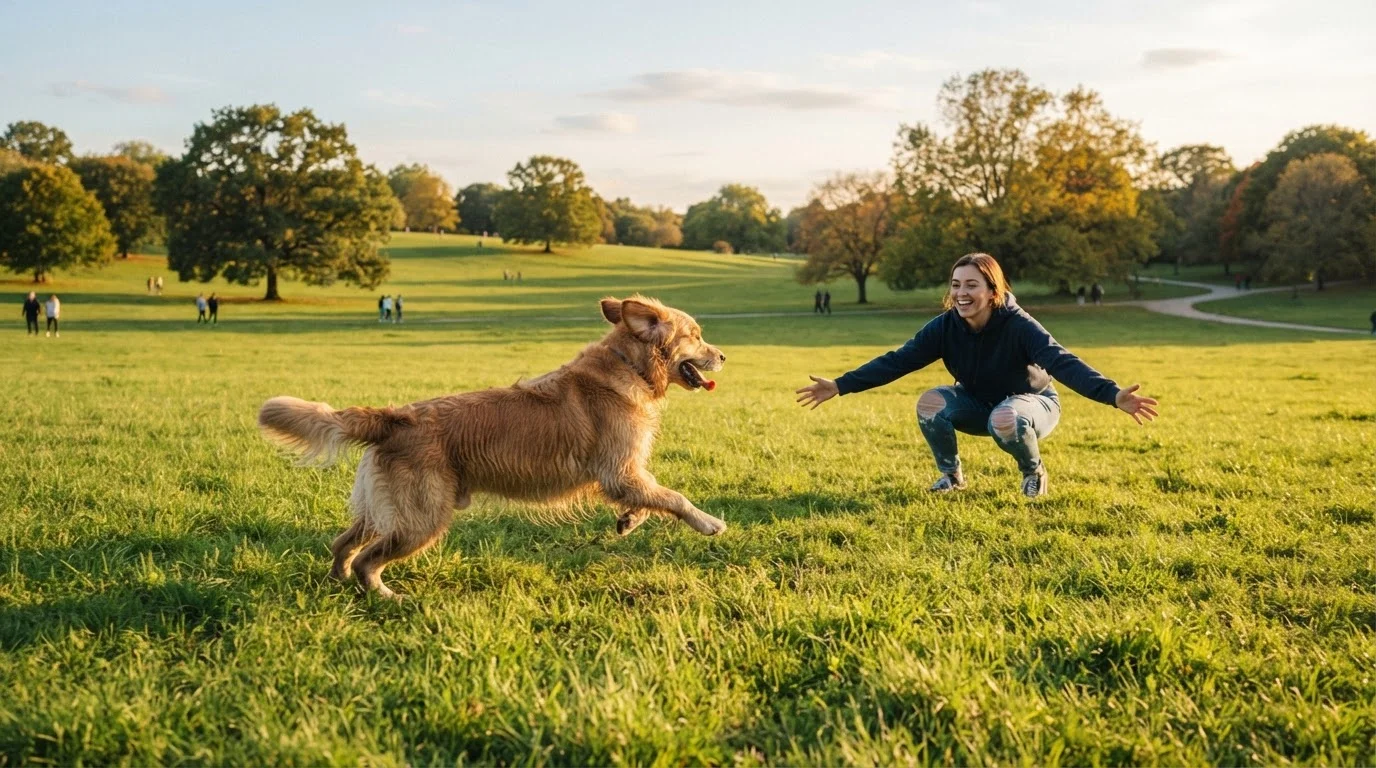
Start in a quiet room with no distractions. Say your cue once in a happy tone, then immediately crouch down and show a treat. The moment your dog reaches you, mark the behavior with a clear "yes!" or a clicker and reward generously. Repeat 5–10 times per session. You're not testing the dog yet — you're simply building a strong association between the cue and good things happening.
Add distance gradually
Once your dog is reliably turning and trotting to you indoors, begin increasing distance. Practice across larger rooms, then in your yard on a long lead. Call once, crouch slightly, and reward enthusiastically when your dog arrives. Avoid repeating the cue multiple times — calling repeatedly teaches dogs that the first "come" is optional.
Introduce mild distractions
Move training to slightly busier environments: a backyard with birds, a quiet sidewalk, or a low-traffic park area. Keep your dog on a long lead for safety. Practice your recall in short bursts — no more than 3–5 repetitions per outing — and always reward with the same level of excitement. At this stage, you're competing with real-world stimuli, so your reward needs to be genuinely worth it.
Practice the real-world "emergency" recall
This version is reserved for situations where it truly matters — traffic, a loose dog approaching, or any safety-critical moment. Use a slightly different cue or tone (some trainers use a whistle or a distinct word) and pair it with your absolute highest-value reward. Practice it only a few times per week so it stays powerful. Never call your dog with this cue for routine recalls.
Maintain the behavior over time
Recall is a skill that degrades if it's never reinforced. Continue rewarding your dog randomly when they come to you — even during off-leash time — so the behavior stays sharp. Dogs that are only rewarded during formal training sessions often lose reliability once the treats disappear. Intermittent reinforcement keeps the behavior strong long-term.
Make Coming Back Always Worth It
The single most common reason recall breaks down is that returning to the owner predicts the end of something fun. Regularly call your dog, reward them warmly, and release them back to play — so coming to you stays a great deal, not a trap.
Never Punish a Dog for Coming to You
Even if your dog took three minutes to respond, reward them when they arrive. Punishing a slow recall teaches the dog that coming to you is unsafe. From your dog's perspective, they came — and that always deserves recognition.
Common Problems and How to Address Them
Recall Is a Safety Skill — Take It Seriously
A reliable recall can prevent a dog from running into traffic, approaching a dangerous animal, or getting lost. Until your dog demonstrates consistent recall across varied, distracting environments, always use a leash or long lead in unsecured areas. Off-leash privileges should be earned gradually, not assumed.
My dog runs toward me and then veers off at the last second. This usually means the reward isn't motivating enough, or the dog has learned that reaching you ends fun. Practice calling your dog, rewarding generously, and immediately releasing them to continue playing. Over time, arriving at you becomes a neutral or positive event rather than a termination.
My dog ignores the cue entirely outdoors. The environment is outpacing your dog's current training level. Return to practicing on the long lead in lower-distraction areas. Consistency matters more than speed — see how daily structure supports training outcomes for context on why routine reinforces learning.
My dog was good at this and then regressed. Recall skills fade without maintenance. Dogs go through developmental phases where previously learned behaviors temporarily weaken — adolescence is especially common for this. Revert to earlier training steps briefly, increase reward value, and rebuild. For a broader refresher on foundational skills, teaching basic commands at home offers useful reinforcement strategies.