

Key Takeaways
- Group classes build socialization and basic obedience skills in a real-world distraction environment.
- Private training is better suited for dogs with fear, aggression, or complex behavior issues.
- Cost, schedule flexibility, and your dog's temperament all factor into the decision.
- Some dogs benefit most from starting private and transitioning to group classes.
- The trainer's credentials and methods matter more than the format itself.
Our Verdict
Neither group classes nor private training is universally superior — each serves a distinct purpose. Group classes work well for social, motivated dogs learning foundational skills, while private training is the stronger choice for dogs with behavioral challenges or owners who need personalized coaching. Many trainers recommend combining both approaches over time.
| Best for | Recommended |
|---|---|
| Puppies and social, food-motivated dogs learning basic obedience | Group Classes |
| Dogs with fear, reactivity, aggression, or specific behavior problems | Private Training |
| Owners on a tighter budget who can commit to consistent attendance | Group Classes |
| Owners who want customized guidance and flexible scheduling | Private Training |
What Each Format Actually Involves
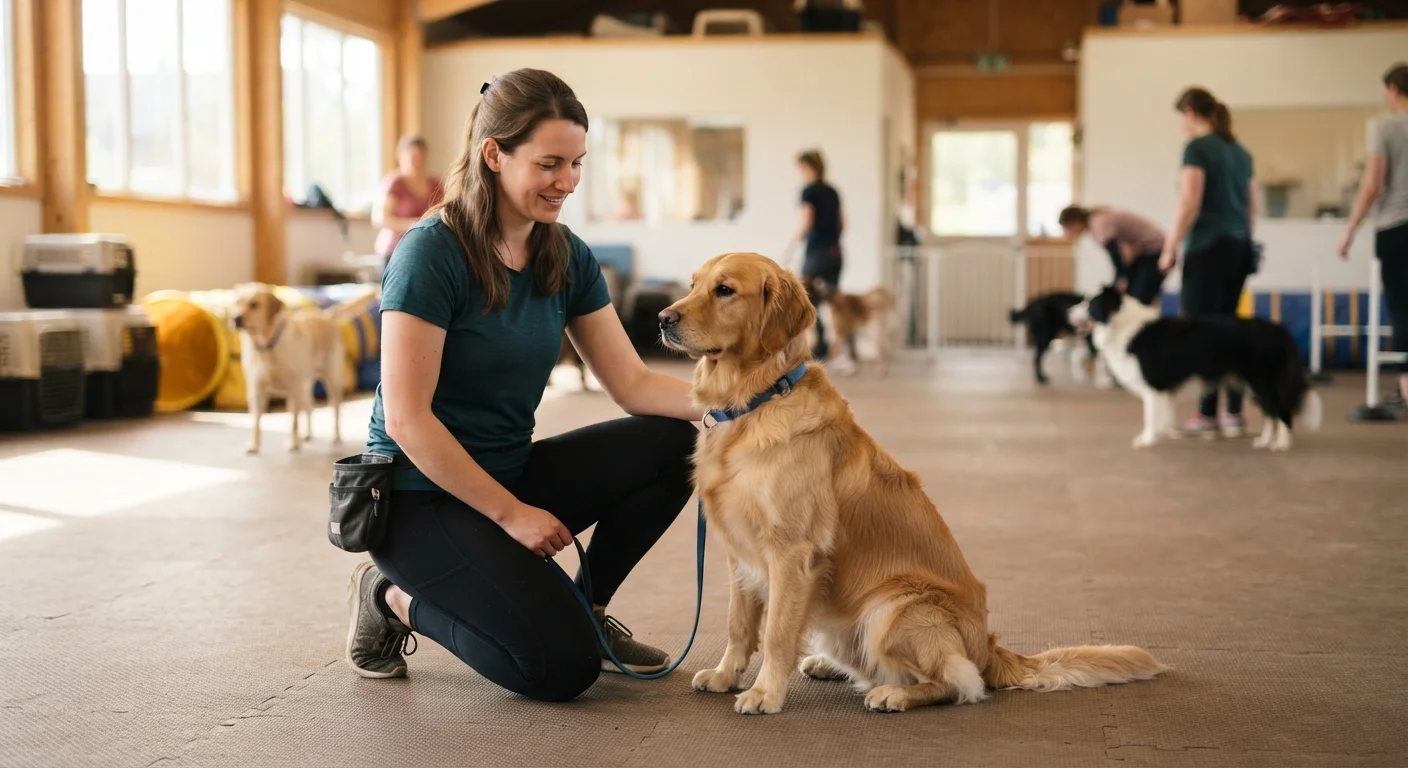
Group classes bring together several dogs and their handlers — typically four to eight pairs — under one trainer's supervision. Sessions usually run 45 to 60 minutes and progress through a set curriculum over multiple weeks. The shared environment is part of the design: dogs learn to focus and respond to cues even with other animals and people nearby.
Private training is one-on-one instruction between a trainer, the dog, and the owner. Sessions are tailored entirely to that dog's needs and can take place in your home, at a training facility, or wherever the problem behavior occurs. There's no fixed curriculum — the trainer adjusts in real time based on what they observe.
Both formats rely on the same core principles of learning. What differs is the structure, setting, and how personalized the feedback can be. For a deeper look at the methods trainers use within either format, see what the science says about training approaches.
When Group Classes Are the Right Fit
Group classes are well-suited for puppies and adult dogs without significant behavioral concerns. If your dog is social, generally calm around other animals, and you're working on foundational skills — sit, stay, leash manners, recall — a group setting delivers those lessons effectively while adding a layer of real-world practice that's hard to replicate at home.
The distraction factor is a genuine advantage. A dog who can sit reliably in a quiet living room but falls apart when another dog passes by hasn't fully generalized the behavior. Group classes create a controlled version of that challenge week after week.
Group classes are also significantly more affordable than private sessions, making consistent attendance more realistic for most households. The structured curriculum helps owners stay on track without having to design their own training plan.
Ask Before You Enroll
Contact the training facility and describe your dog's behavior honestly before signing up for a group class. A reputable trainer will tell you if group classes are appropriate right now or if a private evaluation makes more sense first. This one conversation can save you money and prevent a stressful experience for your dog.
That said, group classes do require a baseline of social comfort. A dog who is reactive, fearful, or easily overwhelmed may not be able to learn effectively in that environment — and could inadvertently practice the wrong behaviors under stress.
When Private Training Makes More Sense
Private training becomes the clearer choice when a dog has specific behavioral issues that need careful management — leash reactivity, resource guarding, separation anxiety, fear-based responses, or aggression toward people or other animals. These situations require a trainer's full attention and a controlled environment. Putting a reactive dog in a group class can set the training back significantly.
Private sessions are also valuable when the problem behavior is tied to a specific context, such as door-dashing, jumping on guests, or destructive behavior at home. A trainer who can observe the dog in that actual setting will get more useful information than one working in a neutral facility.
Owners who have limited time to attend weekly group sessions, or who learn better with direct, personalized feedback, often get more out of private training even when their dog's issues are mild. If you're working with a rescue dog whose history is unknown, private training gives the trainer room to assess and adapt — training a rescue dog carries its own set of considerations that a group format may not accommodate.
| Group Classes | Private Training | |
|---|---|---|
| Typical cost | Lower; often $150–$300 for a multi-week course | Higher; typically $75–$200+ per session |
| Best for | Social dogs, basic obedience, puppies | Reactive, fearful, or complex behavior cases |
| Socialization opportunity | High — built into the format | Low — one-on-one setting |
| Personalized feedback | Limited — shared trainer attention | High — fully tailored to your dog |
| Schedule flexibility | Low — fixed weekly sessions | High — set around your availability |
| Distraction-proofing | Strong — real-world practice built in | Requires deliberate setup by trainer |
How to Make the Call for Your Dog
Start with an honest assessment of your dog's current behavior around other dogs and people. Does your dog pull toward them with excitement, or stiffen and lunge? Excitement without aggression is manageable in a group setting; reactivity generally is not.
Next, consider your goals. Basic manners and socialization? Group classes. A specific problem that's disrupting daily life? Private training. Want to understand what a productive session actually looks like regardless of format? see what a training session should actually look like before you commit.
Some trainers recommend a short private consultation first — even if group classes are ultimately the right destination. A few sessions help the trainer evaluate your dog, establish a starting point, and tell you honestly whether the group environment will be productive or counterproductive at this stage.
Finally, prioritize the trainer over the format. Look for credentials from recognized organizations such as the Certification Council for Professional Dog Trainers (CCPDT) or the International Association of Animal Behavior Consultants (IAABC), and ask about their methods before you book. A well-qualified trainer in either format will outperform a poorly qualified one in the other. For a side-by-side breakdown of all your options including self-teaching, see how group classes, private trainers, and self-teaching compare.
This article is for general informational purposes only. Consult a certified professional dog trainer or veterinary behaviorist for guidance specific to your dog's needs, particularly if behavioral issues involve aggression or fear.