

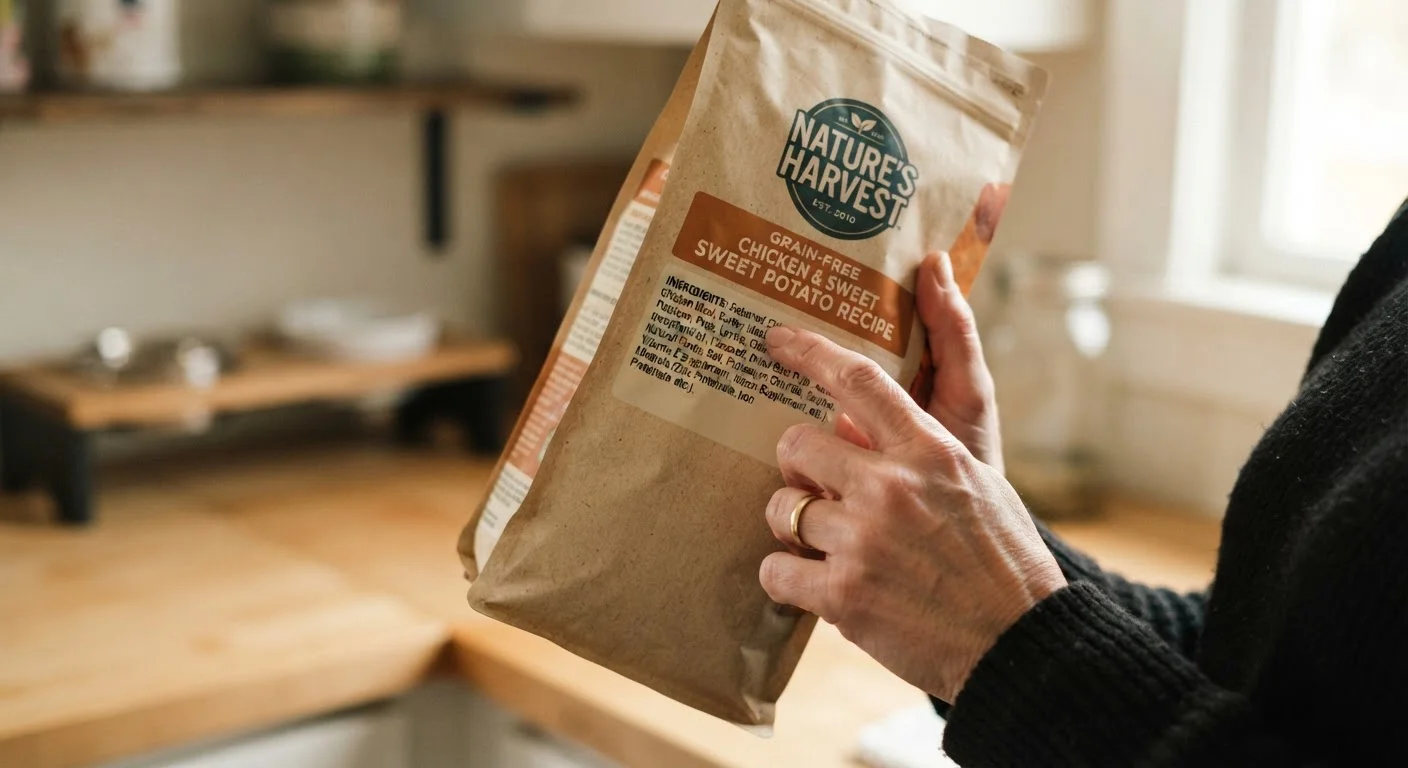
Key Takeaways
- Ingredients are listed by weight before processing, so moisture content affects their order.
- The guaranteed analysis shows minimum or maximum nutrient levels, not exact amounts.
- An AAFCO statement tells you whether a food is complete and balanced — and for which life stage.
- "Natural" and "human-grade" are loosely defined terms that don't guarantee superior nutrition.
- Your veterinarian is the best resource for matching a food label to your specific pet's needs.
Pet Food Label
A pet food label is the printed information on pet food packaging required by law to help consumers understand what's inside. It typically includes an ingredient list, a guaranteed analysis panel, feeding guidelines, and an AAFCO nutritional adequacy statement. Together, these sections tell you what the food is made of, its nutrient profile, and whether it's formulated to meet your pet's basic dietary needs.
Pet food labeling in the U.S. is regulated at both the federal level (by the FDA) and the state level, with most states adopting model regulations developed by the Association of American Feed Control Officials (AAFCO).
Why Pet Food Labels Matter More Than You Think
Standing in the pet food aisle with a dozen bags in front of you, it's easy to go by the picture on the front — a golden retriever bounding through a field, or a sleek cat eyeing a salmon fillet. But the front of the package is marketing. The back is information. Learning to read it is one of the most practical things you can do for your pet's long-term health.
Pet food labeling in the U.S. follows rules set by the FDA and guidelines from the Association of American Feed Control Officials (AAFCO). Understanding these rules helps you cut through the noise and focus on what the label is actually communicating. For a broader look at keeping your pet healthy, label literacy is a great starting point.
Federal and State Regulation Both Apply
Pet food is regulated at the federal level by the FDA for safety and at the state level for labeling, with most states following AAFCO model regulations. This means requirements can vary slightly by state, though the core label elements — ingredient list, guaranteed analysis, AAFCO statement, feeding directions, and manufacturer contact — are standard across the U.S.
The Ingredient List: Order Has Meaning
Ingredients are listed in descending order by weight before processing. This detail matters. Chicken, for example, contains a lot of water — roughly 70% or more. Once cooked, that moisture evaporates, and the actual amount of chicken in the finished food is proportionally smaller. Meanwhile, a dry ingredient like chicken meal (which is already dried and concentrated) may contribute more protein by weight than its lower position on the list suggests.
This doesn't mean whole meats are bad — it just means ingredient order alone doesn't tell the whole story. Look at the ingredient list alongside the guaranteed analysis for a clearer picture.
~70%
Water content in raw chicken before processing
AAFCO labeling guidelines note that ingredients are listed by pre-processing weight, which is why moisture-rich whole meats often appear near the top of pet food ingredient lists.
4
Nutrients guaranteed analysis must always include
U.S. pet food regulations require labels to list minimums for crude protein and crude fat, and maximums for crude fiber and moisture, at a minimum.
The Guaranteed Analysis Panel: Ranges, Not Exactness
The guaranteed analysis shows minimum percentages for crude protein and crude fat, and maximum percentages for crude fiber and moisture. These are regulatory thresholds, not precise measurements of what's in every kibble.
One important nuance: comparing a wet food and a dry food using guaranteed analysis numbers can be misleading because moisture content is so different. To make a fair comparison, you'd need to convert both to a dry-matter basis — a calculation your veterinarian can help with. For more on how label panels work in nutrition contexts, see reading a nutrition label without getting lost.
Convert to Dry Matter for Fair Comparisons
When comparing a wet food to a dry food, raw guaranteed analysis numbers can be misleading because moisture levels differ so dramatically. To compare on equal footing, subtract the moisture percentage from 100 to find the dry matter percentage, then divide each nutrient percentage by that number. Your vet or a veterinary nutritionist can walk you through this calculation.
The AAFCO Statement: The Most Important Line on the Bag
Somewhere on the label — often in small print — you'll find a nutritional adequacy statement. This is the single most useful sentence on the package. It tells you whether the food is intended to be complete and balanced, and for which life stage: growth, adult maintenance, reproduction, or all life stages.
The statement also tells you how the claim was established — either by formulation (the recipe meets AAFCO nutrient profiles) or by feeding trial (animals were actually fed the food under controlled conditions). Both are valid methods, but feeding trials are generally considered a higher standard of evidence.
If a food says it's intended for "intermittent or supplemental feeding only," it is not nutritionally complete on its own. That label language matters. For a deeper dive into decoding these statements, pet nutrition labels are confusing on purpose is worth reading alongside this guide.
Common Label Claims and What They Actually Mean
Front-of-package claims like "natural," "holistic," "human-grade," or "grain-free" are marketing language, not regulated nutritional standards — at least not in the way most pet owners assume. "Natural" has an AAFCO definition, but it primarily restricts the use of synthetic additives, not the overall quality of ingredients. "Human-grade" has no official AAFCO or FDA definition for pet food. "Grain-free" simply means grains were replaced by other carbohydrate sources.
None of these terms guarantee better nutrition. When evaluating a food, return to the AAFCO statement and guaranteed analysis rather than relying on front-panel language. Your veterinarian can help you determine whether a particular food is a good match for your pet's age, size, and health status.
This article is for general informational purposes only and is not a substitute for veterinary advice. Always consult a licensed veterinarian for guidance specific to your pet's health and nutritional needs.