

Key Takeaways
- 'Complete and balanced' is a regulated phrase tied to AAFCO nutrient profiles, not a marketing claim.
- Ingredients are listed by weight before processing, which can be misleading for moisture-heavy items like fresh meat.
- The guaranteed analysis shows minimum or maximum nutrient levels, not exact amounts.
- Life stage statements matter — a food labeled for 'all life stages' must meet the highest nutrient standards.
- Front-of-pack claims like 'natural' or 'premium' have little to no regulatory definition in pet food.
- Your veterinarian is the best resource for matching a pet food to your individual animal's needs.
Pet Food Label
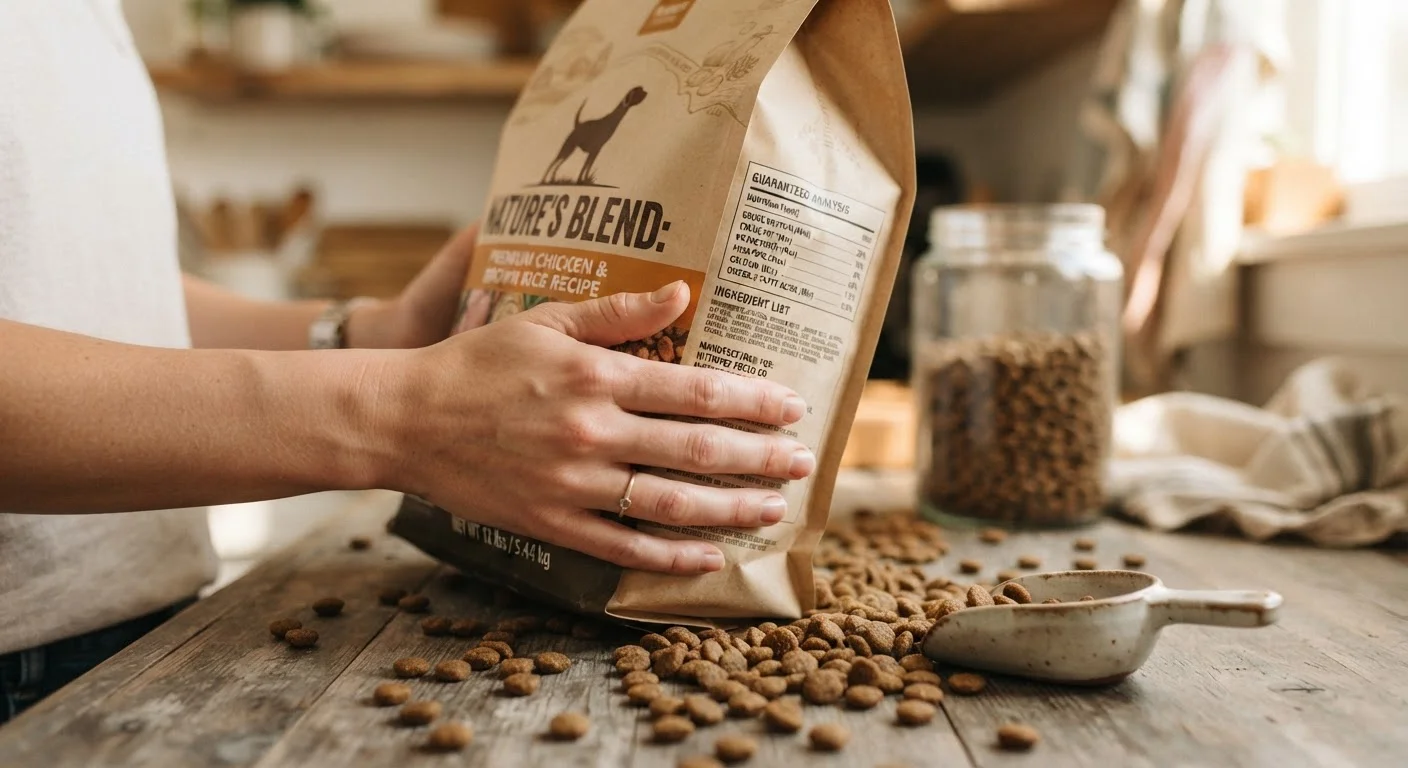
A pet food label is the printed information on pet food packaging required by federal and state regulations. It includes the product name, ingredient list, guaranteed analysis panel, feeding directions, and an AAFCO nutritional adequacy statement. Each section follows specific rules about what must be disclosed — but the rules don't always make the information easy to understand at a glance.
The Association of American Feed Control Officials (AAFCO) sets the model regulations that most U.S. states adopt for pet food labeling, including nutrient profiles and the standards behind 'complete and balanced' claims.
Why Pet Food Labels Feel So Hard to Read
Pick up nearly any bag of pet food and you'll find a wall of small print — ingredient lists that stretch to 40 items, percentages with no clear context, and bold front-of-pack phrases that sound meaningful but offer little guidance. This confusion isn't entirely accidental. Pet food labeling is governed by a patchwork of federal rules and state-level regulations, and the required information is written to satisfy regulatory bodies, not to help a pet owner make a quick, informed decision in a store aisle.
Understanding how labels work puts you back in control. The label has five core sections, each with a specific job. Knowing what each section is designed to tell you — and what it legally cannot tell you — is the foundation for reading pet food more confidently. For a parallel look at how human food labels work, see how nutrition labels on human food are structured.
State Rules Add Another Layer
Pet food labeling in the U.S. is regulated at both the federal level and by individual states, many of which adopt AAFCO's model regulations. In practice, this means the rules can vary slightly depending on where a product is sold. Manufacturers selling nationally typically comply with the most stringent state requirements to simplify distribution.
The Five Sections That Actually Matter
1. The product name. AAFCO naming rules are surprisingly strict. If a food is called "Salmon for Cats," salmon must make up at least 95% of the total product weight (excluding water). Add the word "dinner," "entrée," or "formula" and that drops to 25%. If salmon is listed after "with" — as in "Cat Food with Salmon" — it only needs to be 3%. The name is one of the most regulated parts of the label.
2. The ingredient list. Ingredients appear in descending order by pre-cooking weight. Fresh chicken sounds impressive at the top of the list, but because raw chicken is about 70% water, its actual contribution after processing can be much smaller than that top position implies. This is worth keeping in mind when comparing foods. For a deeper look at ingredient list mechanics, this guide to pet nutrition labels decoded walks through common pitfalls.
3. The guaranteed analysis. This panel shows minimum crude protein and crude fat, and maximum crude fiber and moisture. These are regulatory floors and ceilings — not exact figures. To compare wet and dry foods meaningfully, the numbers need to be converted to a "dry matter basis" by removing the moisture variable. Your vet or a veterinary nutritionist can help interpret these numbers for your pet's needs.
4. The AAFCO nutritional adequacy statement. This is perhaps the most important line on the label. It tells you whether the food is "complete and balanced" for a specific life stage — adult maintenance, growth, reproduction, or all life stages — and whether that claim is based on AAFCO nutrient profiles or an actual feeding trial. Foods substantiated by feeding trials have cleared a higher bar.
5. Feeding guidelines. These are estimates based on an average animal, not a recommendation tailored to your pet. Treat them as a starting point and adjust based on your veterinarian's advice.
95%
Minimum ingredient required for single-ingredient named food
Under AAFCO naming rules, a product named simply after one ingredient (e.g., 'Salmon for Cats') must contain at least 95% of that ingredient by weight, excluding water.
3%
Minimum required for 'with' ingredient claims
AAFCO rules allow a pet food to claim 'with' a specific ingredient on the label if that ingredient comprises just 3% of the product by weight.
~70%
Water content of fresh chicken before processing
Fresh or raw chicken is roughly 70% water by weight, meaning its position at the top of an ingredient list may overstate its contribution to the finished, dried product.
Front-of-Pack Claims: What's Regulated and What Isn't
The front of a pet food bag is prime marketing real estate. Words like "premium," "holistic," "human grade," and "gourmet" are not defined or regulated by AAFCO. A food using these terms is not held to any higher standard than one that doesn't. This mirrors a broader pattern in food marketing — see which packaging claims are regulated and which aren't for a look at how this plays out in human food labeling too.
"Natural" does have an AAFCO definition for pet food: it means ingredients derived from plant, animal, or mined sources without chemically synthetic processing. It says nothing about ingredient quality, sourcing, or nutritional value. "Organic" is regulated by the USDA for pet food in the same way it is for human food, so it carries more consistent meaning.
Use the AAFCO Statement as Your First Filter
Before reading anything else on a pet food label, find the AAFCO nutritional adequacy statement. If it isn't there, or if it says the food is 'intended for intermittent or supplemental feeding only,' that food is not designed to be a complete diet. Confirming this statement takes five seconds and immediately narrows your options to foods that meet baseline nutritional standards.
If a front-of-pack claim matters to you, look for it to be backed up somewhere in the regulated sections of the label — the ingredient list, guaranteed analysis, or AAFCO statement. If it only appears on the front panel, it may be marketing language with no regulatory teeth.
Putting It All Together for Your Pet
No label tells the whole story about a food's quality, and no single number — protein percentage, calorie count, or ingredient ranking — determines whether a food is right for your animal. Life stage, health status, activity level, and individual sensitivities all factor into what makes a diet appropriate. Managing your pet's weight is one example of a decision that depends on far more than what's on a label.
Use label literacy as a tool to filter out noise and ask better questions — not to make final decisions in isolation. A veterinarian or board-certified veterinary nutritionist can help you interpret a specific food's label in the context of your pet's individual needs. For a more detailed walkthrough of every label section, reading pet food labels without getting lost in the fine print is a practical next step.
This article is for general informational purposes only and is not a substitute for professional veterinary advice. Always consult a licensed veterinarian for guidance specific to your pet's health and nutritional needs.