

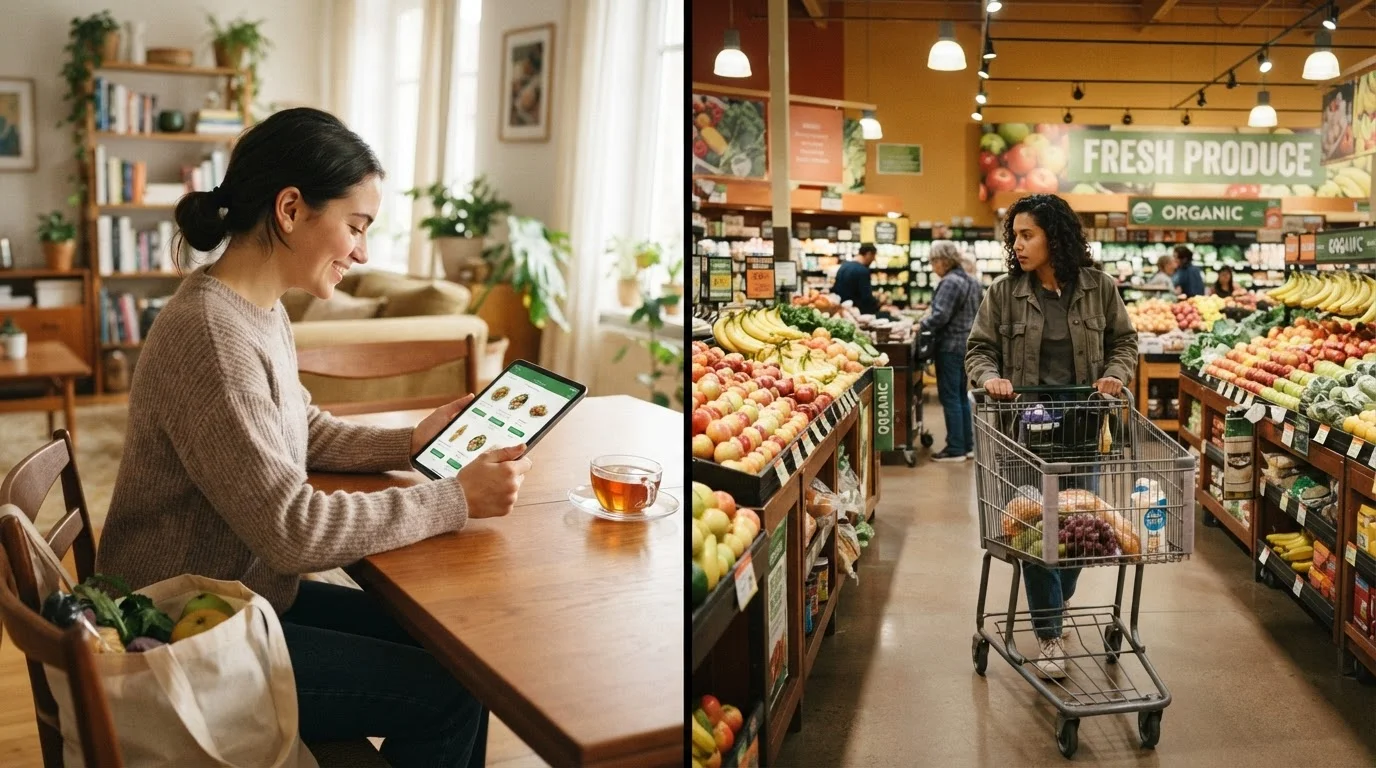
Key Takeaways
- Online grocery shopping typically adds delivery or service fees that reduce or eliminate any price savings.
- In-store shopping lets you judge freshness, compare labels, and take advantage of unadvertised markdowns.
- Online platforms make it easier to stick to a list, which can reduce impulse spending for many shoppers.
- Substitution risk — getting a replacement item you didn't want — is a real drawback of digital grocery orders.
- A hybrid approach (online for staples, in-store for produce and proteins) often delivers the best results.
- Neither channel is universally cheaper; your actual costs depend on fees, habits, and how you shop.
Option A
Online Grocery Shopping
The scheduled, list-driven approach to stocking your kitchen.
Best for: Busy households that want to minimize time spent shopping and reduce unplanned purchases.
Option B
In-Store Supermarket Shopping
The hands-on, flexible way to shop with full sensory access.
Best for: Shoppers who prioritize freshness assessment, spontaneous decisions, and avoiding fees.
If you have a predictable weekly staples list and limited free time
Online Grocery Shopping
Repeating a saved cart takes minutes, and scheduled delivery or curbside pickup eliminates the trip entirely. The time savings often outweigh modest fees.
If freshness and visual inspection matter most to you
In-Store Supermarket Shopping
Choosing your own produce, seafood, and deli items in person gives you control that no picking algorithm can replicate.
If you're prone to impulse buying and want to stick to a budget
Online Grocery Shopping
Shopping from a fixed digital list removes physical temptations like end-cap displays and checkout-lane snacks.
If you want to take advantage of in-store sales, markdowns, and clearance items
In-Store Supermarket Shopping
Many unadvertised price reductions and manager's specials are only visible — and available — when you're physically in the store.
If you want the most flexibility without committing fully to one method
Online Grocery Shopping
Use online ordering for pantry staples and household products, then make a short in-store trip for fresh items — a hybrid routine that captures the strengths of both.
The Core Difference: Control vs. Convenience
Grocery shopping sits at a useful crossroads in the broader online-versus-in-store debate because the stakes are immediate and recurring. You're not making a one-time electronics purchase — you're feeding your household every week. That frequency makes getting the channel right genuinely worth thinking through.
Online grocery shopping — whether delivery or curbside pickup — hands control of the picking process to someone else. You submit a list; a shopper or automated system fulfills it. That trade-off delivers real time savings but introduces a layer of variability: substitutions, out-of-stock items, and the occasional bruised peach you wouldn't have chosen yourself.
In-store shopping keeps control fully in your hands. You can pivot when you spot a better price on a different brand, squeeze the avocados, or grab that marked-down rotisserie chicken you didn't plan for. That flexibility is genuinely valuable — and so is the cost. For a broader look at how these trade-offs play out across all types of purchases, see the real trade-offs between shopping online and in person.
| Criterion | Online Grocery Shopping | In-Store Supermarket Shopping |
|---|---|---|
| Time investment | Low — minutes to reorder a saved cart | Higher — travel, shop, checkout, return |
| Freshness control | Limited — picker chooses for you | Full — inspect every item yourself |
| Fee transparency | Variable — delivery, service, tip fees | Clear — shelf price is what you pay |
| Impulse spending risk | Lower — fixed list, no visual cues | Higher — store design encourages spending |
| Access to markdowns | Limited — clearance rarely online | Strong — in-store specials visible |
| Substitution risk | Present — out-of-stocks trigger swaps | None — you adapt on the spot |
| Accessibility | High — no transport needed | Depends on mobility and location |
What Online Grocery Shopping Does Well
The strongest argument for ordering online is time. Reordering a saved weekly cart can take under five minutes, compared to 45–90 minutes for a full supermarket trip including travel, parking, and checkout. For dual-income households or anyone managing a packed schedule, that difference is substantial.
Digital carts also create a natural barrier to impulse spending. Supermarkets are deliberately designed to encourage unplanned purchases — shelf placement, lighting, and aisle sequencing all influence what lands in your cart. Shopping from a static list on a screen sidesteps much of that pressure. If impulse buys are a recurring budget problem for you, our guide on how grocery store layout is designed against you explains exactly what's happening in the aisles.
For shoppers with mobility limitations, no reliable transportation, or caregiving responsibilities that make leaving home difficult, online ordering isn't just convenient — it can be essential.
~25%
U.S. adults who buy groceries online regularly
Estimates from industry research suggest roughly one in four American adults purchases groceries online at least occasionally, a figure that grew significantly after 2020.
45–90 min
Typical time for a full in-store grocery trip
Including travel, parking, shopping, and checkout, a complete supermarket run consumes significantly more time than placing a digital order.
$5–$15
Typical delivery or service fee range per order
Fees vary widely by platform, location, and membership status; non-member per-order charges commonly fall in this range before tips.
Where In-Store Shopping Holds Its Ground
Freshness is the argument most shoppers make first, and it's legitimate. Picking your own produce, fish, and meat means you see ripeness, smell freshness, and avoid the items a picker might select for quantity rather than quality. That hands-on assessment is something no digital interface replicates well.
Cost transparency is another in-store advantage. When you're physically moving through the store, you see the full price tag — including any per-unit pricing posted on the shelf tag — and you can compare brands side by side in real time. Online platforms sometimes display pricing inconsistently, and fees added at checkout can make a cart look cheaper than it is until the final total appears.
Unadvertised in-store markdowns are also a real factor. Clearance stickers, manager's specials, and short-date reductions rarely make it into digital inventory. Regular in-store shoppers who know where to look can capture savings that online ordering simply doesn't surface. For strategies that stretch your grocery budget further, browse our budget shopping tips hub.
Fees, Substitutions, and Hidden Costs
The true cost of online grocery shopping goes beyond the item prices. Delivery fees, service fees, suggested tips for shoppers, and minimum-order thresholds all add up. Some platforms bundle these into a membership model; others charge per order. Before concluding that online is more or less expensive than your local store, it pays to tally the full transaction cost — not just the subtotal.
Substitutions are the other financial wildcard. When your chosen item is out of stock, platforms typically offer an alternative — sometimes a pricier brand, sometimes a larger size you didn't need. Unchecked, substitutions can quietly inflate a bill. Most platforms allow you to set substitution preferences or reject alternatives outright, but that requires actively managing the order after submission.
For a structured look at how these costs compare to in-store impulse spending, see which channel actually saves you more. If you're new to digital grocery ordering and unsure how the fulfillment process works, curbside pickup, ship-to-store, and same-day delivery explained walks through your options clearly.
The Hybrid Approach Worth Considering
Many households find that neither channel alone is optimal. A practical middle ground: use online ordering for non-perishable staples, household products, and pantry items where freshness isn't a factor — then make a shorter, more focused in-store trip for produce, proteins, and dairy. This reduces total time spent in-store while preserving quality control where it matters most. It also lowers your exposure to delivery fees by consolidating online orders into larger, less frequent carts.