

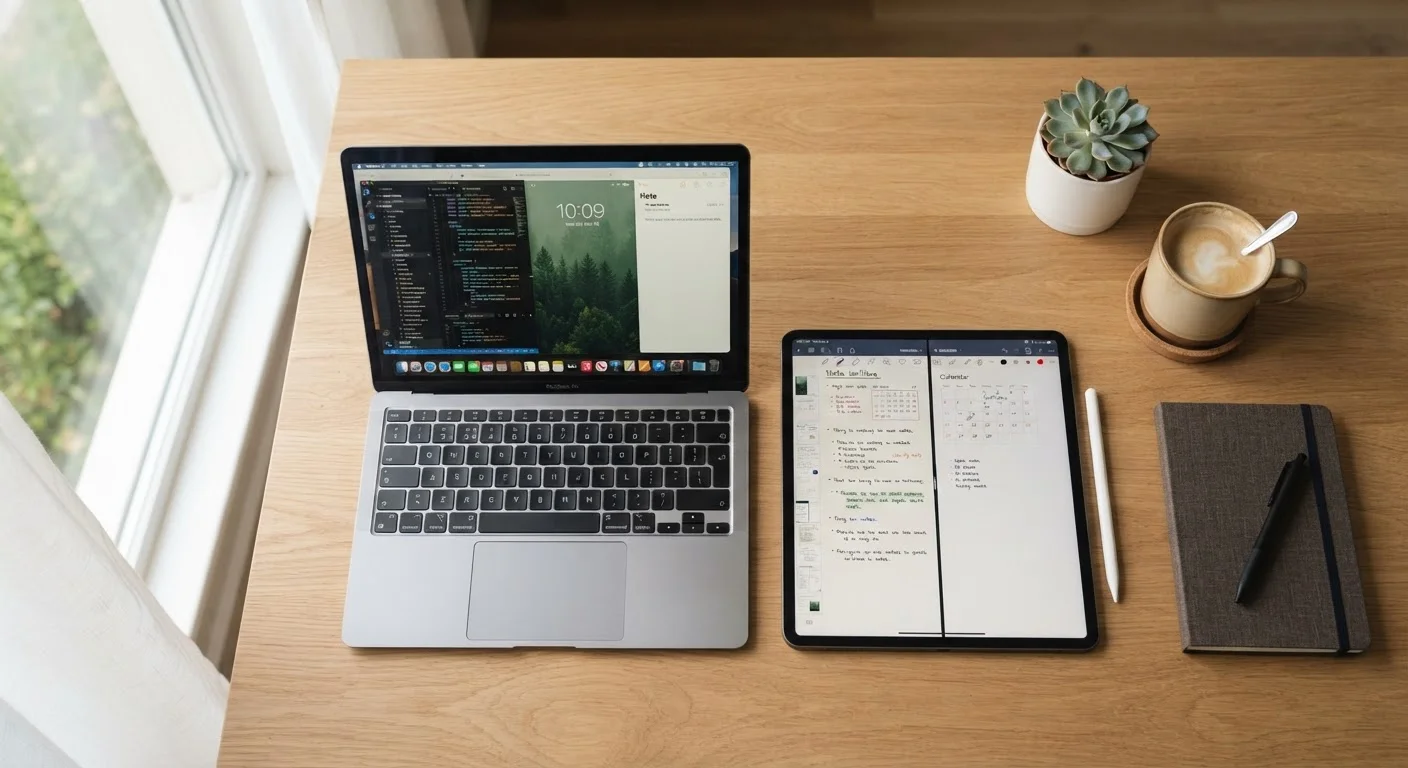
Key Takeaways
- Tablets excel at portability and media consumption but have limits with complex, multi-window tasks.
- Laptops handle demanding productivity work more comfortably thanks to full keyboards and open file systems.
- Many households benefit from both — they solve different daily problems rather than competing directly.
- Keyboard accessories can close some of the gap for tablet users who need occasional typing.
- Battery life and weight are two practical areas where tablets consistently hold an edge.
Option A
Tablet
The lightweight, touch-first companion for consumption and convenience.
Best for: Best for people who primarily browse, stream, read, and handle light communication on the go.
Option B
Laptop
The versatile, keyboard-driven workhorse for serious productivity.
Best for: Best for anyone who regularly writes, edits documents, manages spreadsheets, or multitasks across many apps.
If you mainly stream video, read articles, and check email
Tablet
Tablets are lightweight, instant-on, and purpose-built for these tasks. Long battery life means less hunting for outlets.
If you write documents, build spreadsheets, or use professional software
Laptop
A physical keyboard and a desktop-class operating system make complex, multi-step work far more manageable and less frustrating.
If you want a single device for both productivity and portability
Laptop
Laptops handle the widest range of everyday tasks without requiring workarounds, making them the safer all-in-one choice.
If you want a device for a school-age child's learning and entertainment
Tablet
Tablets are durable, intuitive for younger users, and easy to lock down with parental controls for safer, supervised use.
If you travel frequently and value packing light
Tablet
Tablets slip into a bag without adding much weight, and their battery life typically outlasts most flights or commutes.
What Each Device Is Actually Built to Do
Both tablets and laptops are portable computers, but they were designed around different habits. A tablet is essentially a large touchscreen — you tap, swipe, and scroll your way through apps. Most tablets run mobile operating systems, meaning their software library looks a lot like a phone's, just on a bigger screen. A laptop, by contrast, runs a full desktop operating system (like Windows or macOS), uses a physical keyboard, and gives you access to the same software you'd run on a desktop PC.
That architectural difference shapes nearly every trade-off between them. Tablets are optimized for consuming content — watching, reading, browsing, light messaging. Laptops are optimized for creating and organizing content — writing, calculating, managing files, and switching between multiple open windows. Understanding which mode describes your typical day is the fastest way to figure out which device actually fits your life.
Head-to-Head: How They Stack Up on Everyday Tasks
Browsing the web, checking email, and streaming video work well on both devices — that's the honest starting point. Where the differences emerge is in how comfortable and flexible each device is as tasks get even slightly more complex.
| Criterion | Tablet | Laptop |
|---|---|---|
| Web browsing | Excellent — smooth and intuitive | Excellent — more tab flexibility |
| Streaming video | Excellent — ideal screen for handheld viewing | Excellent — larger screen, more ports |
| Email and messaging | Good for reading; typing can feel slow | Excellent — keyboard makes it fast |
| Document creation | Limited — workable with keyboard case | Excellent — full software, easy file handling |
| Multitasking | Limited split-screen support | Strong — multiple windows simultaneously |
| Portability | Superior — lighter, more compact | Good, but heavier and bulkier |
| Battery life | Typically 8–12 hours under moderate use | Varies widely — 4–12 hours depending on use |
| Software availability | Mobile apps only — some gaps | Full desktop software library |
For most light tasks, a tablet gets the job done without complaint. The friction shows up when you try to attach a file to an email, hop between a document and a reference website simultaneously, or use software that only runs on a full desktop operating system. Laptops handle all of that without workarounds.
Portability and Battery Life: Where Tablets Pull Ahead
Weight and endurance are two categories where tablets have a genuine, consistent advantage. Most tablets weigh roughly one pound or less, while even thin laptops typically clock in at two to four pounds — a meaningful difference if you're slipping a device into a bag every day.
~1 lb
Typical weight of a modern tablet
Most mainstream tablets fall well under 1.5 pounds, while entry-level laptops commonly start around 2.5 pounds.
8–12 hrs
Tablet battery life under moderate use
Manufacturers commonly rate tablet batteries at 10 hours of video playback; real-world mixed use typically lands in the 8–12 hour range.
2–4x
More apps available on desktop vs. mobile
Full desktop operating systems provide access to a significantly broader range of professional and specialized software than mobile app stores.
Battery life follows a similar pattern. Because tablets run simpler software and have no moving parts (no cooling fans, no spinning drives), they tend to sustain eight to twelve hours of screen-on time under moderate use. Laptops vary widely, but heavy workloads can cut runtime significantly. If long stretches away from an outlet are part of your routine — commuting, traveling, working in different rooms — that gap matters.
Productivity Limits: What Tablets Still Struggle With
Tablet manufacturers have worked hard to narrow the productivity gap. Detachable keyboard cases and stylus accessories help, and some tablets now support split-screen multitasking. But certain friction points remain.
File management on a tablet is more restricted — you can't always move files between apps as freely as you can on a laptop. Many professional tools (specific accounting software, advanced photo or video editors, industry-specific platforms) either don't have tablet versions or have stripped-down ones that lack key features. And typing long documents on a glass screen — even a large one — is noticeably less comfortable than a physical keyboard, however good the autocorrect is.
If your household includes a student writing papers, someone working from home occasionally, or anyone managing a side project, a laptop's open file system and full software access will save real time and effort. For families considering handing a tablet to a younger child, built-in parental controls are worth exploring before you hand it over.
Keyboard Cases: A Middle-Ground Worth Considering
If you're leaning toward a tablet but worried about typing, a Bluetooth or snap-on keyboard case can meaningfully improve the experience for emails and shorter documents. It won't replicate a laptop keyboard exactly, but for moderate writing tasks it's a practical compromise. Keep in mind that the keyboard case adds cost and weight — factor both into your comparison before deciding.
Which One Actually Fits Your Household?
The most honest answer is that many households benefit from having one of each — but that's only practical if the budget allows for it. When you need to choose just one, the decision usually comes down to your most frequent use case, not your occasional one.
If the majority of your screen time involves reading articles, watching shows, video calling, and casual browsing, a tablet will feel effortless and get out of your way. If you regularly produce content — drafting emails longer than a paragraph, building reports, editing photos seriously — a laptop will reduce the friction you'll otherwise hit constantly on a tablet.
For a plain-language breakdown of where each device shines in specific scenarios, this deeper comparison walks through the edge cases in more detail. And if you're thinking about how connected devices fit into your broader home setup, home tech basics is a useful starting point for the bigger picture.