
Key Takeaways
- Wearables estimate sleep stages using motion and heart rate, not brain activity measurements.
- Consumer sleep scores can highlight patterns but are not clinically diagnostic tools.
- Obsessing over imperfect sleep data can itself disrupt rest — a phenomenon called orthosomnia.
- Trends over weeks matter more than any single night's reading.
- Persistent sleep concerns should be evaluated by a healthcare professional, not a wearable app.
Reveals long-term sleep duration trends effortlessly
Without any conscious logging, a wearable builds a multi-week picture of how much sleep you're actually getting — useful context that most people genuinely underestimate or misremember.
Highlights lifestyle factors affecting rest
Correlating sleep data with late meals, alcohol, or exercise timing can surface real behavioral patterns, giving you a starting point for experimenting with changes.
Low effort compared to manual sleep journaling
The passive nature of wrist-based tracking means you get data without having to remember to log anything, which increases the chance of consistent, comparable records over time.
May prompt earlier conversations with a doctor
Noticing a persistent pattern — such as frequent nighttime wake events — can give a person concrete information to bring to a healthcare provider, rather than relying solely on subjective recall.
Cannot measure brain activity or true sleep stages
Sleep stage classification (light, deep, REM) without EEG is inherently an inference. Independent research has found that consumer wearables show variable agreement with clinical polysomnography, particularly for deep and REM sleep.
Single-night readings are unreliable indicators
Normal biological variation, device placement, and environmental factors mean any one night's score can swing widely without reflecting meaningful change in actual sleep quality.
Can trigger anxiety that worsens sleep
Orthosomnia — preoccupation with achieving a perfect sleep score — is a recognized concern among sleep researchers, and the anxiety it produces can directly disrupt the rest someone is trying to improve.
Not a substitute for clinical sleep evaluation
Conditions like sleep apnea, restless legs syndrome, or insomnia disorder require professional assessment and cannot be diagnosed or ruled out by a consumer device. See common myths about wearable monitors for more on where consumer devices fall short of clinical tools.
Algorithm differences mean scores aren't comparable across brands
Each manufacturer uses proprietary algorithms to define and score sleep stages, so a "good" score on one platform may reflect entirely different criteria than the same score on another.
Our Verdict
Wearable sleep tracking offers genuine value as a low-effort way to spot long-term patterns in your rest, but the data is an estimate — not a clinical measurement. Used with appropriate skepticism, a sleep score can prompt useful behavior changes. Used as a daily verdict on your health, it can create more anxiety than insight.
Anyone curious about their general sleep habits who wants a loose feedback loop for lifestyle adjustments — not someone seeking a diagnosis or clinical-grade analysis.
How Wearables Actually Measure Sleep
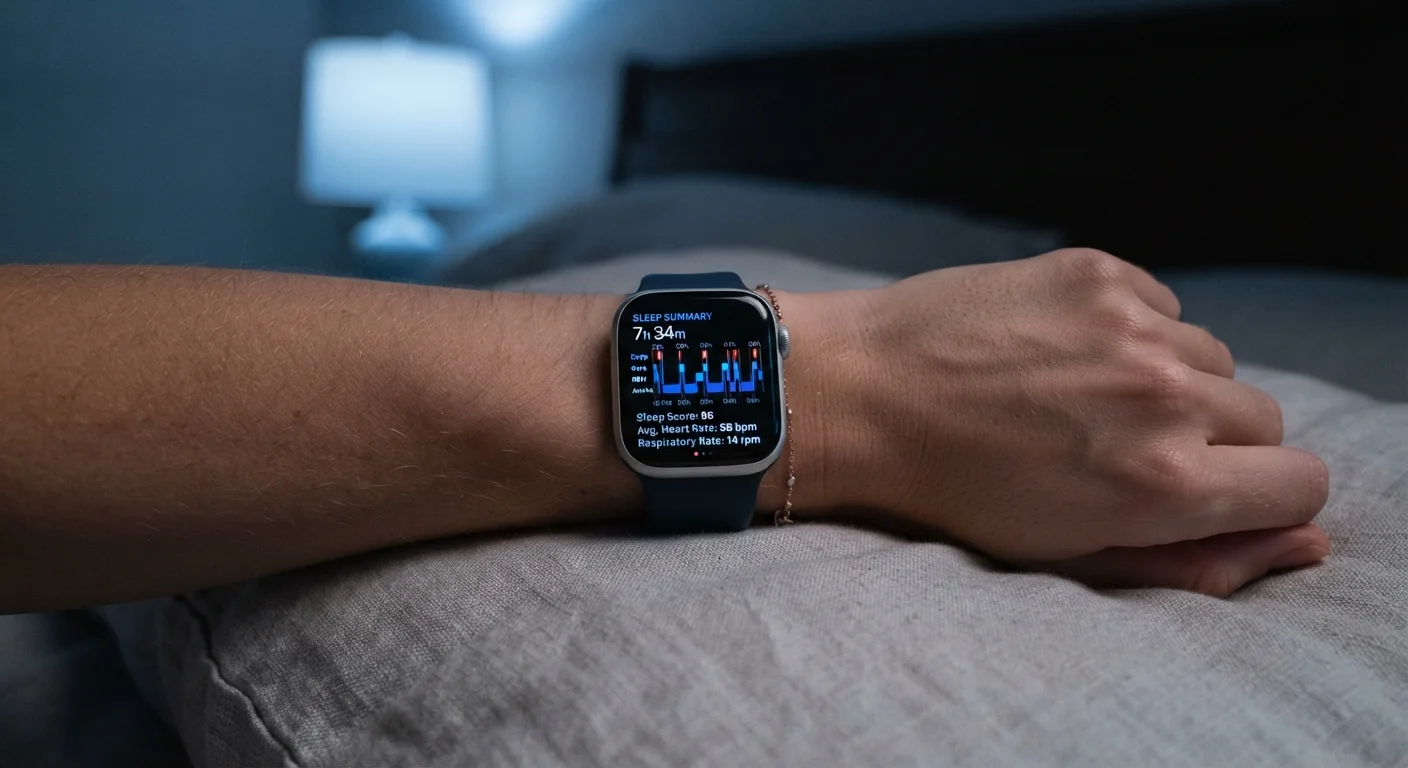
Consumer wearables don't measure sleep the way a sleep clinic does. Clinical sleep studies — called polysomnography — attach sensors directly to the scalp to record brain waves (electroencephalography, or EEG), which is the gold standard for identifying sleep stages like REM and deep sleep. Wearables can't do this.
Instead, smartwatches and fitness trackers rely on two primary inputs: accelerometers (motion sensors that detect stillness) and optical heart rate sensors that measure pulse patterns through the skin. Algorithms then use these signals to estimate when you fell asleep, how often you woke up, and which sleep stages you may have cycled through. Some devices add skin temperature or blood oxygen (SpO2) readings to improve accuracy. For a deeper look at how those sensors work, see what ECG, SpO2, and temperature sensors actually measure.
The key word throughout is estimate. The device is making an educated inference, not a direct observation of your brain state.
What the Data Can Reasonably Tell You
Despite their limitations, wearable sleep trackers offer real practical value when interpreted correctly.
Reveals long-term sleep duration trends effortlessly
Without any conscious logging, a wearable builds a multi-week picture of how much sleep you're actually getting — useful context that most people genuinely underestimate or misremember.
Highlights lifestyle factors affecting rest
Correlating sleep data with late meals, alcohol, or exercise timing can surface real behavioral patterns, giving you a starting point for experimenting with changes.
Low effort compared to manual sleep journaling
The passive nature of wrist-based tracking means you get data without having to remember to log anything, which increases the chance of consistent, comparable records over time.
May prompt earlier conversations with a doctor
Noticing a persistent pattern — such as frequent nighttime wake events — can give a person concrete information to bring to a healthcare provider, rather than relying solely on subjective recall.
The most reliable signal a wearable provides is consistency over time. A single night's data is noisy — you might move around more than usual, wear the watch loosely, or sleep in a new environment. But a 30-day trend showing consistently short sleep windows or frequent middle-of-the-night disturbances is meaningful context worth paying attention to. For guidance on turning that data into actionable habits, these evidence-grounded habits can help you get real value from what you're collecting.
The Real Limits You Should Know
Understanding where wearable sleep data falls short is just as important as knowing what it can do.
Cannot measure brain activity or true sleep stages
Sleep stage classification (light, deep, REM) without EEG is inherently an inference. Independent research has found that consumer wearables show variable agreement with clinical polysomnography, particularly for deep and REM sleep.
Single-night readings are unreliable indicators
Normal biological variation, device placement, and environmental factors mean any one night's score can swing widely without reflecting meaningful change in actual sleep quality.
Can trigger anxiety that worsens sleep
Orthosomnia — preoccupation with achieving a perfect sleep score — is a recognized concern among sleep researchers, and the anxiety it produces can directly disrupt the rest someone is trying to improve.
Not a substitute for clinical sleep evaluation
Conditions like sleep apnea, restless legs syndrome, or insomnia disorder require professional assessment and cannot be diagnosed or ruled out by a consumer device. See common myths about wearable monitors for more on where consumer devices fall short of clinical tools.
Algorithm differences mean scores aren't comparable across brands
Each manufacturer uses proprietary algorithms to define and score sleep stages, so a "good" score on one platform may reflect entirely different criteria than the same score on another.
When to See a Sleep Specialist
If you regularly wake feeling unrefreshed, experience excessive daytime sleepiness, or a partner notices you snoring loudly or stopping breathing during sleep, those are signals worth discussing with a healthcare provider — not something a wearable app can assess. Consumer devices can note disturbances, but they cannot screen for or diagnose sleep disorders such as obstructive sleep apnea. A clinical evaluation involves tools and expertise well beyond what any wrist device provides.
Heart rate accuracy also affects sleep stage estimates — particularly REM detection, which leans on heart rate variability. Optical sensors on wrists can vary in precision, especially with movement or loose fit, which can cascade into less reliable sleep stage breakdowns.
Using Sleep Data Without Letting It Use You
There's a documented pattern — sometimes called orthosomnia — where people become so focused on achieving a perfect sleep score that the anxiety itself interferes with sleep. This is one of the clearest examples of a tool working against the goal it was designed to support.
A few practical principles help avoid this trap:
- Check weekly, not nightly. Reviewing sleep data every morning invites over-reaction to normal night-to-night variation.
- Look for patterns, not grades. A sleep score is a relative indicator, not a report card. Use it to notice whether late nights or alcohol correlate with worse rest — not to judge whether you "passed."
- Pair it with how you actually feel. If you feel rested and your score says otherwise, the score is likely the outlier.
The broader trade-offs of monitoring health metrics daily are worth considering — this honest look at daily health tracking covers both the benefits and the pitfalls across steps, sleep, and more.
~70%
Adults not getting recommended sleep duration
The U.S. Centers for Disease Control and Prevention has reported that roughly one in three American adults regularly sleeps less than the recommended seven hours per night.
Low–Moderate
Wearable accuracy vs. clinical polysomnography
Multiple peer-reviewed studies comparing consumer wearables to lab-based sleep studies have found moderate agreement on sleep/wake detection but substantially lower accuracy for individual sleep stage classification.
This article is for general informational purposes only and does not constitute medical advice. If you have persistent sleep difficulties or concerns about a sleep disorder, consult a qualified healthcare professional.