

Key Takeaways
- Wet food contains 70–80% moisture, making it useful for pets who don't drink enough water.
- Dry kibble's dental health benefits are often overstated; texture alone provides limited plaque control.
- Neither format is universally superior — nutritional quality depends on the specific product, not the format.
- Mixing wet and dry food is a common and generally acceptable feeding approach.
- Cost per calorie is typically higher for wet food than for equivalent dry kibble.
- Always consult your veterinarian before making significant changes to your pet's diet.
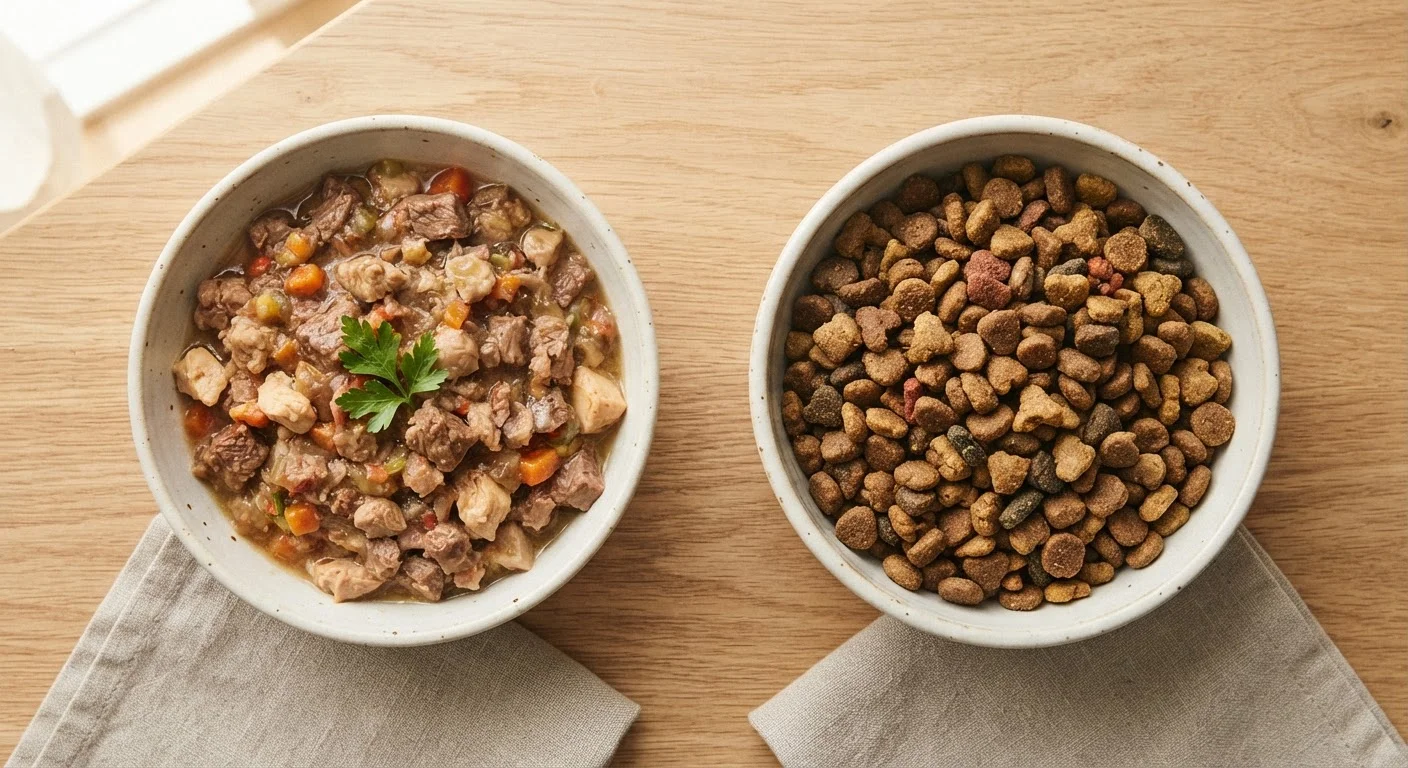
Option A
Wet Food (Canned)
The high-moisture, highly palatable option.
Best for: Pets needing extra hydration, picky eaters, or animals with certain health conditions affecting appetite or urinary health.
Option B
Dry Kibble
The convenient, longer-shelf-life staple.
Best for: Pet owners seeking cost-effective, easy-to-portion feeding with flexible meal scheduling.
If your pet has urinary tract issues or tends to under-drink
Wet Food (Canned)
The high moisture content in wet food can help support urinary tract health by increasing overall fluid intake, which vets often consider beneficial for cats especially.
If convenience and lower cost per meal matter most
Dry Kibble
Kibble is easier to portion, store, and leave out for free-feeding. It typically costs less per calorie than canned food of comparable quality.
If your pet is a picky eater or has a reduced appetite
Wet Food (Canned)
Wet food's stronger aroma and softer texture tend to be more appealing to finicky pets and those recovering from illness or dental procedures.
If you want a flexible approach that addresses both hydration and convenience
Wet Food (Canned)
Many veterinarians support mixing wet and dry food to balance palatability, hydration, and cost — wet food can be a satisfying addition without fully replacing kibble.
If dental health support is a primary concern
Dry Kibble
While the evidence is limited, kibble's firmer texture may provide slightly more mechanical abrasion on teeth than soft wet food, though dedicated dental chews or brushing remain more effective.
Moisture Content: The Biggest Nutritional Difference
The most significant and measurable difference between wet and dry pet food is water content. Canned wet food typically contains 70–80% moisture, while dry kibble usually comes in at just 8–12%. This gap has real implications for how your pet meets its daily fluid needs.
Cats, in particular, evolved in arid environments and have a naturally low thirst drive. Many veterinary nutritionists note that cats on a dry-only diet may consume less total water than those eating wet food, even when fresh water is always available. For dogs, the difference matters less for healthy animals — but for pets managing kidney disease, urinary crystals, or chronic dehydration, a vet may specifically recommend wet food to increase fluid intake.
It's worth noting that moisture dilutes caloric density. When comparing food labels, dry matter basis calculations — which strip out moisture — give a more accurate side-by-side view of protein, fat, and other nutrient levels. Our guide to reading pet food labels explains how to make this comparison correctly.
70–80%
Moisture in typical wet/canned pet food
Compared to just 8–12% in dry kibble, according to published veterinary nutrition references.
~50%
Cats estimated to be chronically under-hydrated on dry diets
Veterinary nutritionists have noted that cats fed exclusively dry food often consume significantly less water than those eating wet food.
Few
Kibble products with VOHC dental seal
Only a small number of dry pet food products have earned the Veterinary Oral Health Council's seal for plaque or tartar reduction.
Dental Health Claims: What the Evidence Actually Shows
One of the most persistent beliefs about dry kibble is that it cleans pets' teeth. The reasoning is intuitive: crunchy texture should scrub plaque away. In practice, the evidence is less convincing.
Most kibble shatters vertically when a pet bites down, providing minimal side-to-side scrubbing against the gum line where plaque accumulates. The Veterinary Oral Health Council (VOHC) grants a seal of acceptance to products shown in clinical trials to meaningfully reduce plaque or tartar — and only a small subset of kibble products have earned it. Wet food, by contrast, leaves more residue on teeth and offers no mechanical abrasion, but it also doesn't appear to dramatically worsen dental disease in otherwise healthy pets when paired with appropriate dental care.
Veterinary dentists generally agree that tooth brushing remains the gold standard for pet dental health, regardless of diet. Dental chews with the VOHC seal are a well-supported secondary option. Relying on kibble alone to protect your pet's teeth is likely to fall short. For more on how food format shapes your pet's health over time, see our breakdown of how feeding format affects pet health.
| Criterion | Wet Food (Canned) | Dry Kibble |
|---|---|---|
| Moisture content | 70–80% | 8–12% |
| Palatability | Generally higher | Varies; lower aroma |
| Dental benefits | Minimal | Limited; product-dependent |
| Cost per calorie | Higher | Lower |
| Shelf life (opened) | 2–3 days refrigerated | Several weeks when sealed |
| Portion control ease | Moderate | Easy to measure |
| Suitable for hydration needs | Yes | Less so |
Palatability, Cost, and Practical Tradeoffs
Wet food consistently scores higher on palatability studies — its stronger aroma and softer texture make it more enticing for most cats and many dogs. This makes it particularly useful for sick, elderly, or recovering animals with reduced appetites. Dry kibble, meanwhile, is more shelf-stable: an open bag can last weeks when stored properly, while opened canned food must be refrigerated and used within a few days.
On cost, dry kibble generally delivers more calories per dollar than wet food of comparable nutritional quality. For large dogs especially, feeding wet food exclusively can be substantially more expensive. A mixed feeding approach — sometimes called a combination diet — is practical for many households: wet food at one meal for palatability and hydration, kibble at another for convenience and cost control. Most veterinarians consider this a reasonable strategy, provided both products are complete and balanced.
Combination Feeding Is Common and Generally Safe
Many veterinarians support offering a mix of wet and dry food within the same day, as long as both products carry an AAFCO statement confirming they are complete and balanced for your pet's life stage. The key is monitoring total caloric intake to avoid overfeeding. Ask your vet what ratio makes sense for your specific pet's weight, age, and health status.
For a broader look at how these formats compare alongside raw feeding, the evidence on dry, wet, and raw diets is a useful reference. And if you want to evaluate any product's label before buying, our pet food label explainer walks through what each panel really means.
This article is for general informational purposes only and is not a substitute for personalized veterinary advice. Consult your veterinarian before making significant changes to your pet's diet, especially if your pet has an existing health condition.