

Key Takeaways
- Ingredients are listed by weight before processing, so the first few ingredients dominate the formula.
- The guaranteed analysis shows minimum or maximum nutrient levels, not exact amounts.
- An AAFCO nutritional adequacy statement tells you whether a food is complete and balanced for a specific life stage.
- Front-of-bag marketing claims are largely unregulated; the back panel is where the useful facts live.
- Moisture content differences make direct protein comparisons between wet and dry food misleading without conversion.
- Your veterinarian is the best resource for interpreting labels in the context of your specific pet's needs.
Pet Food Label
A pet food label is the regulated text printed on packaging that describes what is inside the product, its nutritional content, and who it is intended for. In the United States, pet food labels must follow rules set by the FDA and guidelines from AAFCO (the Association of American Feed Control Officials). Key sections include the ingredient list, guaranteed analysis panel, and a nutritional adequacy statement.
AAFCO does not directly test or approve pet foods; it publishes nutrient profiles and model regulations that individual states adopt and enforce.
Why the Back of the Bag Matters More Than the Front
Pet food packaging is designed to be appealing. Words like "premium," "wholesome," and "ancestral recipe" appear on the front of the bag and carry little legal weight. The information that actually matters — and that is at least partially regulated — lives on the back or side panel. Understanding four core label sections puts you in a much stronger position as a pet owner.
For a broader look at how labeling norms apply across food products, see our guide to food label basics. The concepts overlap in useful ways. For a deeper dive specifically into pet food packaging claims, this companion article walks through what labels are legally required to say — and what they strategically leave out.
The Ingredient List: Order and Context
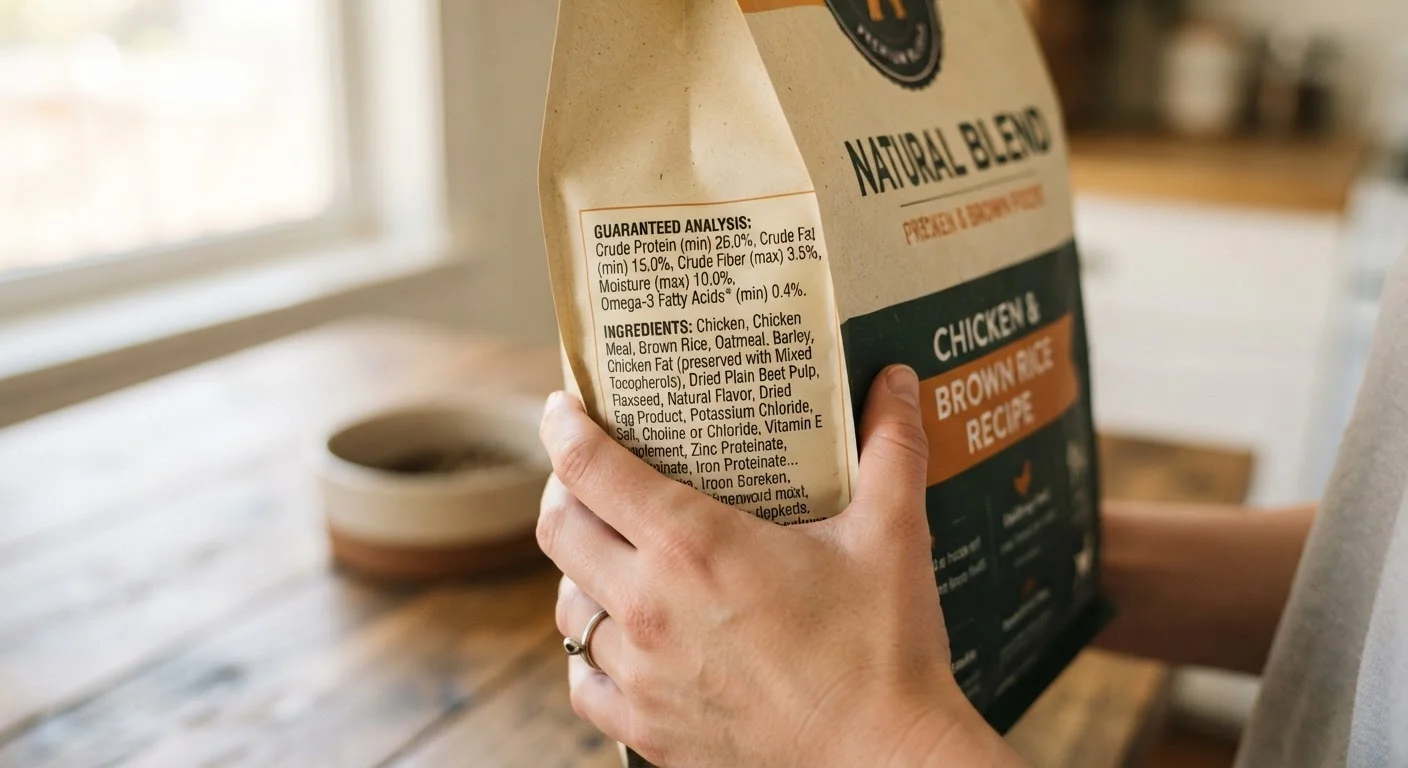
Ingredients are listed in descending order by weight before processing. That sounds straightforward, but moisture complicates things. A whole chicken may appear first on the list, but it contains roughly 70% water. After cooking, its contribution to the finished product may be smaller than "chicken meal" listed third — because meal is already dried and concentrated.
This is why scanning only the first ingredient misses the full picture. Look at the first five to eight ingredients together to get a realistic sense of what the food is primarily made of.
Watch for Ingredient Splitting
Manufacturers sometimes list several forms of the same ingredient separately — for example, corn flour, ground corn, and corn gluten meal — rather than as a single entry. This pushes each form lower on the ingredient list, making that ingredient appear less prominent than it really is. If you see multiple variations of one base ingredient, mentally combine them when assessing how significant that ingredient actually is in the formula.
Ingredient splitting is another practice worth knowing. If a manufacturer lists "ground corn," "corn gluten meal," and "corn flour" separately, each appears lower on the list than if corn were listed as a single combined entry. This can make a primary ingredient appear less dominant than it actually is.
For a full comparison of how feeding formats affect what ends up in the bowl, see our dry vs. wet food overview.
The Guaranteed Analysis: What the Numbers Actually Tell You
The guaranteed analysis panel lists four values at minimum: crude protein (minimum), crude fat (minimum), crude fiber (maximum), and moisture (maximum). Notice these are limits, not precise measurements. A food stating "minimum 26% crude protein" could contain significantly more.
4
Minimum guaranteed analysis values required by AAFCO
All pet food sold in the U.S. must list crude protein, crude fat, crude fiber, and moisture at minimum on the guaranteed analysis panel.
~75–80%
Typical moisture content in canned wet pet food
This high moisture level means nutrient percentages on wet food labels are not directly comparable to dry food without a dry-matter basis conversion.
2
Ways AAFCO nutritional adequacy can be established
A manufacturer can claim nutritional adequacy by meeting AAFCO's published nutrient profiles or by completing an AAFCO-protocol feeding trial with real animals.
The word "crude" refers to the laboratory method used to measure each nutrient, not the quality of the ingredient. Crude protein, for example, is estimated by measuring total nitrogen — it does not distinguish between highly digestible protein and less digestible sources.
Comparing wet and dry food directly using these numbers is misleading because moisture content varies dramatically. Wet food may be 78% moisture; dry kibble typically runs 10% or less. To make a fair comparison, nutrient values need to be recalculated on a dry-matter basis — a process your veterinarian can assist with. See also what the research says about wet vs. dry kibble for broader context.
The AAFCO Nutritional Adequacy Statement
This is arguably the most important line on the label. The AAFCO nutritional adequacy statement tells you whether a food is intended to serve as a complete diet or only a supplement or treat. It also specifies the life stage the food is formulated for: growth (puppies or kittens), adult maintenance, all life stages, or senior.
A food labeled "for all life stages" meets requirements for growth and reproduction — the most demanding nutritional standard — which means it may contain more calories and certain nutrients than a healthy adult animal needs. Life stage matching matters. Our life stage nutrition guide explains why the distinctions between puppy, adult, and senior formulations are meaningful.
The statement also indicates whether the claim is based on AAFCO nutrient profiles or an actual feeding trial. Feeding trials involve real animals eating the food over time, which is generally considered stronger evidence of real-world nutritional performance.
This article provides general educational information about pet food labeling and is not a substitute for personalized veterinary advice. Always consult your veterinarian regarding your pet's specific dietary needs.
Putting It Together for Your Pet
No label tells the full story on its own. A food can meet AAFCO minimums and still be a poor fit for an individual animal with specific health conditions, weight concerns, or age-related needs. The label is a starting point, not a final verdict.
When reviewing a label, move through it in order: check the AAFCO statement first to confirm the food is complete and appropriate for your pet's life stage, then scan the first several ingredients, then review the guaranteed analysis with moisture in mind. Front-of-bag claims — "grain-free," "limited ingredient," "ancestral formula" — are worth noting, but should not drive your decision without the back-panel data to support them.
For pets managing weight, understanding how vets assess healthy weight can add useful context to how you read caloric content claims. And if the overall volume of label information feels overwhelming, this practical guide to reading pet food labels offers a streamlined approach for navigating the pet food aisle with more confidence.
When to Involve Your Veterinarian
Label literacy is a useful skill, but it has real limits. If your pet has a diagnosed condition, is overweight, or is in a special life stage such as pregnancy or advanced age, label information alone is not enough to guide feeding decisions. A veterinarian or board-certified veterinary nutritionist can evaluate your pet's specific needs and help you interpret label data in that context. General pet nutrition guidance — including what you find on labels — is not a substitute for individualized veterinary care.