

Key Takeaways
- Unit price is the cost per ounce, count, or measure — not the sticker price on the package.
- Bigger packages have a lower unit price more often than not, but not always.
- Sale prices can flip the unit price advantage entirely — always check both numbers.
- Unit pricing works across groceries, cleaning supplies, personal care, and paper goods.
- You can calculate unit price yourself by dividing the total price by the quantity.
Unit Price
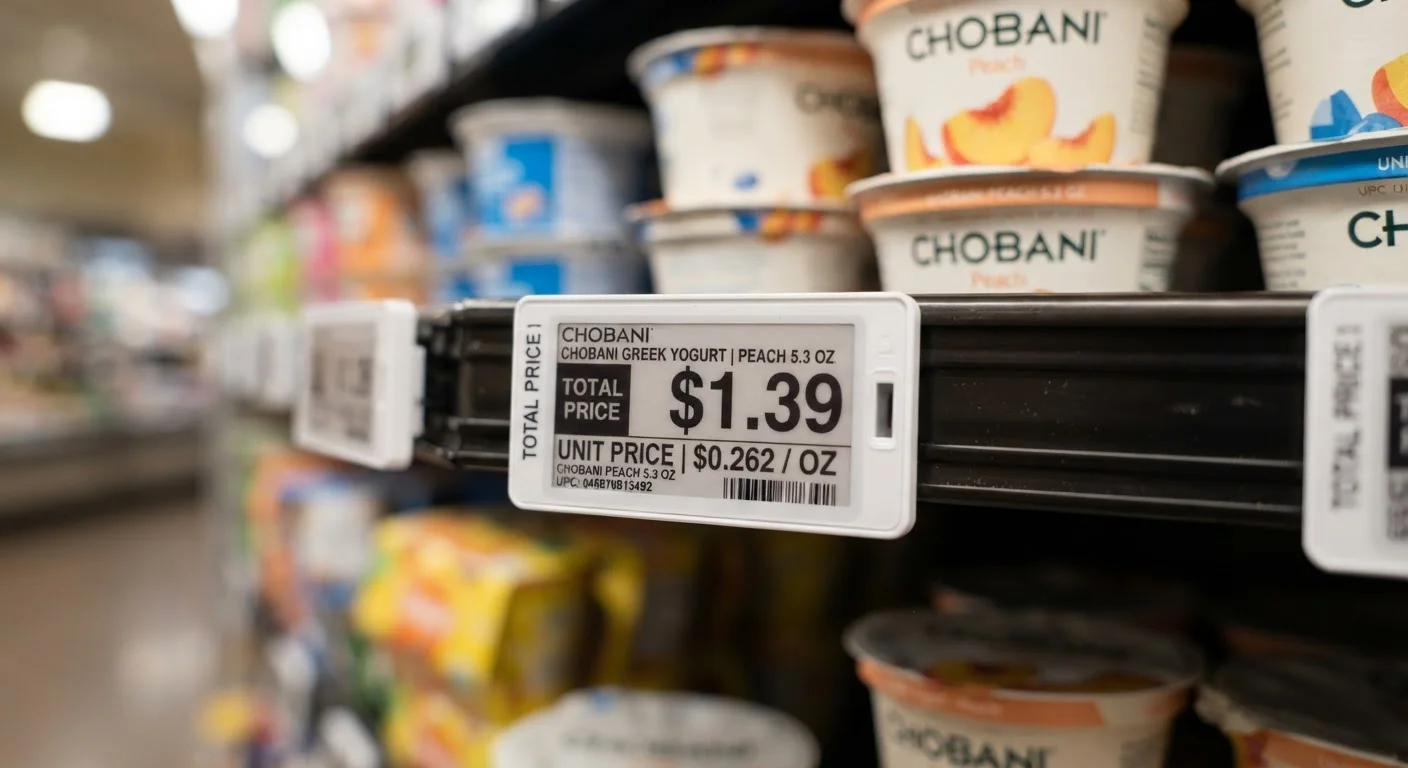
A unit price tells you what a product costs per single unit of measurement — such as per ounce, per count, per fluid ounce, or per square foot. It lets you compare the true cost of two products regardless of how differently they're packaged or sized. Instead of guessing whether the 18-oz bottle is a better deal than the 32-oz one, unit pricing gives you a single, apples-to-apples number.
In many U.S. states, retailers are legally required to display unit prices on shelf tags for grocery and household items, though the specific rules vary by jurisdiction.
The Number Hiding in Plain Sight
Most shoppers look at the big number — the retail price — and use it to decide between products. That instinct is understandable, but it's incomplete. A $3.99 bottle and a $5.49 bottle aren't directly comparable if they hold different amounts. The only number that settles the question is the unit price.
Unit pricing strips away the packaging and tells you what you're actually paying for the product itself. Every extra ounce, every additional sheet, every tablet in the bottle — unit pricing accounts for all of it. It's the shelf tag detail that most shoppers walk past without a second glance, and it's often the most useful number in the aisle.
Understanding this single concept is a foundation of smarter grocery shopping. As the unit pricing skill applied to grocery aisles shows, it can deliver more consistent savings than coupon chasing ever will.
~35%
Shoppers who regularly check unit prices
Consumer research has consistently found that a minority of shoppers actively use unit pricing at the shelf, leaving the majority making size comparisons on retail price alone.
Up to 30%
Potential unit price difference between package sizes
Studies of grocery pricing have found per-unit cost gaps of 20–30% between differently sized packages of the same product, depending on category and retailer.
3 in 5
Grocery categories affected by shrinkflation
Consumer advocacy groups have documented package size reductions across a wide range of grocery categories, making unit price tracking more important than ever for spotting real cost increases.
How to Read and Use Unit Pricing
Most U.S. grocery stores display unit prices directly on the shelf label. The format varies, but you're looking for a smaller number accompanied by a unit of measure: per oz, per 100 ct, per sq ft, or similar. That number is your comparison tool.
To use it effectively, pick a consistent unit and compare only products measured in the same way. Two pasta sauces both priced per ounce? Compare directly. A shampoo listed per fluid ounce versus a conditioner listed per liter? Convert first — there are 33.8 fluid ounces in a liter — then compare.
If no unit price is displayed, calculate it yourself: divide the total price by the package quantity. A $6.29 canister holding 42 ounces works out to roughly $0.15 per ounce. That's a number you can benchmark against anything else on the shelf.
Keep a Running Unit Price Baseline
For staples you buy every few weeks, jot down the unit price you typically pay — even a note in your phone works. When a 'sale' appears, compare the discounted unit price to your baseline. If it's not actually lower per unit, it may not be the deal it appears to be.
When Bulk Isn't Better and Sales Change Everything
The most common assumption in unit pricing is that bigger packages always win. That's true more often than not, but exceptions are frequent enough to matter. A store-brand smaller size will routinely undercut a name-brand bulk size. A smaller package on clearance can flip the math entirely.
Sales complicate the picture further. A 10-pack priced at regular retail may have a higher unit price than a 4-pack on a 30% discount. The shelf tag unit price should update to reflect promotional pricing, but it's worth double-checking — especially for items where you typically buy in quantity.
This connects to a broader truth about value: sticker price is only one layer. True value accounts for durability, usability, and replacement frequency, not just what something costs upfront. Unit pricing handles the quantity variable well, but you still need to factor in how quickly you'll actually use the product before it expires or degrades.
Building Unit Pricing Into Your Routine
Unit pricing works best when it becomes automatic rather than effortful. A few habits make it second nature: scan the unit price before reaching for a product, use your phone's calculator for any quick conversions, and note the unit price of your regular staples so you have a mental baseline for what counts as a good deal.
For items you buy repeatedly — cooking oil, laundry detergent, canned goods — knowing your baseline unit price means you can recognize a genuine deal versus a package redesign that looks like a bargain but isn't. It also guards against shrinkflation, where the package size quietly decreases while the retail price holds steady, inflating the real unit cost without any visible price change.
Combined with an awareness of retailer price-drop cycles, unit pricing gives you two complementary tools: knowing the real cost per unit today, and knowing when that cost is likely to be lower. Together they form a practical, low-effort framework that holds up across any budget level.
“Unit pricing is one of the most democratizing tools in retail — it levels the information playing field between the shopper and the store, if you know to use it.”
— Edgar Mayer, Consumer economics researcher and retail pricing analyst